The Merchant Robbed by Monkeys (1562, Met-Objekt 1884)
Original title: The Merchant Robbed by Monkeys
kurzbeschreibung
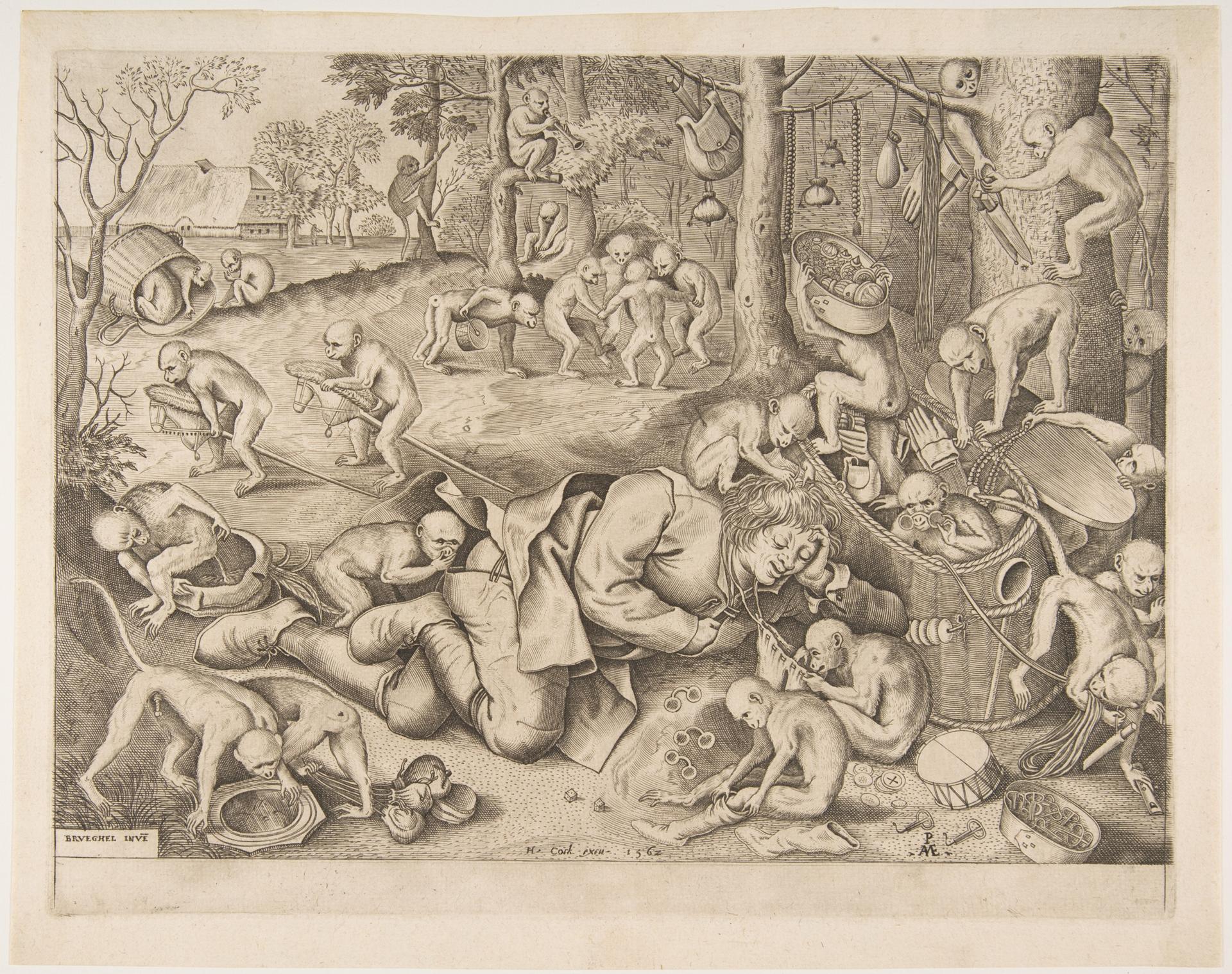
Pieter van der Heyden made this engraving in 1562. It depicts a merchant who has fallen to the ground, surrounded by a troop of monkeys. The animals ransack his wares while going about their own peculiar business.
Description
Monkeys swarm across trees and ground. The trader lies stretched out at the base, pressed by the creatures. Some clamber along branches and reach for objects, others squat below washing or sorting things. Further back, more monkeys can be seen climbing trunks and stirring. Fine gradations of gray dominate the sheet, the lines are precisely drawn, the figures deliberately placed.
Context
The Fleming Pieter van der Heyden often engraved after designs by Pieter Bruegel the Elder in the sixteenth century. This print from 1562 is the first of five states, suggesting repeated working of the plate. Monkeys imitating human behavior were a common motif in the Renaissance and often served as satire on human folly.
Impact
The wealth of detail and the lively distribution of the monkeys make the sheet immediately narrative. The fine linework gives the scene an elegant quality, while the robbery adds an ironic, cautionary undertone. Gray tones and clear contours draw the eye to the interplay between human and animal.
Technique
In engraving, the design is cut into a copper plate. The lines come out precise and fine, allowing high detail. Printing is in black on paper; gray values arise from varying line density and hatching.
AI-generated description text
Source: Metropolitan Museum of Art · Public Domain (CC0 1.0)