The Festival of Fools
Original title: The Festival of Fools
kurzbeschreibung
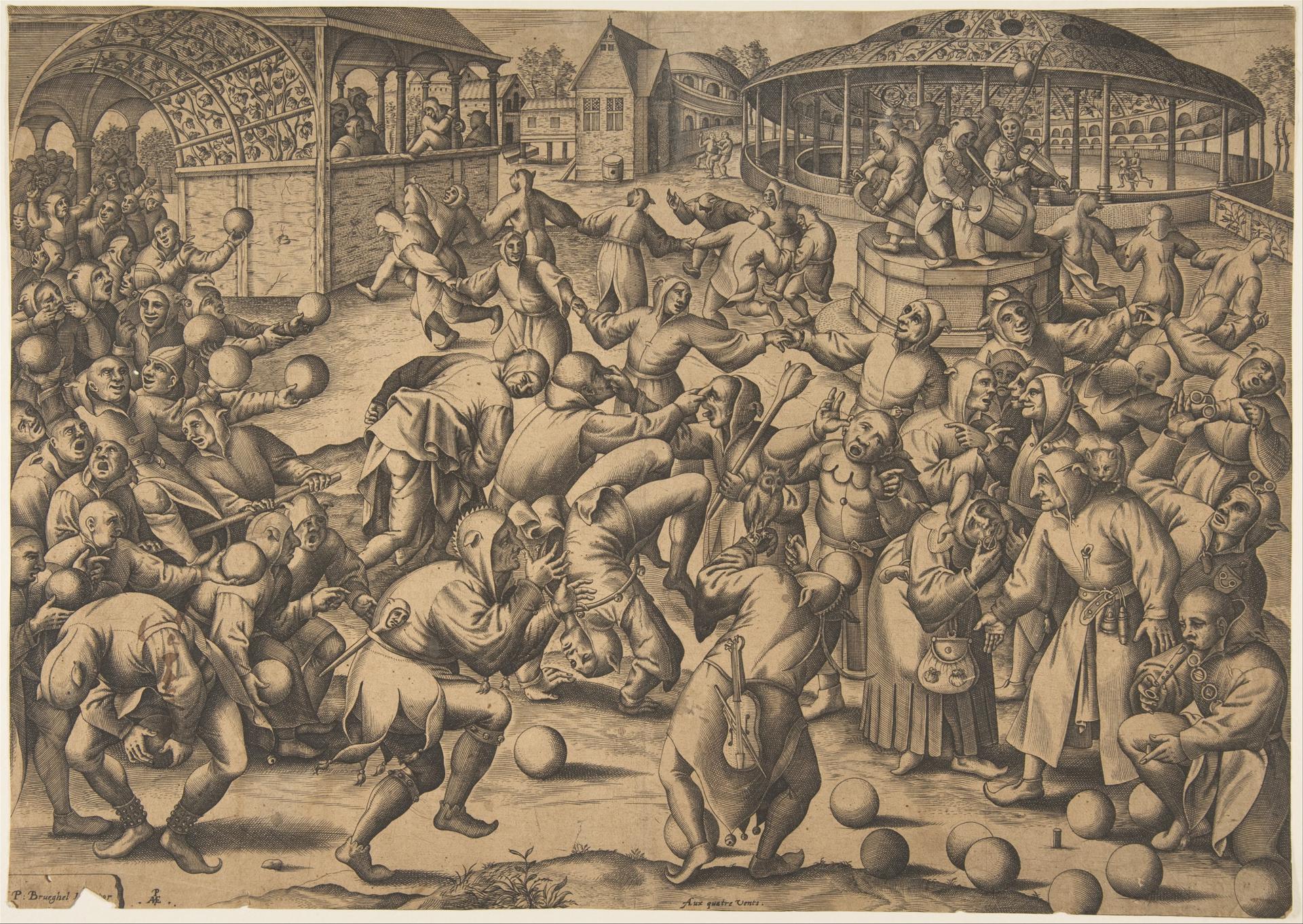
An engraving by Pieter Bruegel the Elder, made after 1570 and surviving in the second of three states: Das Narrenfest. The print presents a boisterous festive company in a dense crowd, interspersed with fool figures and all manner of playful doings.
Description
Balls fly through the air while some figures dance and others turn toward one another, filling the image with a multitude of characters engaged in the widest range of activities. Behind them rise buildings and a raised platform, likely a stage or dancing floor, on which further people can be seen. The clothing of those depicted is plain and points to a bygone era. The motif remains monochrome, with even lighting and no strong shadows, as is characteristic of an etching.
Context
The print was made after 1570 in the Netherlands, a period marked by political and religious tensions. Bruegel left behind numerous works with a moralizing and satirical edge, often drawing on proverbs and popular customs. Das Narrenfest also belongs to this tradition, presenting fools and exuberant goings-on and perhaps alluding to the transience and folly of human endeavor. The print was presumably published by a publisher in Antwerp, where Bruegel worked for a time.
Impact
The crowded abundance of figures creates a lively, even chaotic atmosphere that draws the viewer directly into the action. Anyone who delves into the many details is encouraged to discover and at the same time receives a moralizing lesson about human foolishness. The even lighting and precise linework give the sheet a calm, almost documentary air.
Technique
The work was produced by engraving: the motif is incised into a copper plate and then printed. The fact that the second of three states is present suggests possible revisions or additions compared with the first state. Extremely fine lines and the detailed execution are in keeping with sixteenth-century printmaking.
AI-generated description text
Source: Metropolitan Museum of Art · Public Domain (CC0 1.0)