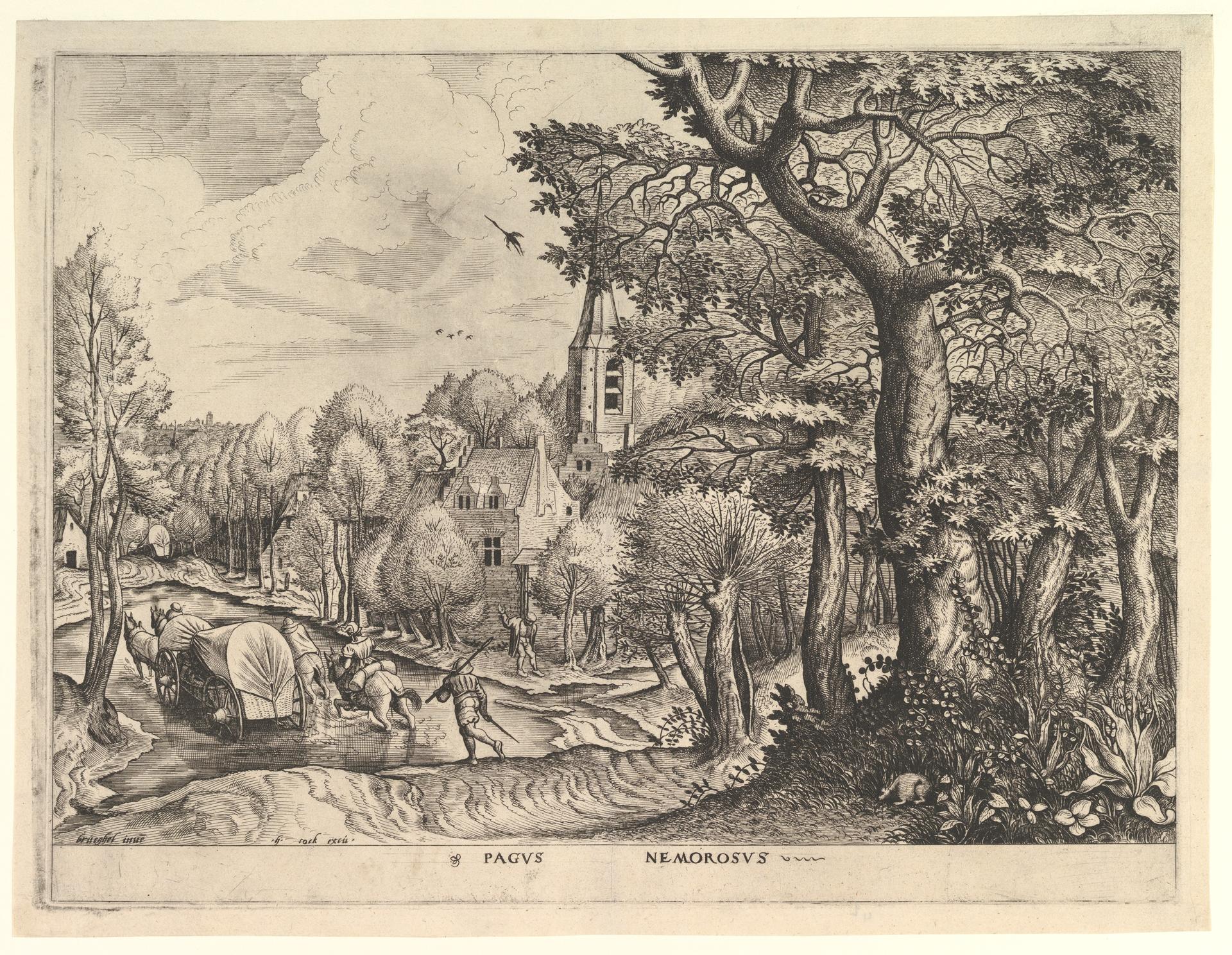
Wooded Region (Pagus Nemorosus), from "The Large Landscapes"
Original title: Wooded Region (Pagus Nemorosus), from "The Large Landscapes"
kurzbeschreibung
Unlike related landscape etchings of the period, Waldregion (Pagus Nemorosus) does not treat the forest as a backdrop but as an independent pictorial space. Pieter Bruegel the Elder made this print around 1555–56 as an etching with engraving. An expansive forest fills the foreground, with a village and its church tower behind, and several people travel along a path or work around a wagon.
Description
What distinguishes this view from other prints in the series is the broad, almost relief-like band of forest that occupies the lower half of the image. The arrangement stays horizontal: dense trees and bushes give way to an open zone with a village, whose tall church tower acts as a vertical anchor. A path runs through the middle of the picture, where several figures move about, some on foot, others busy with a wagon. Birds fly across the cloudy sky. The black-and-white etching uses thin lines and graduated hatching to bring out the depth and surface texture of the landscape.
Context
The subject belongs to the series Die großen Landschaften (The Large Landscapes), which Bruegel began in the 1550s. The Netherlandish landscape tradition, especially Pieter Coecke van Aelst and the publisher Hieronymus Cock, strongly shaped these works. Bruegel's presumed journey to the Alps influenced his conception of landscape. The series was intended for the international art market and consolidated his reputation as a landscape draughtsman.
Impact
The dense, richly detailed forest gives the print a quiet, almost contemplative atmosphere. Precise linework and a balanced layout guide the eye from the foreground to the village and on into the distance, making the depth of the landscape palpable. The monochrome palette enhances graphic clarity and allows the structure of nature to stand out clearly.
Technique
The etching was subsequently reworked with a burin. This combination made it possible to achieve fine lines and exact shading. The present impression is the first of two states, which suggests careful control of the printing process. The technique allows for a high degree of detail, which was used to render the structure of the trees and the figures.
AI-generated description text
Source: Metropolitan Museum of Art · Public Domain (CC0 1.0)