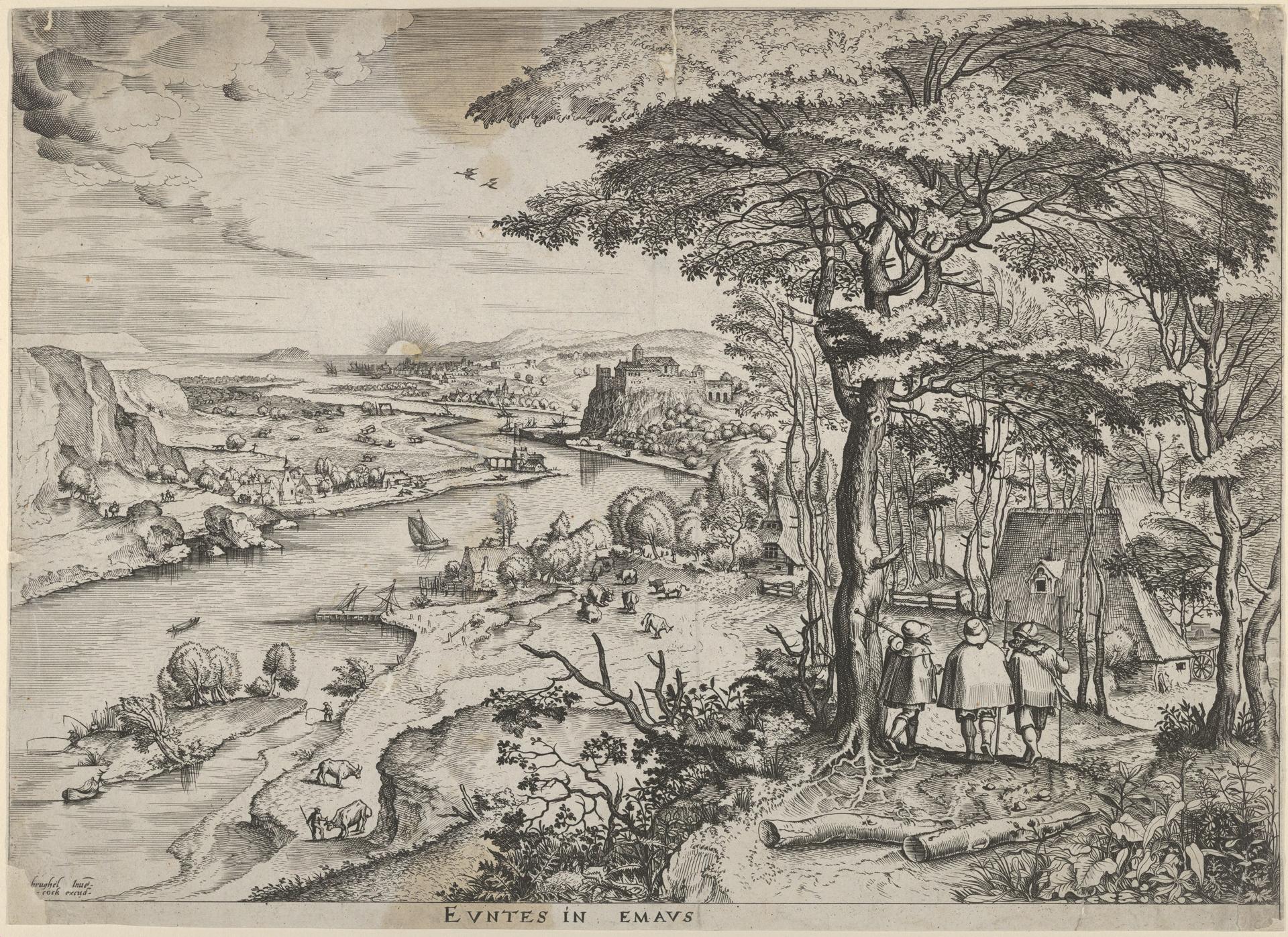
Euntes in Emaus (Landscape with Pilgrims at Emmaus)
Original title: Euntes in Emaus (Landscape with Pilgrims at Emmaus)
kurzbeschreibung
Pieter Bruegel the Elder made the etching Euntes in Emaus around 1555–56. Three travellers are seen on a path through an expansive landscape, so that the biblical story is set within a closely observed natural scene.
Description
Three figures in contemporary dress and hats move in the foreground along a path that leads to a small settlement. The surroundings are rich in detail: trees, bushes, a meandering stream and a small lake. Mountains rise in the distance, and a village with houses and a tower can be made out. The sun sits on the horizon, giving the scene a calm air. The layout is horizontal and draws the eye into the distance through a strong sense of depth.
Context
The print was made in the Netherlands in the mid-16th century. At that time landscape imagery was gaining increasing weight in art. Bruegel was known for his precise observation of nature and for linking religious themes with everyday scenes. This etching belongs to a series of landscapes that the artist etched and published himself.
Impact
A quiet, contemplative mood emanates from the image, carried by the differentiated linework and the bright treatment of the horizon. The travellers appear small before the vastness of nature, which emphasises the sublimity of the landscape. The viewer can follow the figures’ path with their eyes and enter into the scene.
Technique
Etching and engraving were both used here, with the plate cut to 30.8 x 43.2 cm. Fine lines and graduated grey tones are characteristic of the printmaking of this era. Through the etching technique Bruegel rendered details of trees, buildings and terrain formations precisely.
AI-generated description text
Source: Metropolitan Museum of Art · Public Domain (CC0 1.0)