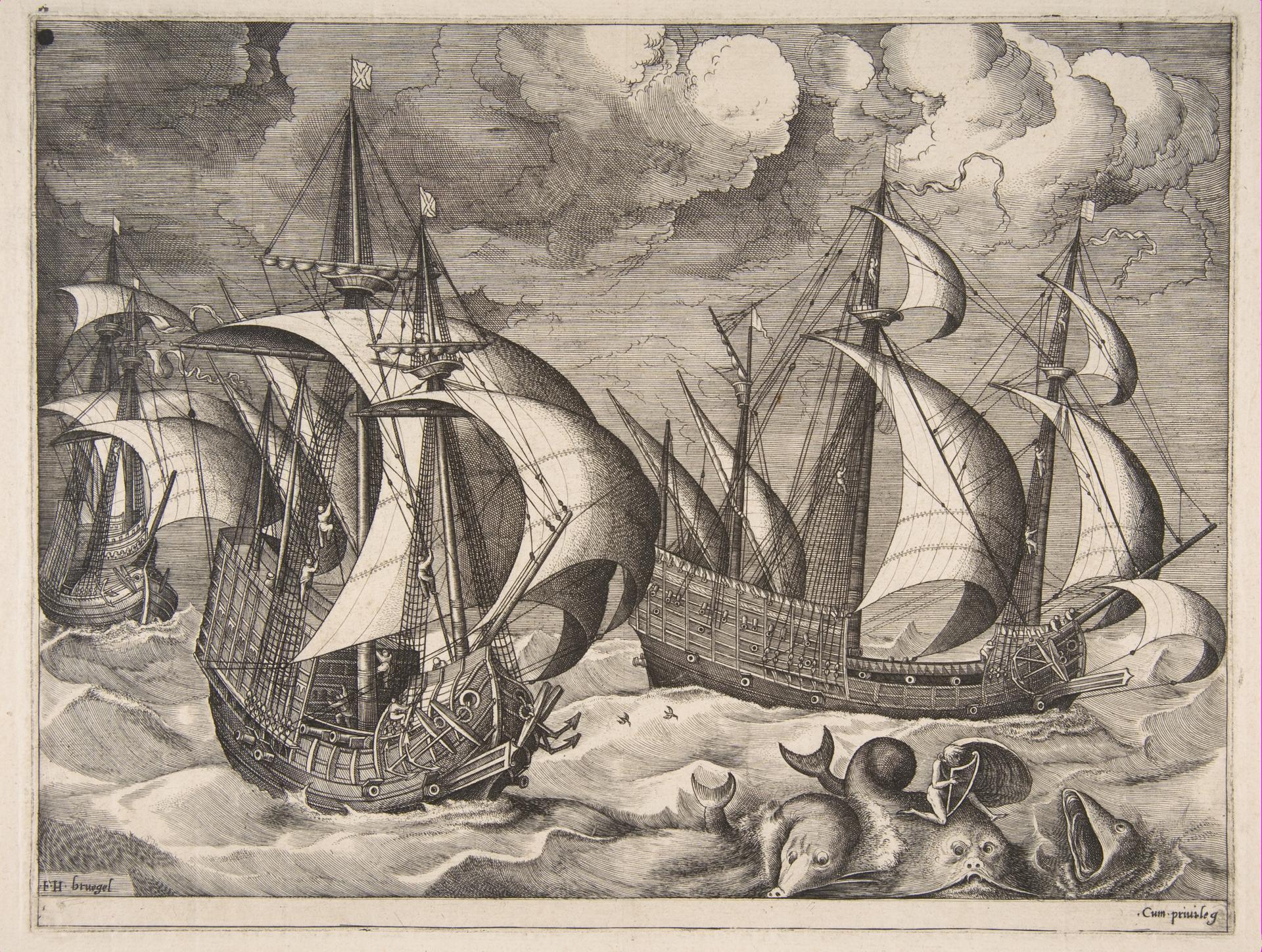
Three Caravels in a Rising Squall with Arion on a Dolphin from "The Sailing Vessels"
Original title: Three Caravels in a Rising Squall with Arion on a Dolphin from "The Sailing Vessels"
kurzbeschreibung
Pieter Bruegel the Elder made the etching 'Three Caravels in a Rising Storm with Arion on a Dolphin' between 1561 and 1565. The print belongs to the series 'The Sailing Ships' and measures 22 x 28.6 cm. It is executed as an etching and engraving; the present impression is the first state of six.
Description
In the foreground a ship struggles with a broken rudder; at its stern sits a capital-like structure. To the right another vessel moves forward with several sails and masts. In the rear a third ship is caught by the storm. Waves pile up, creating a restless, chaotic mood. At the bottom edge two mermaids emerge from the water, one with a shield, the other with a sword. Dramatic clouds sweep across the sky and heighten the sense of threat.
Context
The series 'The Sailing Ships' was created in 1561–65, when the Netherlands were under Spanish rule and maritime trade was economically central. Bruegel presumably worked with the publisher Hieronymus Cock, known for his prints. Ships and storms drew on contemporary maritime motifs popular in the Renaissance. The mythological figure of Arion on the dolphin refers to classical literature received in humanist circles.
Impact
The dynamic layout conveys the violence of the storm and the fragility of the ships. Fine lines and contrasting tonal values create dramatic depth and draw the viewer into the action. The combination of realistic ship depiction and mythological elements produces a peculiar tension.
Technique
Etching and engraving shape the print; this is visible in the fine line structure and strong contrasts. The technique allowed precise details and differentiated shading, used for waves and clouds. That this is the first state of six points to careful revision by the artist.
AI-generated description text
Source: Metropolitan Museum of Art · Public Domain (CC0 1.0)