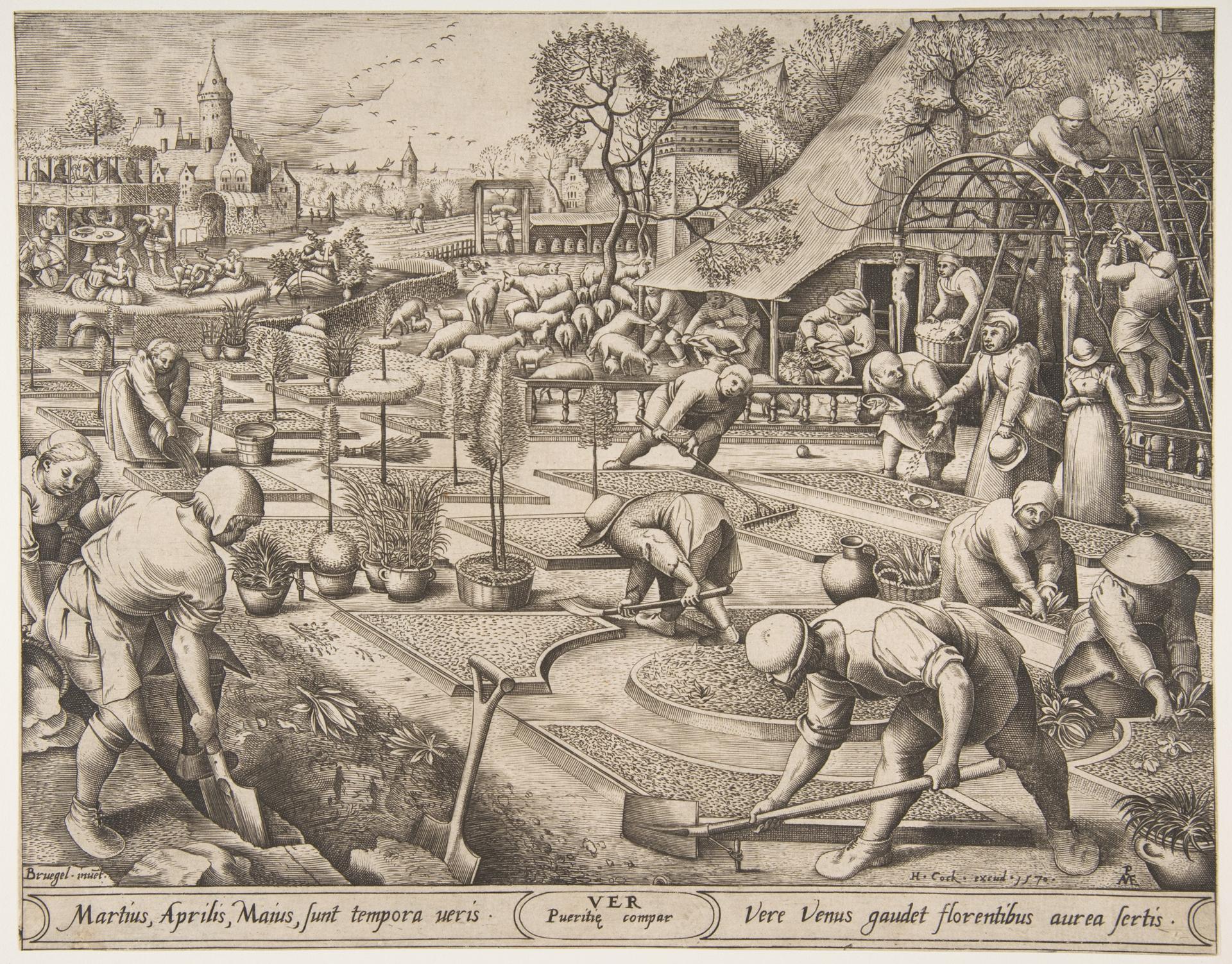
Spring (Ver), from "The Seasons"
Original title: Spring (Ver), from "The Seasons"
kurzbeschreibung
Pieter van der Heyden engraved Spring in 1570 for the series The Four Seasons. The image presents an expansive garden scene in which men and women go about their work, a direct reference to the field labour of the season. This impression is the first of three states.
Description
Workers tend rectangular beds in the foreground, handling spades and other tools, while others pot up plants. Beyond them sheep graze in a field, and inside a building further figures can be seen at their tasks. Houses and trees knit together into a rural prospect. The layout reads clearly and parades a wealth of activities proper to spring; the black-and-white print and crisp outlines heighten the density of detail.
Context
The engraving follows a design by Pieter Bruegel the Elder, who devised the Four Seasons cycle. Van der Heyden, a Flemish engraver, often drew on Bruegel's drawings. The series appeared in 1570 and ranks among the best-known seasonal images in Netherlandish art.
Impact
Calm and well ordered, the scene radiates quiet and captures spring's mood of industry and harmony. Precise lines and a lucid arrangement give it an almost documentary exactness, drawing the viewer into the rural working world of the sixteenth century.
Technique
For this engraving the lines were cut into a copper plate and then printed. That method allows the fine particulars and sharp edges visible in the plants and tools. What survives here is an impression of the first of three states, pointing to an early version of the print.
AI-generated description text
Source: Metropolitan Museum of Art · Public Domain (CC0 1.0)