Christ in Limbo
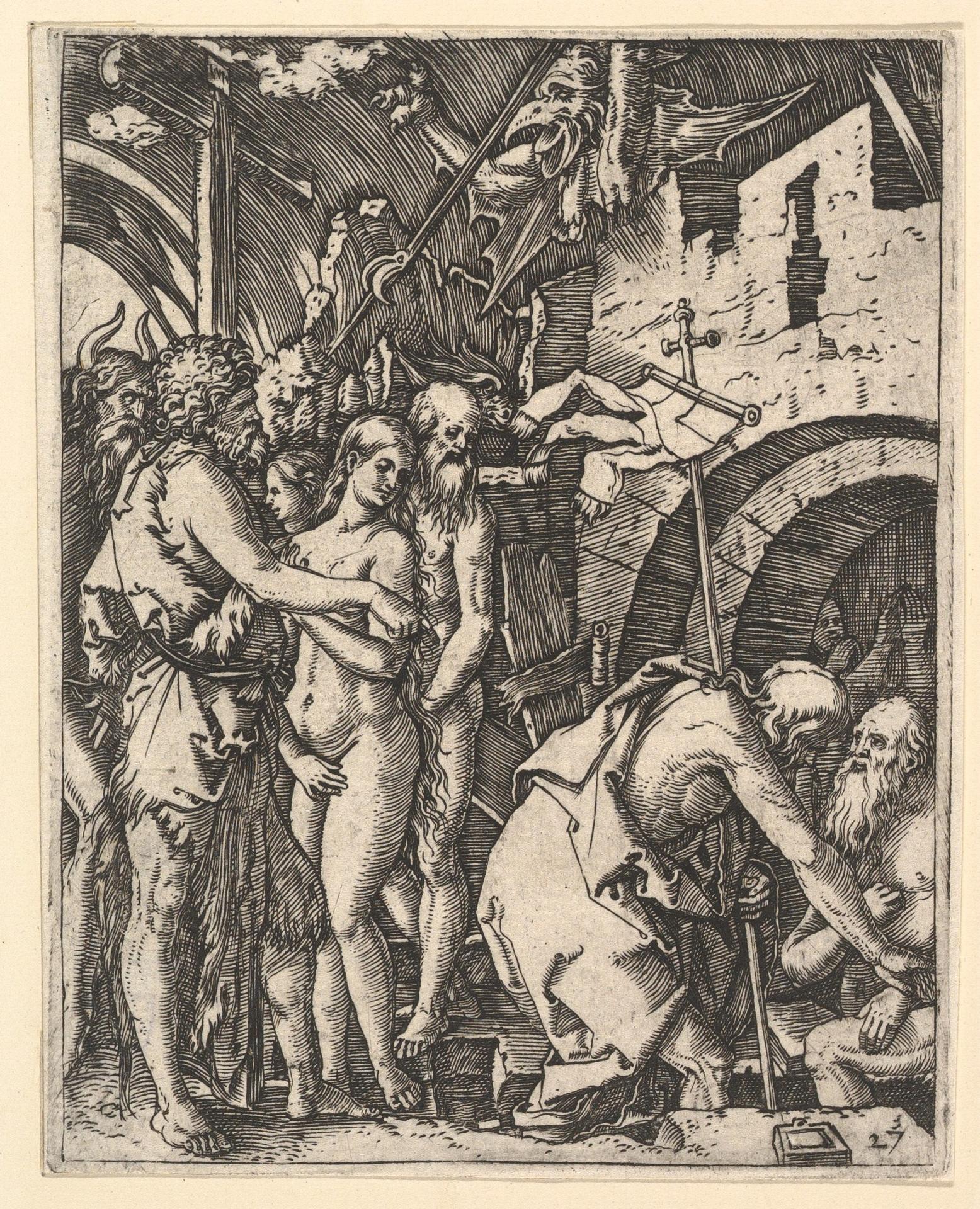
Original title: Christ in Limbo; Christ walking down to the arched gateway to Limbo on the right, on the left a group of people including Moses, John the Baptist, Adam and Eve, from "The Passion of Christ", after Dürer
kurzbeschreibung
Christ descends into limbo, surrounded by Moses, John the Baptist, Adam, and Eve. Marcantonio Raimondi made this engraving around 1500–34 as a sheet from the 'Passion of Christ' series after a model by Albrecht Dürer. The second of three states survives.
Description
At the front, Christ stands on a cross while a demonic creature thrusts a sword at him. To the left, Moses, John the Baptist, Adam, and Eve appear in shifting poses. On the right, an old man kneels, likely an apostle or saint. A Gothic arch opens behind them, marking the entrance to limbo. Sharp contours and detailed lines clearly separate figures from architecture.
Context
Raimondi based this print on a design by Albrecht Dürer, whose Passion of Christ series served as a model. Raimondi was known for reproductive engravings that spread Dürer's works across Europe. The dating around 1500–34 covers Raimondi's Roman period, when he collaborated with artists such as Raphael. The limbo motif was widespread in Christian iconography, denoting the place where the righteous of the Old Covenant awaited redemption.
Impact
The eye is first drawn by the calm, clear linework, then by the tension between Christ and the attacking creature. The figures' expressions and postures are vivid and heighten the drama of the moment. The monochrome scheme brings out the narrative details and the fine graphic execution.
Technique
For this engraving, lines were cut into a metal plate, which was then inked and printed on paper. Raimondi used fine, dense lines to create shadows and textures. The second state may show reworkings or additions compared to the first, as is typical for printmaking.
AI-generated description text
Source: Metropolitan Museum of Art · Public Domain (CC0 1.0)