The Land of Cockaigne
Original title: The Land of Cockaigne
kurzbeschreibung
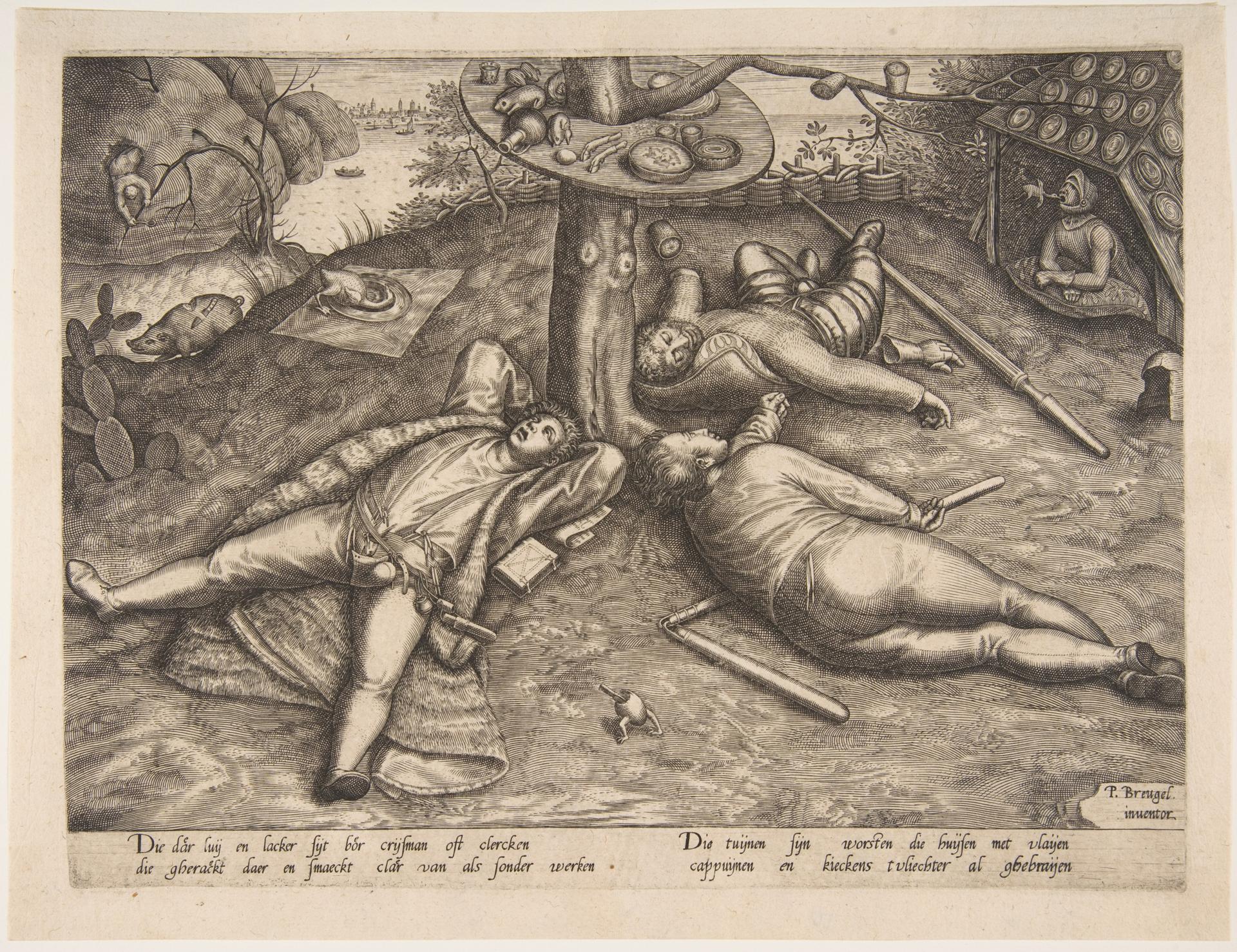
Figures sprawl across the ground amid trees and a table set for a meal — Pieter van der Heyden's engraving "Das Schlaraffenland" dates from after 1570 and presents a rural setting in which people and objects lie scattered without order. The disorder suggests a clash or a quarrel.
Description
There they lie, some in traditional dress, others more plainly clothed, spread over the ground. The foreground belongs to the reclining figures, while further back other people and landscape motifs remain only faintly outlined. The layout feels asymmetrical, the distribution of figures and things irregular. Muted, almost monochrome tones prevail, as is usual for an engraving; the light is even, without strong shadows or highlights.
Context
Pieter van der Heyden, a sixteenth-century Flemish engraver, often worked from designs by Pieter Bruegel the Elder. The land of Cockaigne was a common motif in Netherlandish art of the period, used to satirize gluttony and sloth. The date after 1570 falls in a phase of political and religious tension in the Netherlands, which may explain the print's critical edge. That the engraving exists in three states, with the first shown here, points to its successful circulation.
Impact
The disordered sprawl of the figures is unsettling: it brings a battlefield to mind, yet is set in a paradisiacal place. The monochrome execution sharpens attention to the graphic precision and to details of the arrangement. In this way the viewer is prompted to a moral reflection on the vices depicted.
Technique
For an engraving, the image is cut into a copper plate. This impression comes from the first of three states, suggesting careful reworking and development of the plate. Fine lines and even hatching are characteristic of Renaissance printmaking.
AI-generated description text
Source: Metropolitan Museum of Art · Public Domain (CC0 1.0)