The Dirty Bride or the Marriage of Mopsus and Nisa
Original title: The Dirty Bride or the Marriage of Mopsus and Nisa
kurzbeschreibung
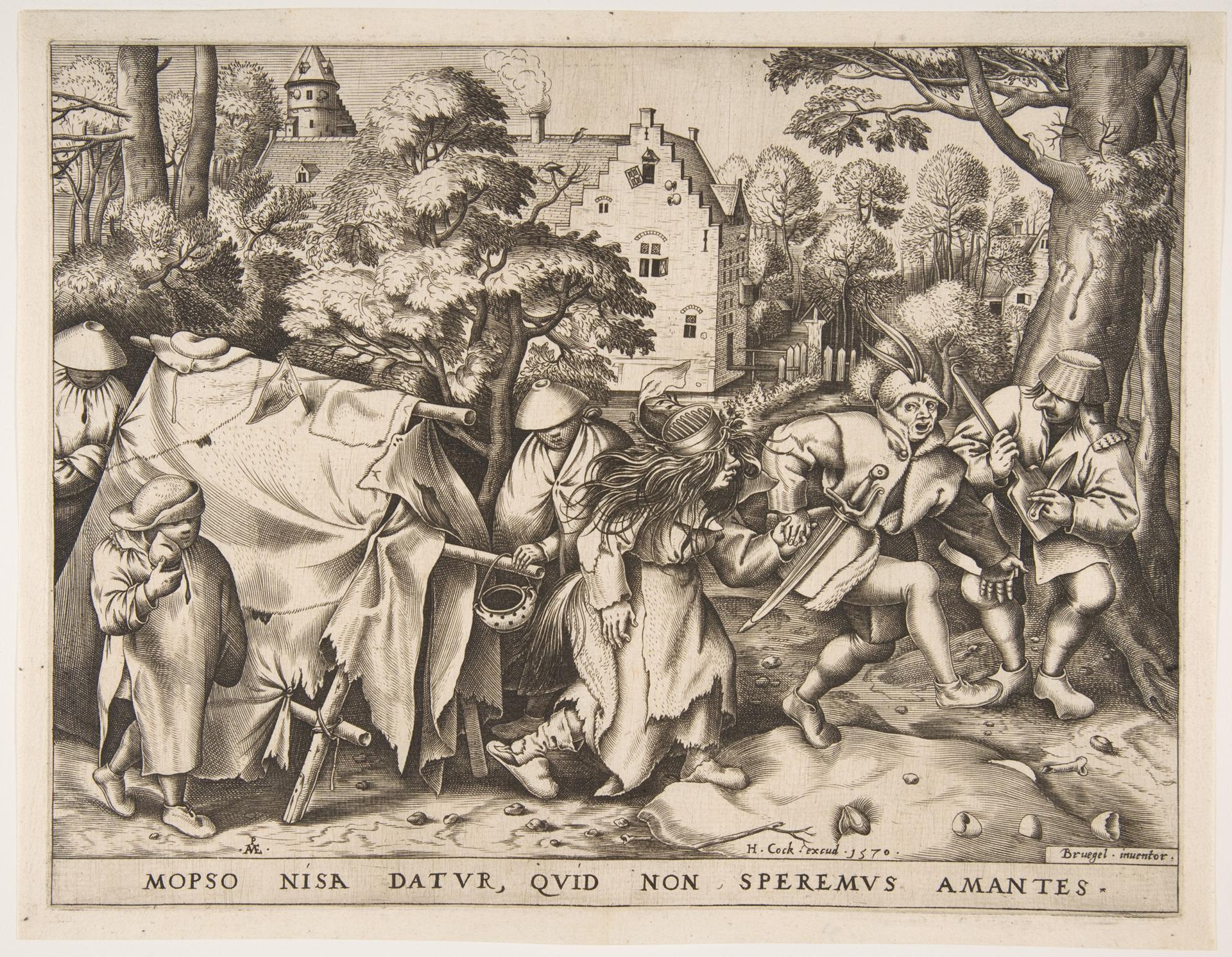
Dated 1570, Pieter Bruegel the Elder's engraving "The Dirty Bride, or the Wedding of Mopsus and Nisa" presents a violent episode set in the countryside. In the foreground a woman is threatened by a man with a drawn sword, while other figures stand around watching. The sheet is the first state of four and measures 22.2 x 28.9 cm.
Description
A woman in a long gown, her hair loose, stands at the front while a man raises his sword against her. Beside her a man in traditional dress holds a shield. Further back another man, helmeted and armed with a sword, joins the fray, and at the left a figure carrying a large cloth turns away. Trees and a building with a tower, resembling a manor house, close off the view. Along the bottom edge run a Latin poem, the signature "H. Coek" and the year 1570.
Context
The print was made in 1570 in the Netherlands, a period of religious and political unrest. Bruegel supplied the design, which Hendrik Coeck the Younger later engraved, as the signature at lower right records. The Latin verse "MOPSO NISA DATVR, QVID NON SPEREMUS AMANTES" alludes to the love story of Mopsus and Nisa from classical literature. The scene may carry a satirical or moralizing point about marriage and human folly.
Impact
Diagonal lines of movement among the figures and the menacing gesture of the sword give the sheet a tense energy. Rural idyll and violence meet head-on, producing a mood that unsettles yet holds the eye. The crowded detail and the Latin quotation set the viewer thinking about what is actually going on.
Technique
Engraving is an intaglio process: lines are cut into a copper plate, which is then printed. Fine strokes and hatching give the figures plastic modelling and build up graded areas of light and shade. This impression is the first state of four, pointing to later reworking of the plate.
AI-generated description text
Source: Metropolitan Museum of Art · Public Domain (CC0 1.0)