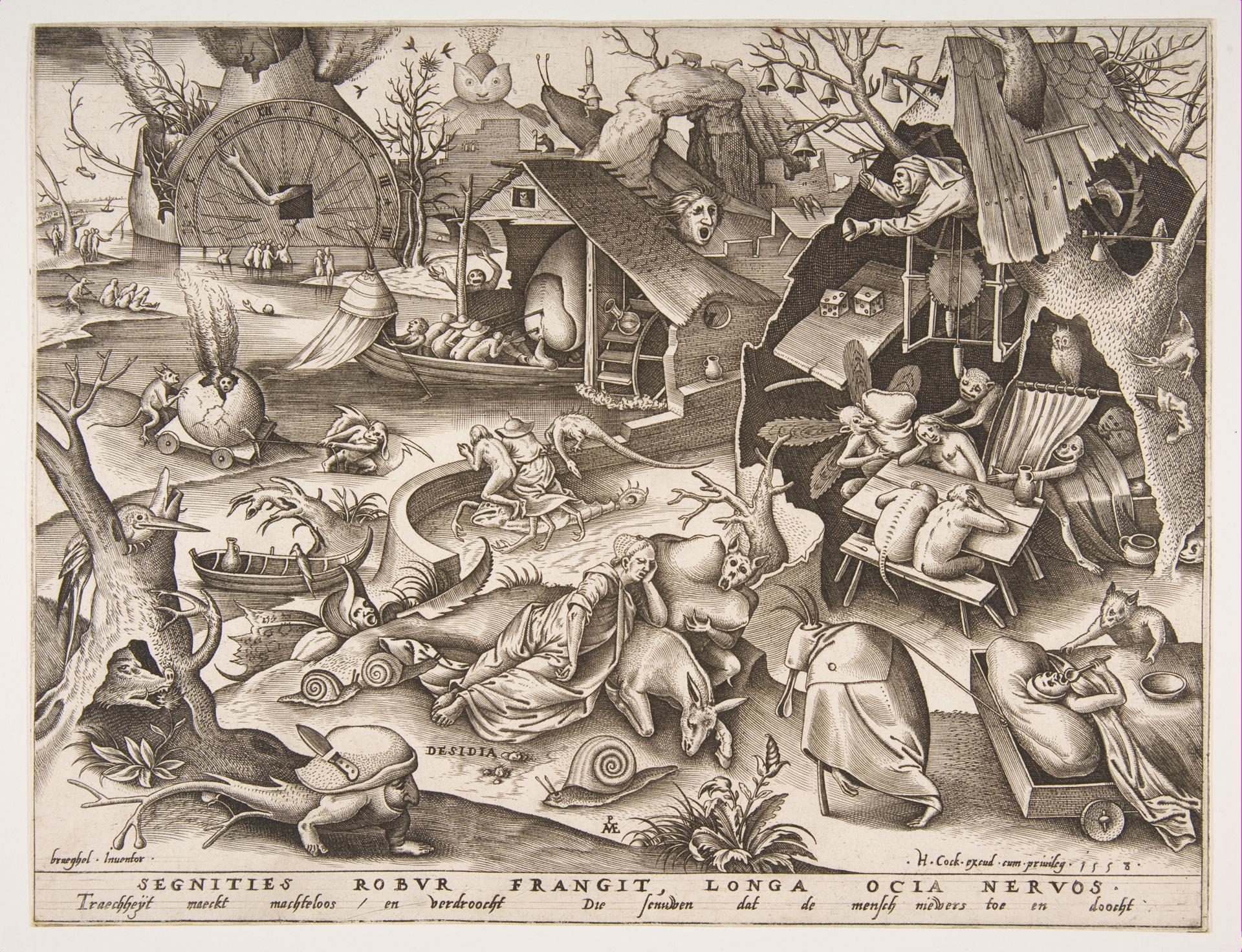
Sloth (Desidia), from "The Seven Deadly Sins"
Original title: Sloth (Desidia), from "The Seven Deadly Sins"
kurzbeschreibung
In 1558 Pieter van der Heyden engraved the allegorical figure of Sloth (Desidia) after a design by Pieter Bruegel the Elder, setting her among scenes of idle pastime. The sheet belongs to the series 'The Seven Deadly Sins' and was printed in black and white with delicate lines.
Description
A draped figure sprawled on a rock, her head that of a deer, with a snake beside her, anchors the print. Around her, people give themselves over to laziness in every form: some lie in bed, others amuse themselves or linger outdoors. Music is played and pictures are studied, while trees, houses and stretches of landscape fill the rear. The layout is dense and packed with incident, drawn in sharp, clear lines characteristic of the Renaissance.
Context
The 1558 engraving forms part of the series 'The Seven Deadly Sins', which van der Heyden executed after models by Bruegel the Elder. Moralising print series of this kind were common in the sixteenth-century Netherlands, meant to put vices before the viewer as a lesson. The series was published by Hieronymus Cock, an influential print publisher in Antwerp.
Impact
The sheer abundance of detail across the sheet pushes the viewer to look closely. Through the monochrome black-and-white technique the scene comes across as grave and admonishing.
Technique
The copperplate was made by cutting the lines into the printing plate with a burin. The sheet measures 22.7 x 29.6 cm and carries the precise, sharp lines that mark this technique.
AI-generated description text
Source: Metropolitan Museum of Art · Public Domain (CC0 1.0)