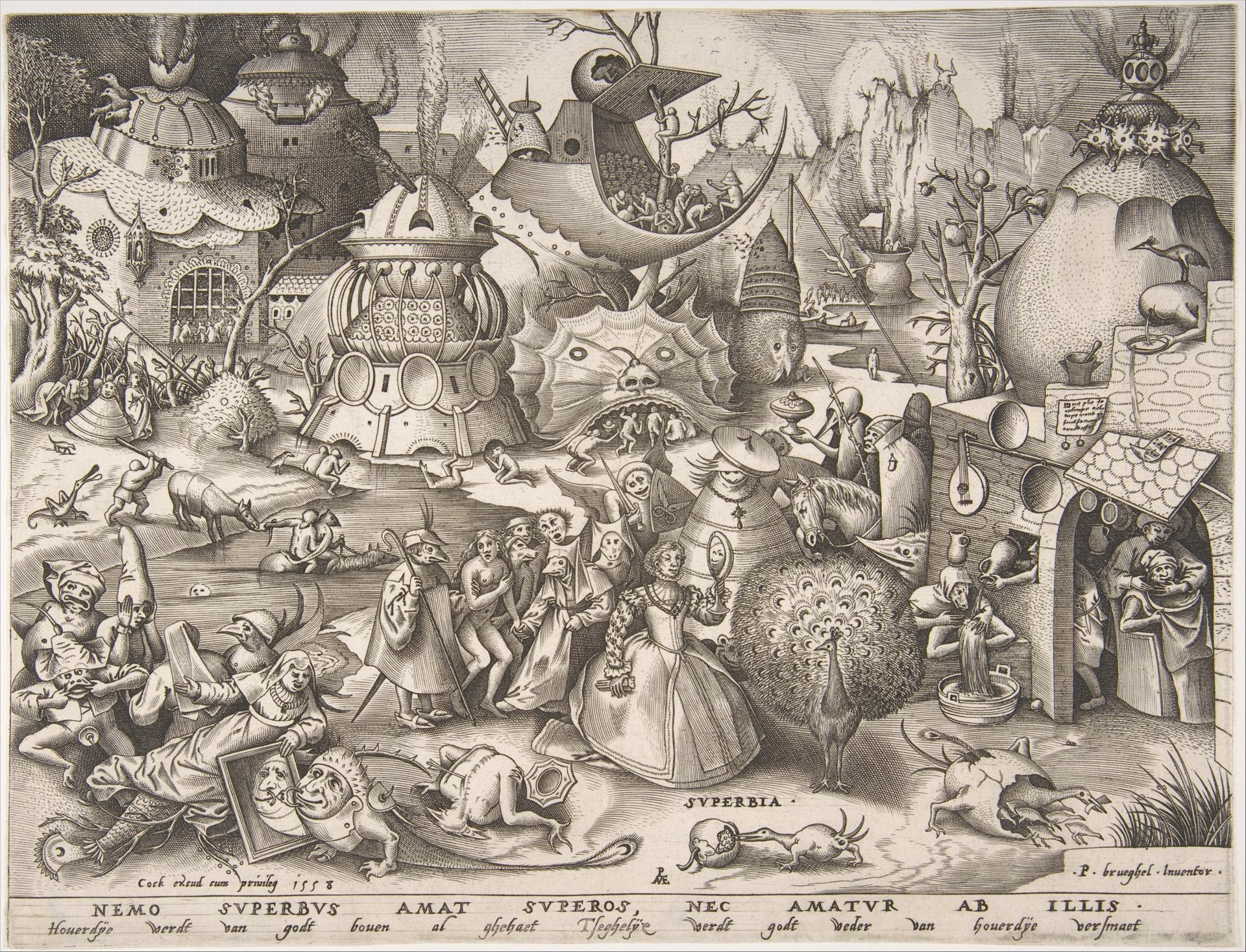
Pride (Superbia), from "The Seven Deadly Sins"
Original title: Pride (Superbia), from "The Seven Deadly Sins"
kurzbeschreibung
Unlike related virtue and vice prints of its time, Pieter van der Heyden's 1558 engraving 'Pride (Superbia)' after a design by Pieter Bruegel the Elder does not present the deadly sin as a single personification but as a layered pictorial structure. A magnificently dressed woman gazes at her reflection; a peacock, a mirror, and a ornate cart join her. Numerous scenes in the background illustrate the consequences of Superbia.
Description
An elaborately dressed woman occupies the middle of the image, examining herself in a mirror she holds. To her right stands a peacock; to her left, a ornate cart pulled by strange creatures. Distress and destruction spread through the rear: tormented animals, a devastated landscape. Densely packed and rich in detail, the figures form a complex arrangement that explores many facets of pride. Monochrome and with evenly distributed light, the sheet matches the printmaking of the Renaissance.
Context
Created in 1558 as part of the series 'The Seven Deadly Sins', the engraving was executed by Pieter van der Heyden, who transferred designs by Pieter Bruegel the Elder to the copper plate. Bruegel drew these designs at a time when moralizing image cycles were in high demand in the Netherlands. In the series, religious morality combines with social criticism and fantasy, as is characteristic of Bruegel's work. The prints were published by Hieronymus Cock in Antwerp, one of the leading publishers of those years.
Impact
The lavish, almost overloaded arrangement creates an oppressive mood that makes the reprehensibility of pride sensually tangible. Ostentatious self-display in the foreground and the negative consequences in the background enter into a moral tension that invites reflection. Even light and precise lines give the sheet a calm yet uncanny aura.
Technique
A burin was used to incise the lines into a copper plate, a technique that allows very fine and exact lines and supports the high density of detail in the print. Printing was done with black ink on paper, resulting in the monochrome appearance with even tonal distribution.
AI-generated description text
Source: Metropolitan Museum of Art · Public Domain (CC0 1.0)