Big Fish Eat Little Fish (1557, Met-Objekt 1850)
Original title: Big Fish Eat Little Fish
kurzbeschreibung
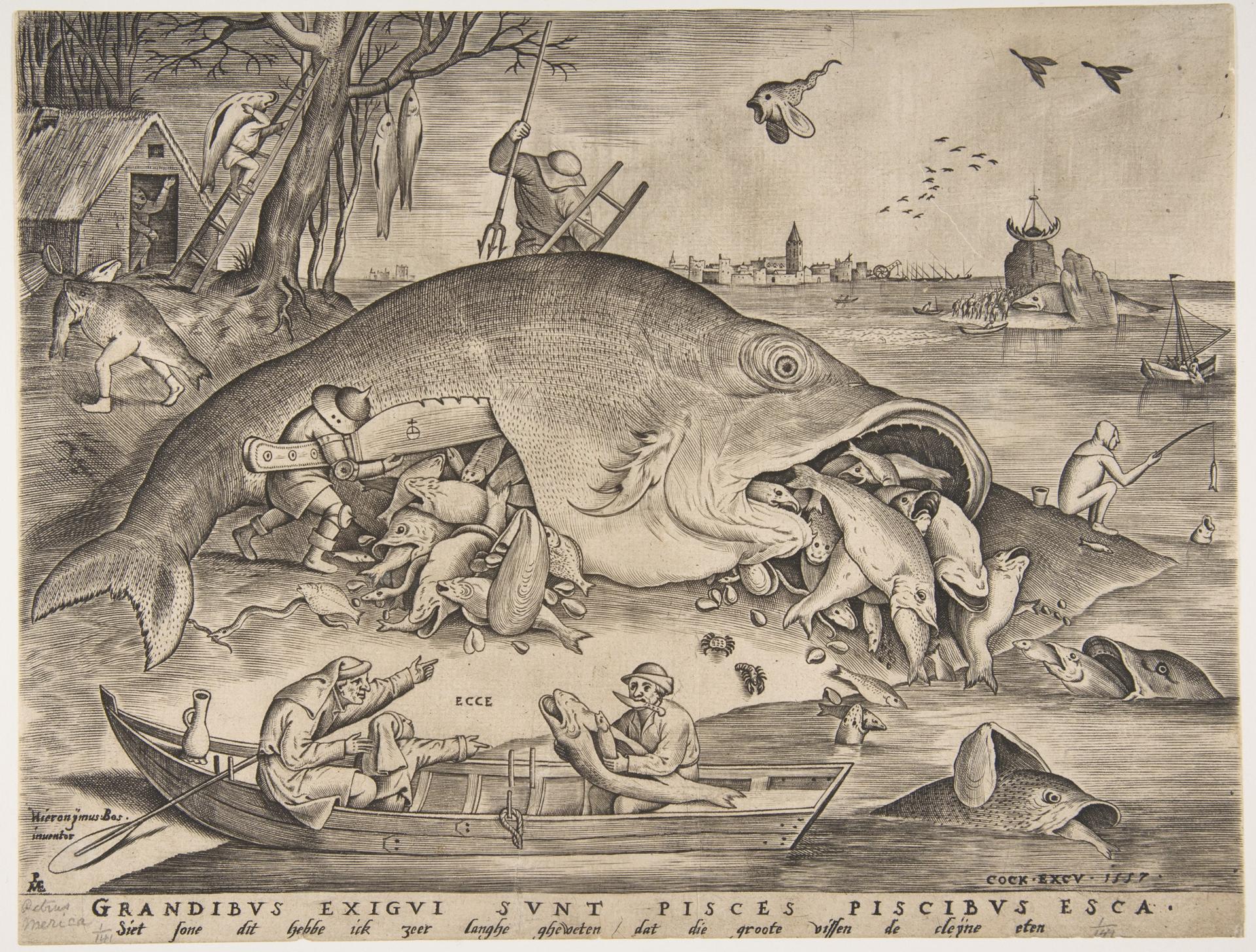
Pieter van der Heyden's 1557 engraving, titled 'Big Fish Eat Little Fish', presents an allegorical scene: a large fish swallows smaller fish and sea creatures. People can be seen on the beach and on the water. This impression is the first of four states.
Description
In the foreground, a large fish gapes open its mouth, from which smaller fish and other sea creatures protrude; some have already been swallowed. Behind, people walk on land, others fish or move about on the water. The clothing of the figures points to the 16th century. The setting is a beach with trees and buildings in the distance. Many figures and animals look or move in different directions, which enlivens the layout.
Context
The engraving was made in 1557, when allegories and moralizing motifs were common in Netherlandish art. Pieter van der Heyden worked as an engraver in Antwerp, often after designs by Pieter Bruegel the Elder. The motif of the big fish swallowing the small ones stood for social inequality and abuse of power at the time. That the work survives in four states suggests repeated reworking of the printing plate.
Impact
The viewer is immediately drawn to the drastic feeding scene, which has a direct impact through its detailed rendering. The even lighting and precise linework give the print a factual, almost documentary character. The allegorical meaning invites reflection on social hierarchies.
Technique
Engraving is a process in which the design is incised into a copper plate. The lines appear sharp and detailed, as is typical of 16th-century printmaking. As usual for engravings of this period, the work remains monochromatic; its dimensions are 22.9 x 29.6 cm.
AI-generated description text
Source: Metropolitan Museum of Art · Public Domain (CC0 1.0)