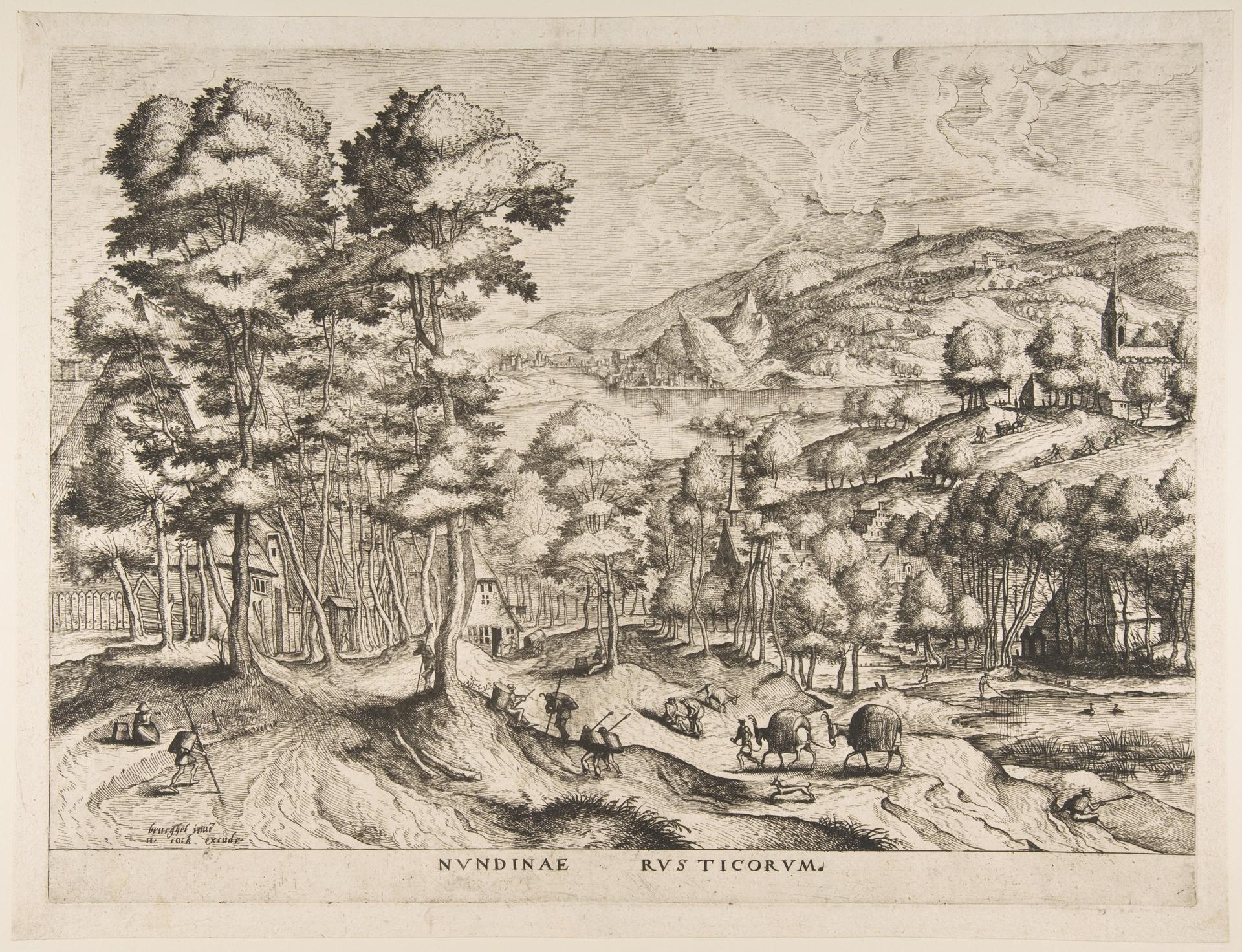
Rustic Market (Nundinae Rusticorum), from "The Large Landscapes" (ca. 1555–56, Met-Objekt 1846)
Original title: Rustic Market (Nundinae Rusticorum), from "The Large Landscapes"
kurzbeschreibung
A busy market unfolds along a river in 'Ländlicher Markt' (Nundinae Rusticorum), one of the prints from the series 'Die großen Landschaften'. Pieter Bruegel the Elder made the work around 1555–56 as an etching with engraving; the surviving impression is the second of three states.
Description
A river bordered by trees and shrubs runs through the foreground terrain. Farmsteads lie to the left, while a village with houses and church towers stands to the right. Wooded hills and mountains rise behind. Numerous figures populate the image: peasants at work, pulling wagons, some with loads on their backs. Under a cloudy sky the layout spreads wide, with the river dividing the picture into two halves.
Context
The series 'Die großen Landschaften' was produced around 1555–56, during Bruegel's Antwerp years with the publisher Hieronymus Cock. As one of the earliest landscape series in printmaking, it addressed a wealthy urban audience. Inspiration came from the Alpine landscapes of Bruegel's Italian journey, though Flemish motifs such as the market also entered the mix.
Impact
Even light and a balanced arrangement give the view a quiet, peaceful mood. The rich details of landscape and staffage invite close looking and evoke an idyllic picture of rural life.
Technique
The etching was subsequently reworked with the burin, which shows in bold lines and delicate hatching. Through the light-dark gradations of the monochrome print, a sculptural effect emerges. The present impression is the second of three states, pointing to later interventions in the plate.
AI-generated description text
Source: Metropolitan Museum of Art · Public Domain (CC0 1.0)