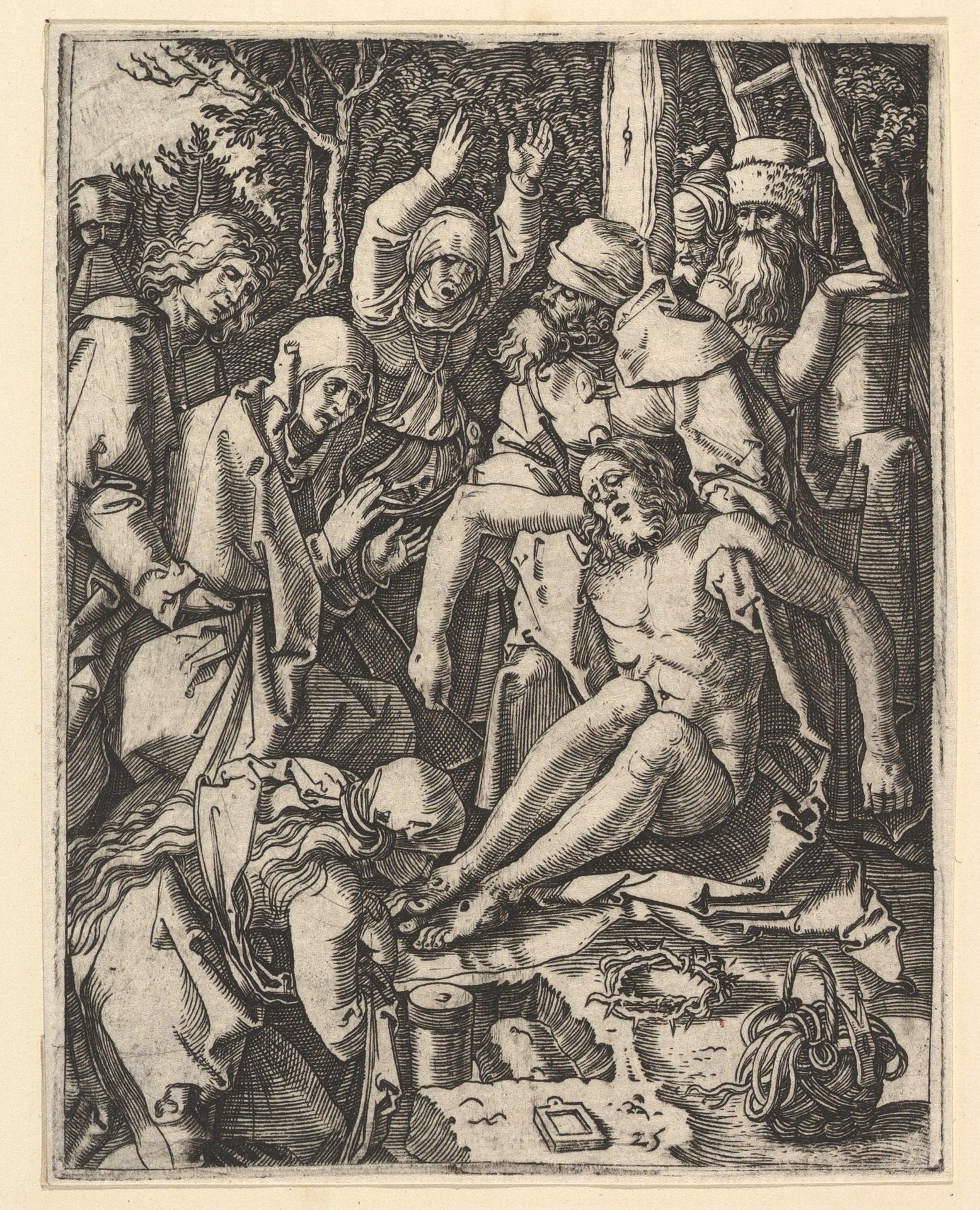
The Deposition; Christ being taken from the Cross, a man on a ladder is holding the body while St John is supporting the weight with a cloth rope, from "The Passion of Christ", after Dürer
Original title: The Deposition; Christ being taken from the Cross, a man on a ladder is holding the body while St John is supporting the weight with a cloth rope, from "The Passion of Christ", after Dürer
kurzbeschreibung
Here we see Christ being taken down from the cross – an episode from the Passion. While a man on a ladder holds the body, Saint John secures its weight with a cloth rope. Marcantonio Raimondi created this print, which dates to around 1500–34.
Description
Christ lies motionless on the ground, his body wrapped in a cloth that a man on a ladder grips. Another man – likely John – supports the corpse with a rope. Around them, several figures stand and kneel, showing grief and deep emotion; some raise their hands, others pray. Trees and a praying man appear in the background. Fine lines and shading define the monochrome rendering typical of an engraving.
Context
The basis is a design by Albrecht Dürer from his Passion cycle. Marcantonio Raimondi, an Italian engraver, reproduced numerous works by Dürer. This print exists as the second of three states and was made in the first half of the 16th century.
Impact
The layout feels calm and solemn. The mourners' grief is conveyed forcefully through their gestures and postures. Clear organization and precise linework give the print a quiet, almost meditative aura.
Technique
An engraving is made by incising lines into a metal plate and then printing it. Varying the density and direction of the lines creates shading, allowing light and shadow to be rendered precisely. The present work is the second of three printing states.
AI-generated description text
Source: Metropolitan Museum of Art · Public Domain (CC0 1.0)