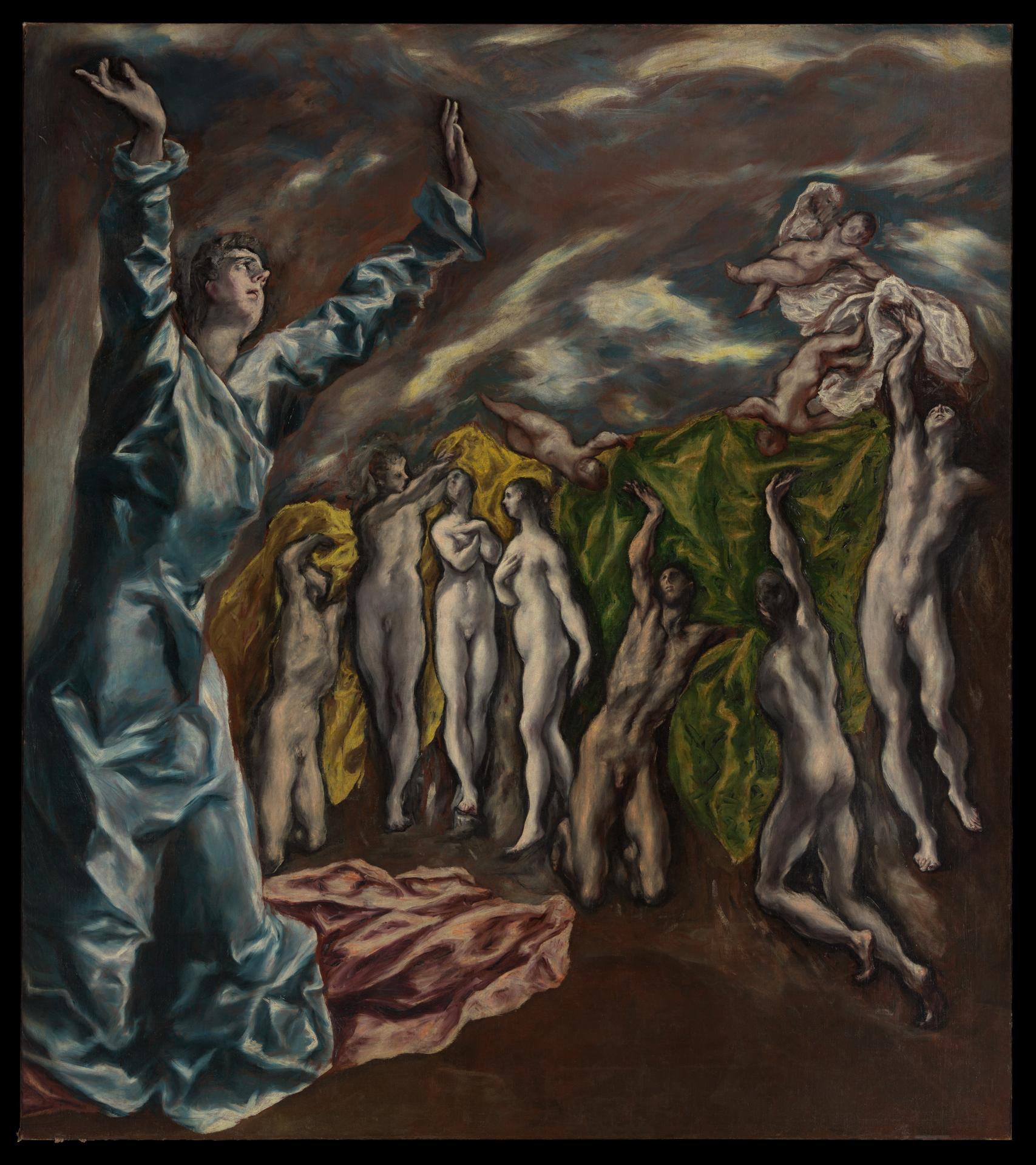
The Vision of Saint John
Original title: The Vision of Saint John
kurzbeschreibung
El Greco, active in Toledo from 1577, painted The Vision of Saint John around 1608–14 in oil on canvas. The Evangelist John is shown receiving an apocalyptic vision; naked figures and a turbulent, cloud-filled sky surround him.
Description
In the foreground a man in a blue robe stands with both hands raised, as if receiving something from above. Around him are several naked figures in various poses, some with arms lifted, others more still. Deeper in the picture further figures emerge, including one carried by an angel. Dark, towering clouds dominate the sky and lend the whole an unreal quality. Dark tones define the palette, shot through with blue and white.
Context
In his final years in Toledo, El Greco worked in a period of deep religious devotion and mystical piety, from which this late work emerged. Its source is the Book of Revelation, a central text of Christian apocalypticism. The arrangement of bared figures and the heavenly apparition also needs to be seen against the backdrop of the Counter-Reformation, which shaped Catholic art of the time.
Impact
The agitated brushwork and focused light create a palpable tension. The dark, cloud-covered field heightens the impression of the supernatural and enigmatic. Standing before the painting, viewers are quickly drawn into the pull of this vision and follow the saint's religious ecstasy.
Technique
The picture is executed in oil on canvas, with El Greco employing his typical fluid, sweeping brushstrokes. The colors are laid in thin layers over one another, producing a soft, almost hovering effect. The canvas measures about 222 x 193 cm; additions at the edges point to later restorations.
AI-generated description text
Source: Metropolitan Museum of Art · Public Domain (CC0 1.0)