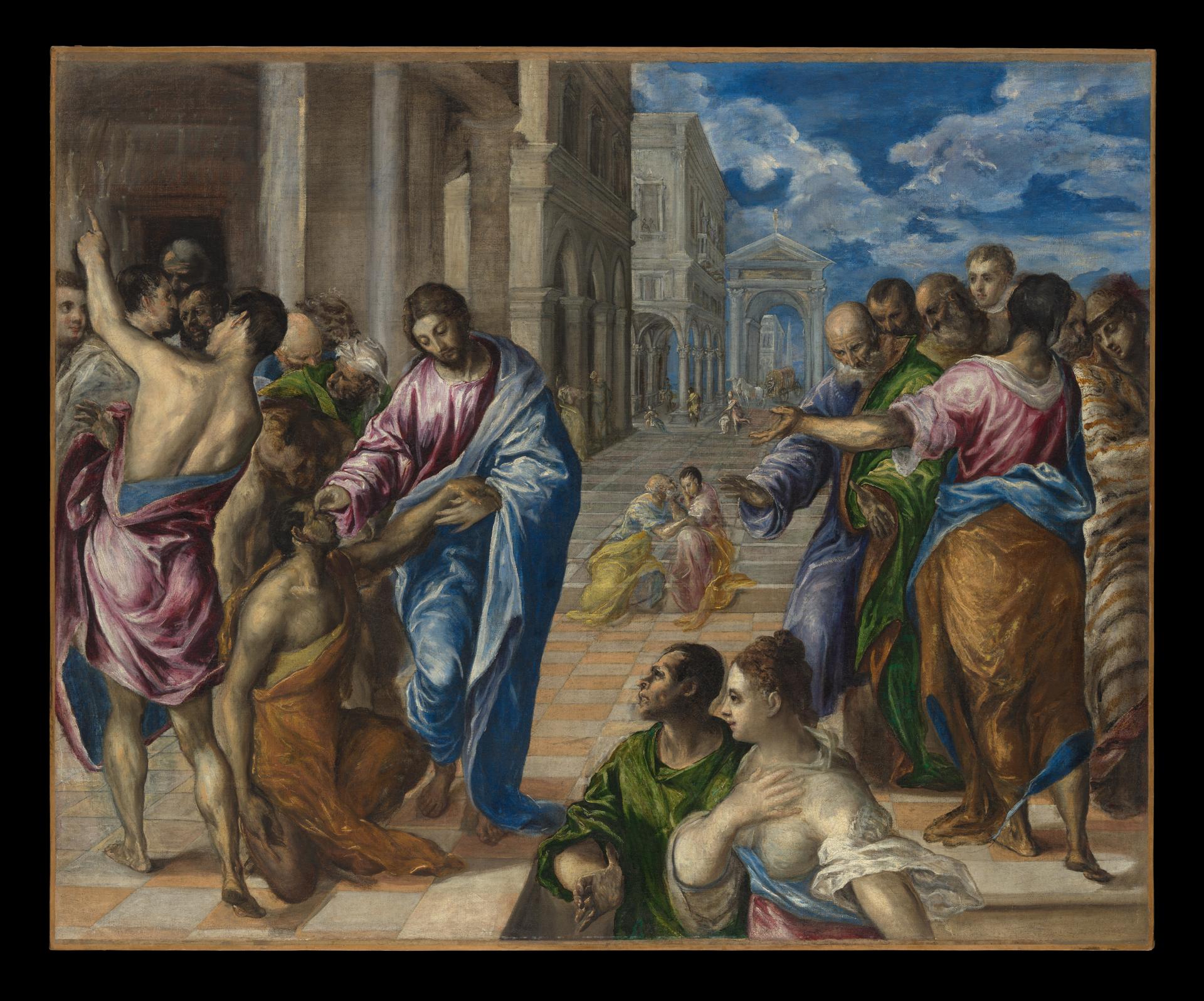
Christ Healing the Blind
Original title: Christ Healing the Blind
kurzbeschreibung
El Greco's painting Christ Healing the Blind, made around 1570 in oil on canvas (119.4 x 146.1 cm), brings a New Testament episode to life: Jesus restores sight to a blind person. At the heart of the image stands Christ, touching a blind woman who kneels before him.
Description
Jesus Christ appears at the center, his raised hand resting on a blind woman who kneels and looks up at him. Around them stand other figures, some in traditional robes, some barefoot, watching the event. Architecture with columns and an arch suggests an ancient or biblical setting. Soft, diffuse light falls from above, illuminating all the figures evenly. The palette ranges from strong blue and red to yellow and green.
Context
Domenikos Theotokopoulos, known as El Greco, was born on Crete and painted this work during his stay in Venice or Rome, before his move to Spain. The layout owes much to Byzantine iconography but already shows the influence of the Italian Renaissance, especially in the handling of space and figures. The healing of the blind was popular in the Counter-Reformation because it emphasized Christ's miraculous power. The painting was probably part of a series of healing miracles commissioned by a private collector.
Impact
The arrangement around Christ as the center and the alert attention of the bystanders create a quiet yet insistent mood. Luminous colors and even light give the event a solemn clarity that underscores its supernatural nature. The slightly elongated figures and expressive gestures already point to El Greco's later mannerist style.
Technique
Oil on canvas—a technique El Greco mastered in Venice. The colors are applied in thin layers with fluid brushstrokes that give the figures soft modeling. The garments and architecture are detailed yet loosely painted, characteristic of the artist's early career.
AI-generated description text
Source: Metropolitan Museum of Art · Public Domain (CC0 1.0)