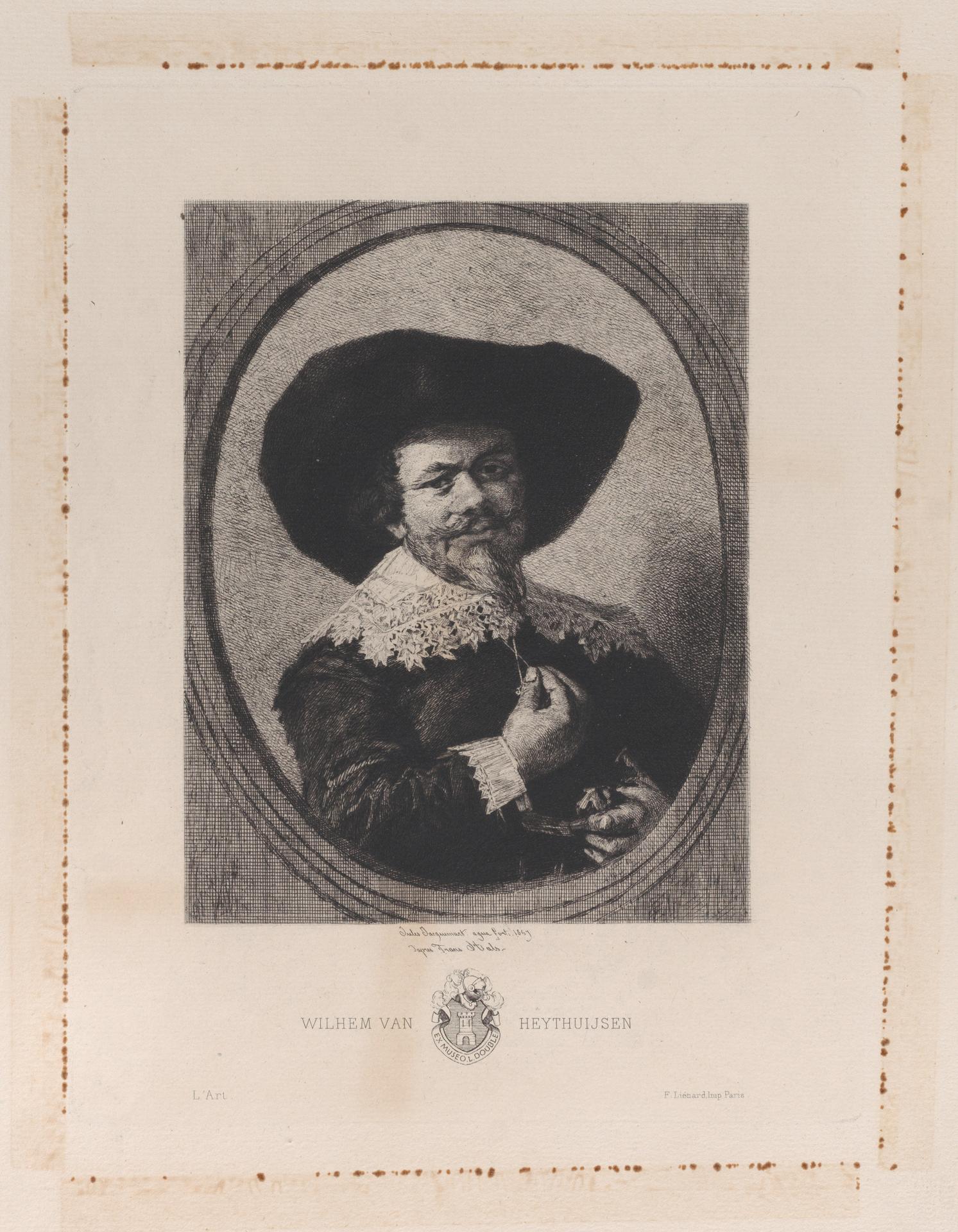
Portrait of Wilhem van Heythuijsen, after Frans Hals
Original title: Portrait of Wilhem van Heythuijsen, after Frans Hals
kurzbeschreibung
In 1869, Jules-Ferdinand Jacquemart reproduced Frans Hals's portrait of Wilhem van Heythuijsen as an etching. The print translates the painted likeness into the graphic medium, setting the man's figure within an oval frame.
Description
A man in a wide-brimmed hat looks out from an oval frame, lace collar and cuffs laid over his jacket and wrists. One hand touches a quill lightly. Behind him, a soft, unarticulated ground opens up. Along the bottom edge appear the name 'Wilhem van Heythuijsen' and a coat of arms. Grey tones dominate the sheet, with even light that avoids harsh contrasts.
Context
Jacquemart, a French etcher, was valued for his reproductions of well-known paintings. Frans Hals made the original portrait in the 17th century, when Dutch portraiture flourished. The 1869 etching belongs to an era when reproductive prints brought artworks to a wider public.
Impact
Delicate lines and the absence of colour give the sheet a calm, distinguished air. Even as a reproduction, the etching conveys the liveliness characteristic of Hals's portraits.
Technique
The print is an etching, an intaglio process in which the drawing is etched into a metal plate and deepened with acid. Jacquemart used fine lines to capture light and shade and the surfaces of fabric and lace. The plate measures 25.3 × 19 cm, the sheet 42 × 27.5 cm.
AI-generated description text
Source: Metropolitan Museum of Art · Public Domain (CC0 1.0)