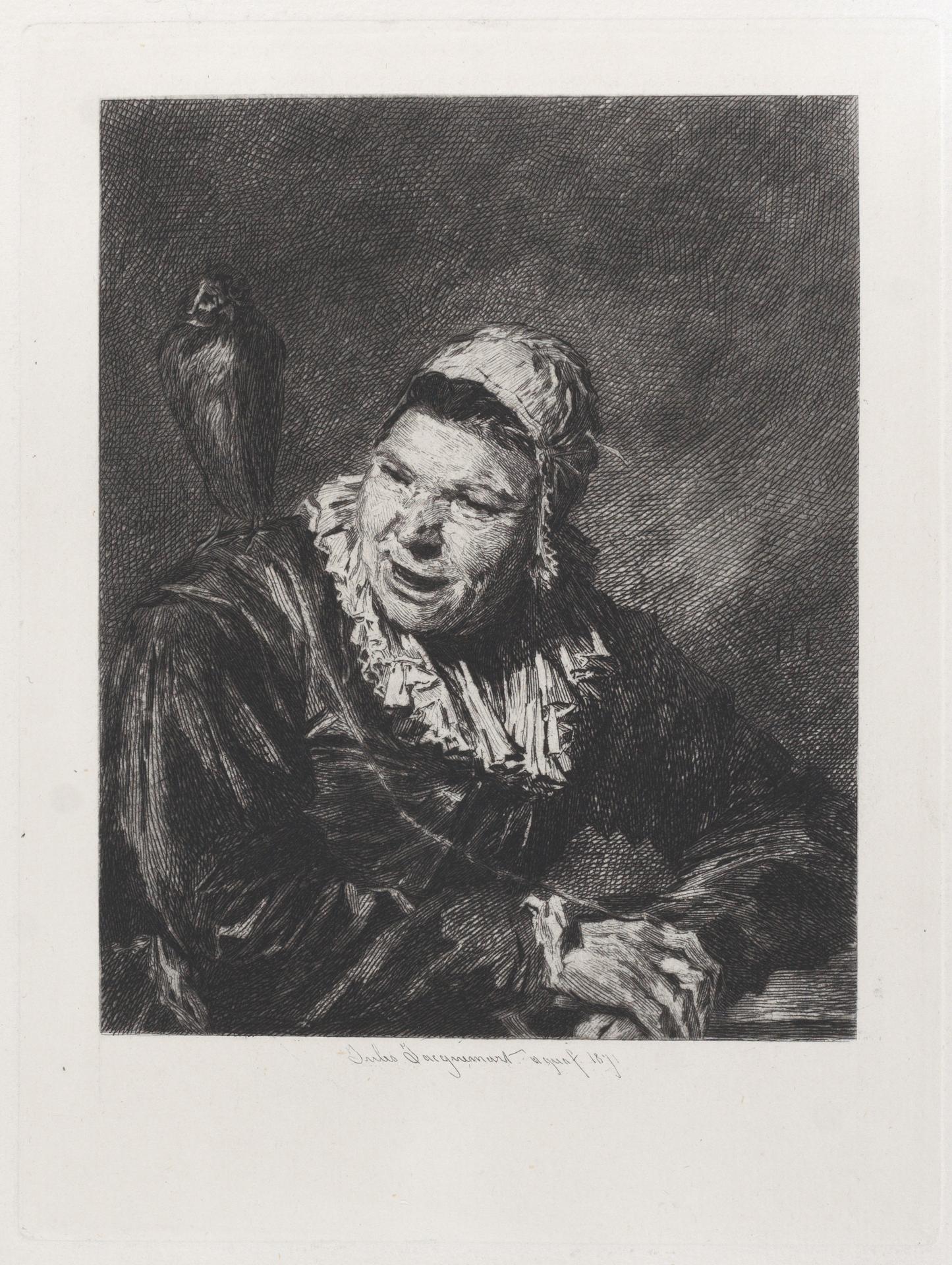
Malle Babbe, after Frans Hals, from "Etchings of Pictures in the Metropolitan Museum New York"
Original title: Malle Babbe, after Frans Hals, from "Etchings of Pictures in the Metropolitan Museum New York"
kurzbeschreibung
Jules-Ferdinand Jacquemart's 1871 etching reproduces Frans Hals's painting 'Malle Babbe' as a print. A laughing woman carrying a chicken on her arm fills the plate, which measures 20 × 15 cm. This is the third of four states (Gonse).
Description
Her laughter is the first thing that catches the eye, along with the chicken perched on her left shoulder. The woman dominates the centre, wearing a ruffled apron and a head covering. A dark, textured background makes the figure stand out. The grey tones come from strokes of varying strength and direction. Frontal light sharpens contours and surfaces.
Context
The etching was made in 1871 for a series in which Jacquemart reproduced paintings from the Metropolitan Museum of Art. The model was Frans Hals's 'Malle Babbe', painted around 1633–1635; the portrait shows a possibly mentally disturbed woman known in Haarlem as 'Malle Babbe'. Jacquemart, a French etcher, was valued for his precise reproductions. The series aimed to bring art closer to a wider public.
Impact
A coarse, infectious cheerfulness hits the viewer immediately. Dark shadows and delicate linework create an intimate, almost dramatic mood that draws the gaze to the figure. The technique gives the sheet a textural depth reminiscent of Hals's handling of paint.
Technique
For this etching, the lines were bitten into a metal plate. Jacquemart used fine strokes and changing stroke directions to create shading and textures. The print in black on white paper underscores the monochrome effect.
AI-generated description text
Source: Metropolitan Museum of Art · Public Domain (CC0 1.0)