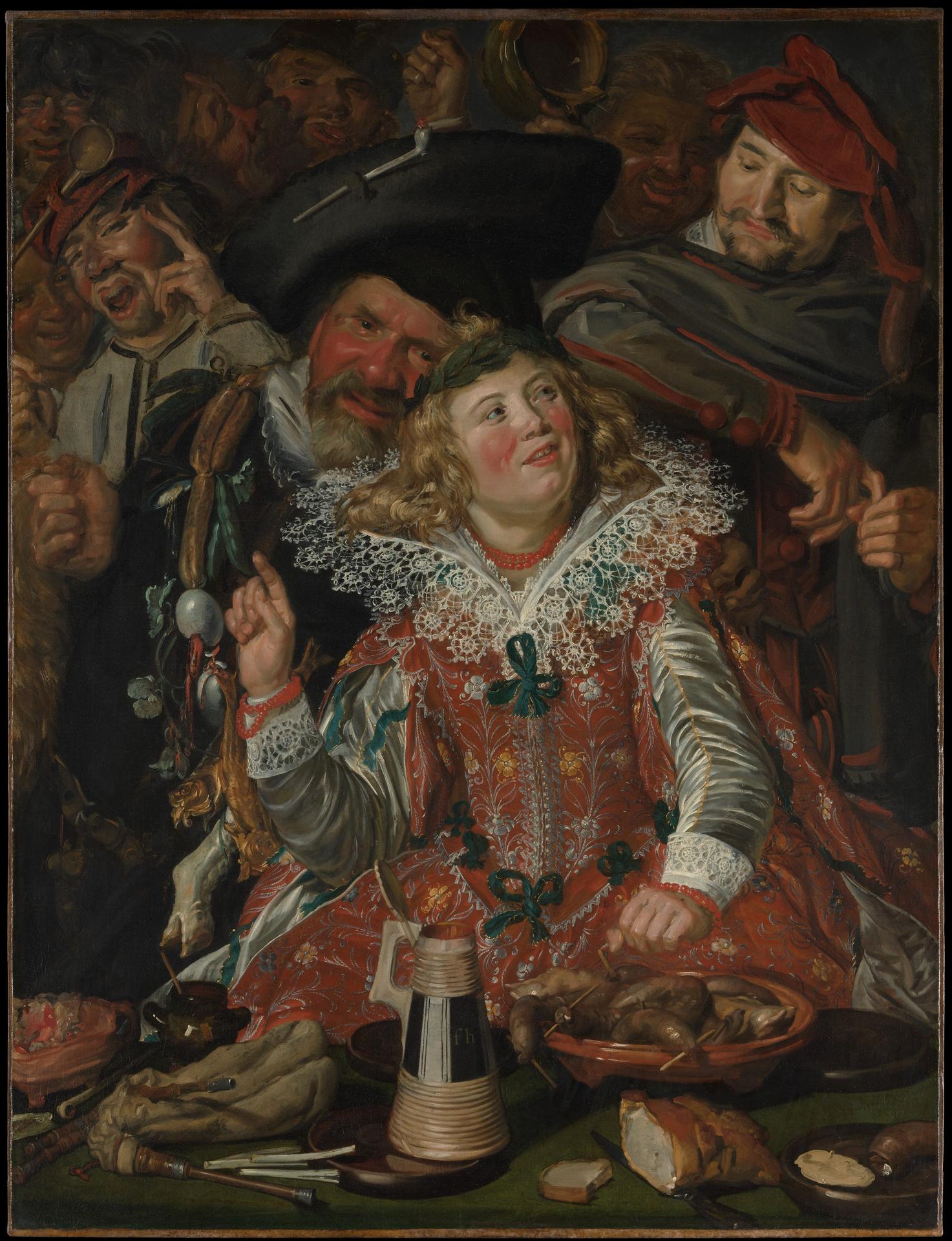
Merrymakers at Shrovetide
Original title: Merrymakers at Shrovetide
kurzbeschreibung
Around 1616–17, Frans Hals painted this oil picture of a boisterous festive company. At the front stands a young man in richly embroidered red and white with lace trim. The painting is considered a typical example of seventeenth-century Dutch genre painting.
Description
A young man in splendid red-and-white clothing dominates the foreground; he holds a fork and seems to be eating or drinking. Behind him press several figures whose expressions range from laughter to serious reserve, some wearing hats and historical headgear. On the table lie a jug, bread, ham and other foods. The light draws out the textures of the fabrics and the refinements of the picture's construction, while the colors stand vigorously and tensely against one another.
Context
The picture was made in the Dutch Golden Age, when scenes of festive everyday life were in strong demand in the Republic of the Netherlands. Carnival, the feast before Lent, was a popular subject. Hals was working in Haarlem at the time and was known for his lively portrayals of sociable situations. Influences from Pieter Bruegel the Elder and other Flemish models are recognizable, yet Hals's own loose brushwork remains decisive.
Impact
Vivid colors and moving figures pull the eye at once. A boisterous mood meets very different facial expressions, giving the layout an atmospheric density that draws the viewer into the scene. The precise rendering of fabrics and foods lends the image a sensual presence characteristic of Dutch painting.
Technique
The picture is executed in oil on canvas, a common medium in the seventeenth-century Netherlands. Hals worked with a loose, sketchy brushstroke, especially in the faces and garments, which gives the figures freshness. The palette is strong; dominant red and white tones are offset by darker areas of the background.
AI-generated description text
Source: Metropolitan Museum of Art · Public Domain (CC0 1.0)