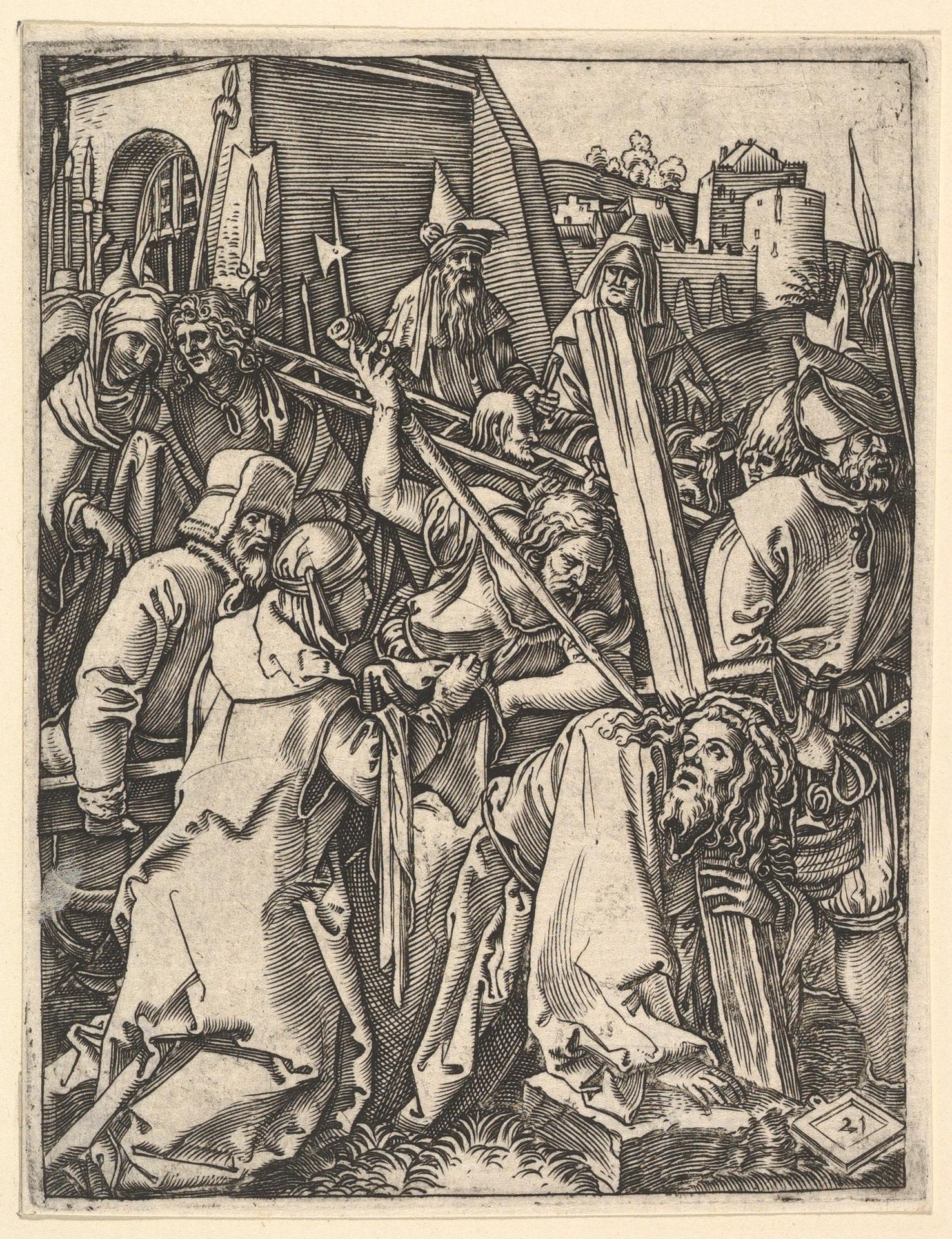
The Bearing of the Cross; Christ Bearing the Cross, Supporting Himself with One Arm on the Ground, from "The Passion of Christ"
Original title: The Bearing of the Cross; Christ bearing the cross, supporting himself with one arm on the ground, from "The Passion of Christ", after Dürer
kurzbeschreibung
Marcantonio Raimondi, an Italian engraver whose career was closely tied to reproducing major models, made this print of Christ carrying the cross and supporting himself with one arm on the ground between about 1500 and 1534. The impression is the third of three states, executed as an engraving.
Description
Christ kneels at the center, one hand pressed to the ground while the other grips the cross. His face conveys strain and pain. Soldiers and other figures crowd around him, some seizing the cross, others gazing at the sufferer. Behind the group, buildings and a fortress suggest an urban setting. The participants' garments correspond to the sixteenth century. The arrangement is tight and lively: many people look and act in different directions.
Context
For this engraving, Marcantonio Raimondi took as his model a work by Albrecht Dürer, likely from his well-known Passion series. Raimondi was an Italian Renaissance engraver who stood out above all for his reproductive prints after works by major artists. Its creation falls between about 1500 and 1534, when Raimondi was working in Rome and Bologna. The sheet belongs to a series devoted to the Passion of Christ—a central motif in the Christian art of that era.
Impact
The dense layout and Christ's suffering expression give the print a poignant, emotional impact. Precise linework and delicate hatching produce an even, calm distribution of light that nonetheless clearly outlines the dramatic event. The style matches the Renaissance and demonstrates the engraver's high technical skill.
Technique
This print employs engraving, in which lines are incised into a copper plate. Shading arises from varying line densities and hatching, characteristic of monochrome reproduction. It is the third state of three, indicating later reworkings of the plate.
AI-generated description text
Source: Metropolitan Museum of Art · Public Domain (CC0 1.0)