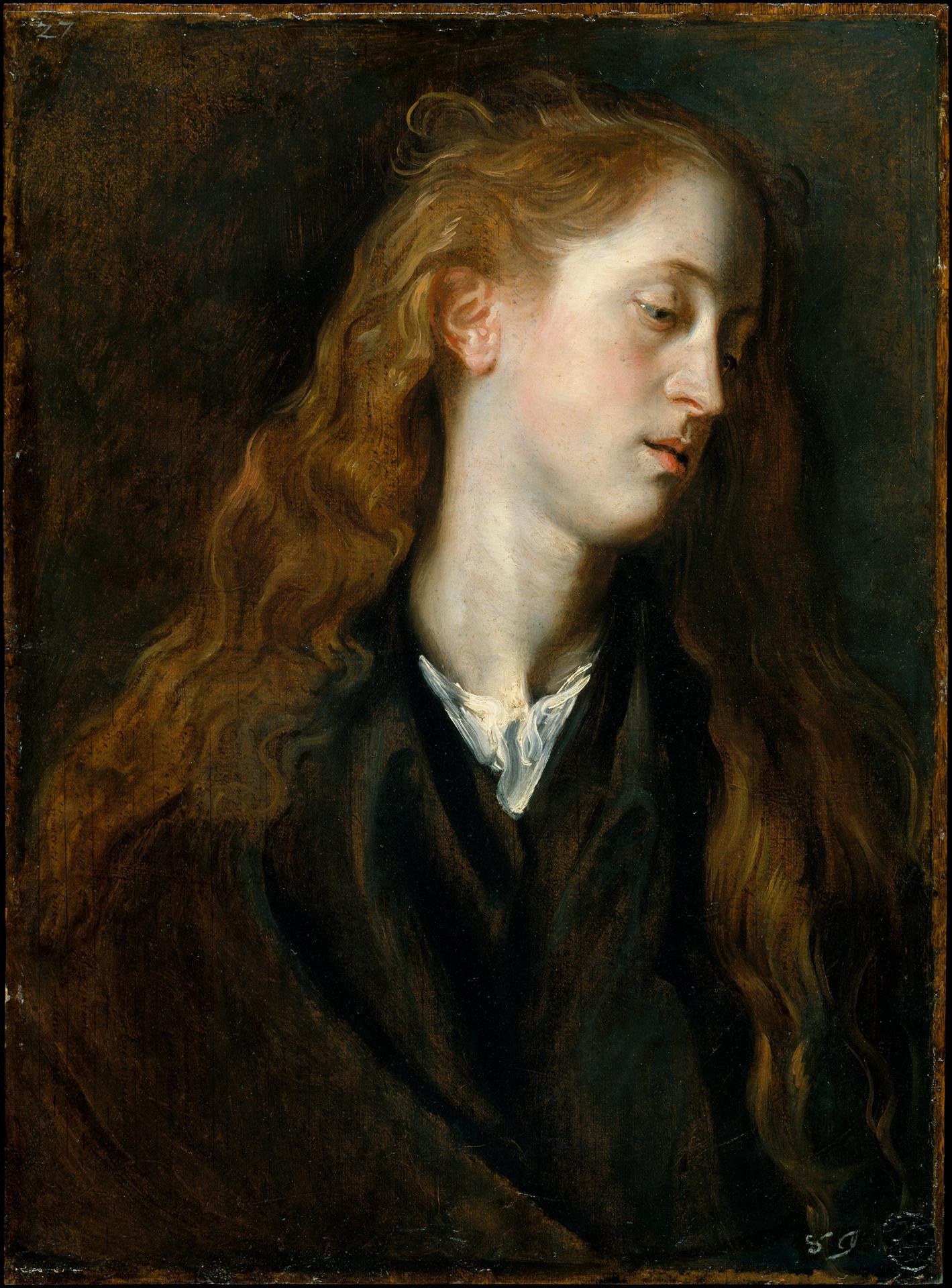
Study Head of a Young Woman
Original title: Study Head of a Young Woman
kurzbeschreibung
Unlike many of his contemporary portrait studies, this sheet by Anthony van Dyck, made around 1618–20, concentrates entirely on the head of a young woman seen in profile. Painted in oil on paper that was later laid down on wood, it is an intimate study that brings facial features and hairstyle to the fore.
Description
The sitter wears her long, wavy hair falling over one shoulder. A dark bodice and a white collar dress her, and her face turns gently to the left in profile. Muted, mostly dark and warm tones dominate the image, drawing attention to face and hair. Side light picks out the contours, while the background stays dark and undefined, guiding the eye toward the countenance.
Context
Van Dyck made this study during his early Antwerp years, before he left for England in 1620. Head studies were common in seventeenth-century Flemish painting and often served as models for larger compositions. The artist was then working in Peter Paul Rubens's studio, and studies of this kind belonged to his working practice. The sheet bears witness to an intense engagement with light and texture in Baroque painting.
Impact
Immediacy and intimacy distinguish this study and direct the viewer straight to the young woman's face. The side lighting and soft modelling create a calm, reflective mood. By concentrating on essentials, the work gains a timeless elegance.
Technique
Oil on paper, later laid down on wood, was a customary technique for studies. Visible brushstrokes and shading model the texture of skin and hair. Working this way allowed van Dyck to capture his subject quickly and spontaneously.
AI-generated description text
Source: Metropolitan Museum of Art · Public Domain (CC0 1.0)