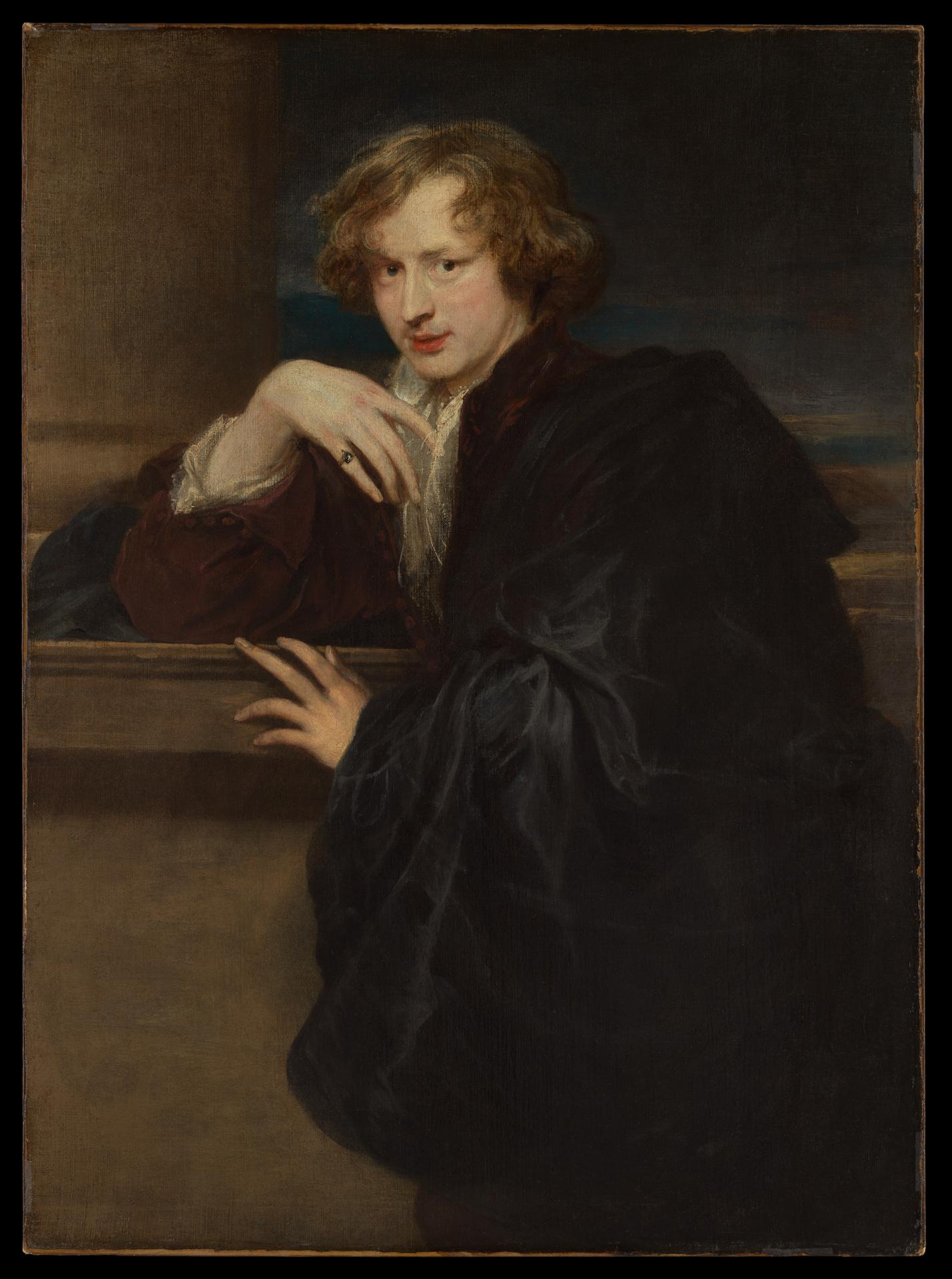
Self-Portrait (ca. 1620–21)
Original title: Self-Portrait
kurzbeschreibung
Around 1620–21, Anthony van Dyck painted himself as a young man. This half-length oil on canvas shows him against a dark background, making his face and hands stand out clearly.
Description
The sitter has curly brown hair, a dark red shirt, and a black jacket over it. One hand rests on a marble ledge, the other is slightly raised. The background stays dark and indistinct, allowing the figure to emerge while light falls on his face and hands. The muted colors and strong chiaroscuro are typical of the Baroque era.
Context
Van Dyck made this self-portrait early in his career, at about 21, before leaving for Italy. It was created in Antwerp, where he worked as an assistant to Peter Paul Rubens. The influence of Flemish Baroque painting is evident, as is van Dyck's precocious skill in portraiture.
Impact
The strong lighting and direct gaze create an intimacy that draws the viewer in immediately. The young man's calm yet self-assured pose gives the portrait a timeless elegance.
Technique
Executed in oil on canvas, with fine brushstrokes and glazing layers. The targeted lighting and soft modeling of the skin demonstrate van Dyck's virtuoso technique, which later established his reputation as a portraitist.
AI-generated description text
Source: Metropolitan Museum of Art · Public Domain (CC0 1.0)