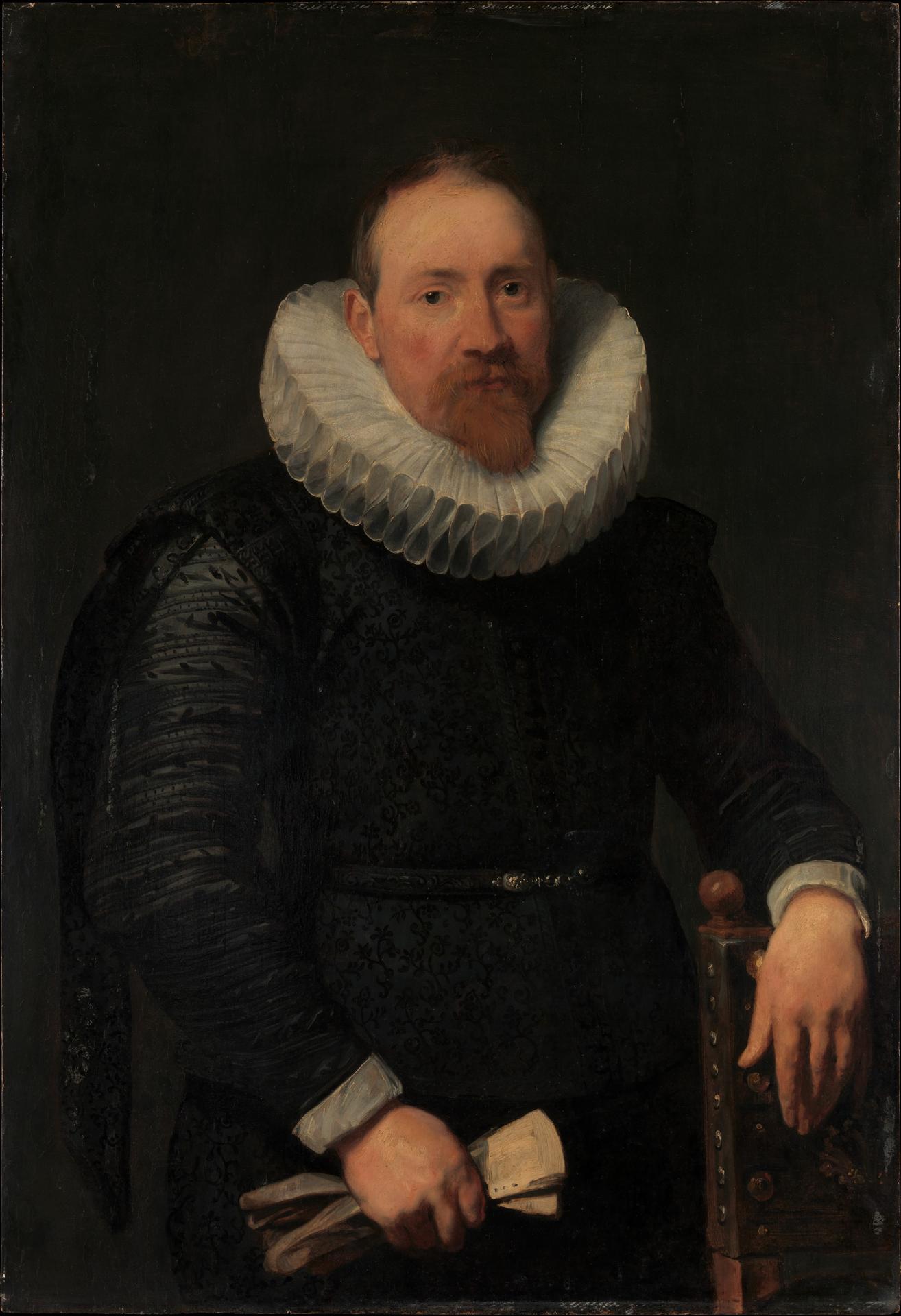
Portrait of a Man (ca. 1618)
Original title: Portrait of a Man
kurzbeschreibung
A man in a dark, patterned garment and a white ruffled collar gazes out from this portrait by Anthony van Dyck, painted around 1618. Executed in oil on wood, the panel measures 106 x 72.7 cm. What the portrait conveys is the sitter's serious, thoughtful expression and the careful rendering of fabric and accessories.
Description
The man's gaze meets the viewer directly, his face serious and withdrawn. A dark garment with intricate patterning surrounds him, while the white ruffled collar creates a strong accent in front. His left hand holds a book or parchment scroll, and his right rests on a wooden chair. Behind the figure, the background remains dark and bare, making him stand out clearly. The arrangement is balanced around the central axis, and the overall tones stay subdued.
Context
Around 1618, Anthony van Dyck was working in Antwerp as an assistant to Peter Paul Rubens, in an early phase of his career. He was about 19 at the time and was already making a name for himself as an independent portraitist. The identity of the sitter has not been passed down, which is fairly common for middle-class portraits of that period. Van Dyck knew how to make his models' rank and character visible through clothing and posture.
Impact
The direct gaze and calm posture make the man seem close and present. Dark tones and the bright collar as a contrast create a collected, almost intimate mood. Because the fabrics are described so precisely, the picture feels tactile, and the viewer instinctively moves closer.
Technique
The painting was done in oil on wood, as was customary in 17th-century Flemish painting. With fine brushstrokes, van Dyck precisely rendered the patterns of the garment and the ruffles of the collar. A dark underpainting and glazing layers produce deep, rich colors against which the white stands out clearly.
AI-generated description text
Source: Metropolitan Museum of Art · Public Domain (CC0 1.0)