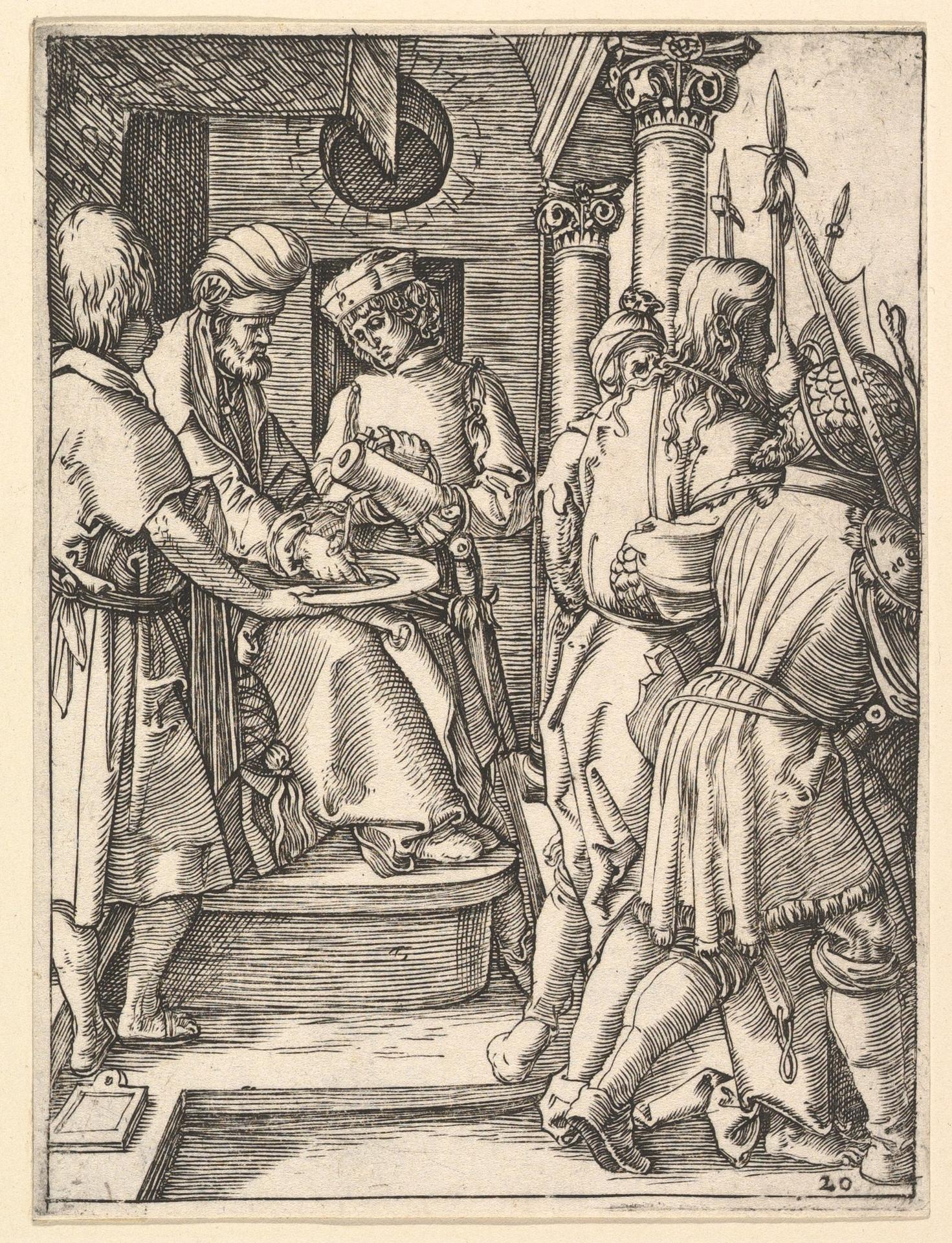
Pilate sitting on throne and washing hands while Christ is lead away by henchmen, from "The Passion of Christ"
Original title: Pilate sitting on throne and washing hands while Christ is lead away by henchmen, from "The Passion of Christ", after Dürer
kurzbeschreibung
Pilate washes his hands while Christ is led away by armed men in this engraving by Marcantonio Raimondi, made between about 1500 and 1534. It belongs to the series 'The Passion of Christ' and is based on a composition by Albrecht Dürer. The dimensions are 13 × 9.8 cm.
Description
Seated on a throne, Pilate holds a chalice in one hand and performs the hand-washing with the other. His appearance is marked by sumptuous garments, a headpiece, and a long robe. From the left, a bearded man wearing a headscarf offers him the chalice, while on the right an armored figure with a shield has taken a seat. Columns and weapons suggest the royal setting. In the foreground, two armed men lead Christ away, dressed in traditional clothing. The monochrome print, with even lighting and precise lines, brings the action to the fore.
Context
Raimondi, an Italian engraver of the Renaissance, became known for his reproductive engravings after other artists. He worked closely with Albrecht Dürer and took up Dürer's Passion series as a model. The series 'The Passion of Christ' was made in Rome, where Raimondi was active from about 1510. Such prints helped spread Dürer's pictorial inventions in Italy and Europe.
Impact
The layout is clear and directs the viewer's gaze to Pilate and Christ, emphasizing the dramatic tension of the scene. The detailed style, with fine lines, gives the print a noble, almost ceremonial atmosphere that underscores the significance of the moment.
Technique
An engraving: lines are incised into a copper plate and then transferred to paper with printing ink. Raimondi used precise, fine lines to render the texture of garments and architecture. The small format of 13 × 9.8 cm invites intimate viewing, as is typical for devotional images.
AI-generated description text
Source: Metropolitan Museum of Art · Public Domain (CC0 1.0)