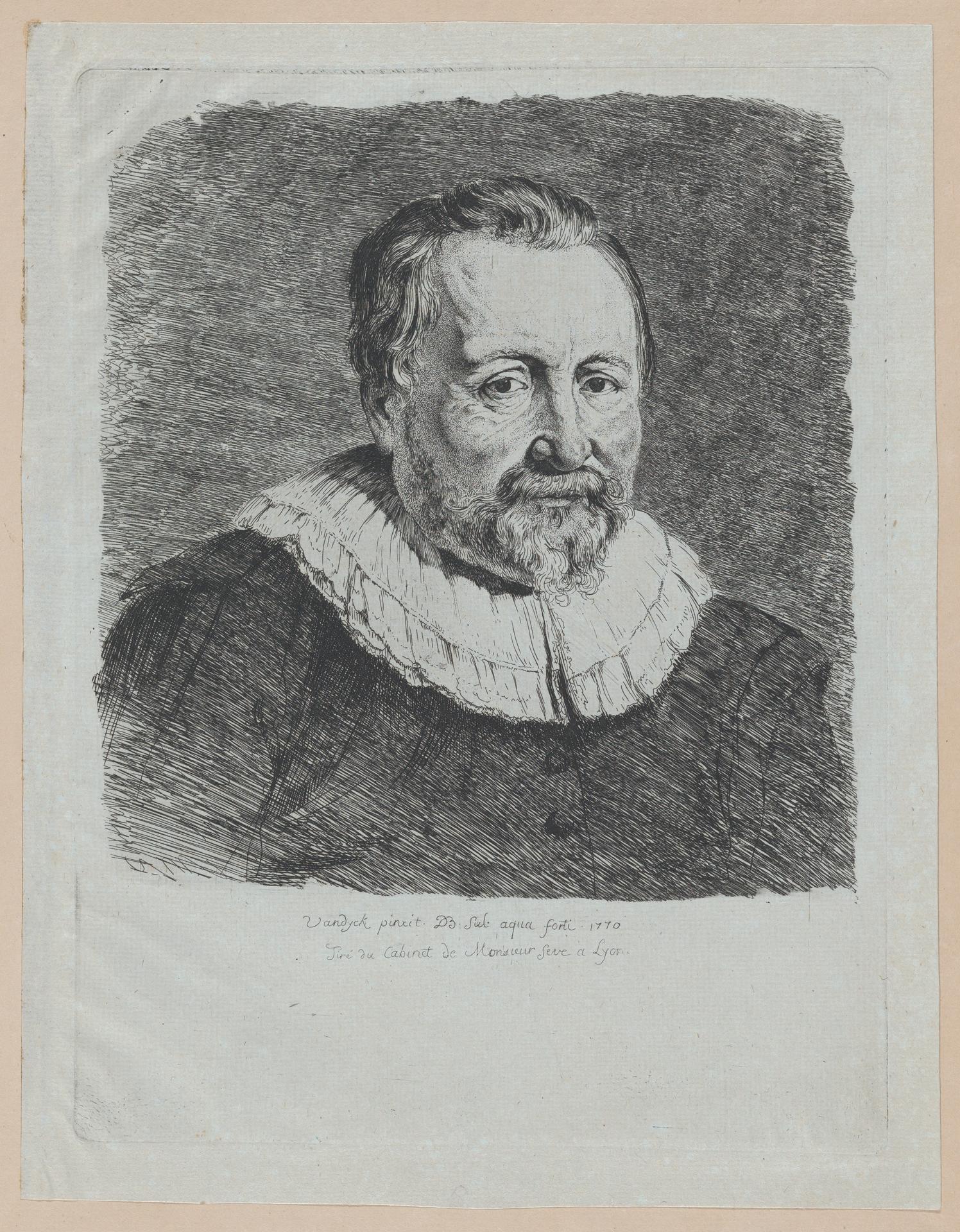
Portrait, after Van Dyck (1770, Met-Objekt 1788)
Original title: Portrait, after Van Dyck
kurzbeschreibung
In 1770 Jean Jacques de Boissieu issued this etching after a painting by Van Dyck. The sitter's appearance calls Peter Paul Rubens to mind. This impression is the fourth of five states and once belonged to the collection of Monsieur Seve in Lyon.
Description
A man looks out from the plate with a grave, thoughtful expression. His beard is short and his hair carefully arranged. Over a dark jacket sits a broad white collar trimmed with ruffles. The ground stays dark and undefined, so the face comes forward. Along the bottom are the signature and the inscriptions 'Vandyck pinxit. D3. Sol. aqua fort. 1770.' and 'Tir. du Cabinet de Monsieur Seve a Lyon.'
Context
The print was made in 1770 as a reproductive etching after a Van Dyck painting then in the Lyon collection of Monsieur Seve. That Boissieu pulled the fourth of five states can be read from the working of the plate. For his painstaking etchings the artist often turned to models by the old masters.
Impact
Dark ground and clear line give the sheet a quiet, collected mood. The bright white of the collar stands against the dark garment, drawing the eye to the face, whose seriousness comes through all the more.
Technique
Etching means biting the lines into a metal plate with acid. The fourth of five states shows that Boissieu reworked the plate several times to sharpen detail and contrast. It was printed on paper, and the sheet measures 37 × 26 cm.
AI-generated description text
Source: Metropolitan Museum of Art · Public Domain (CC0 1.0)