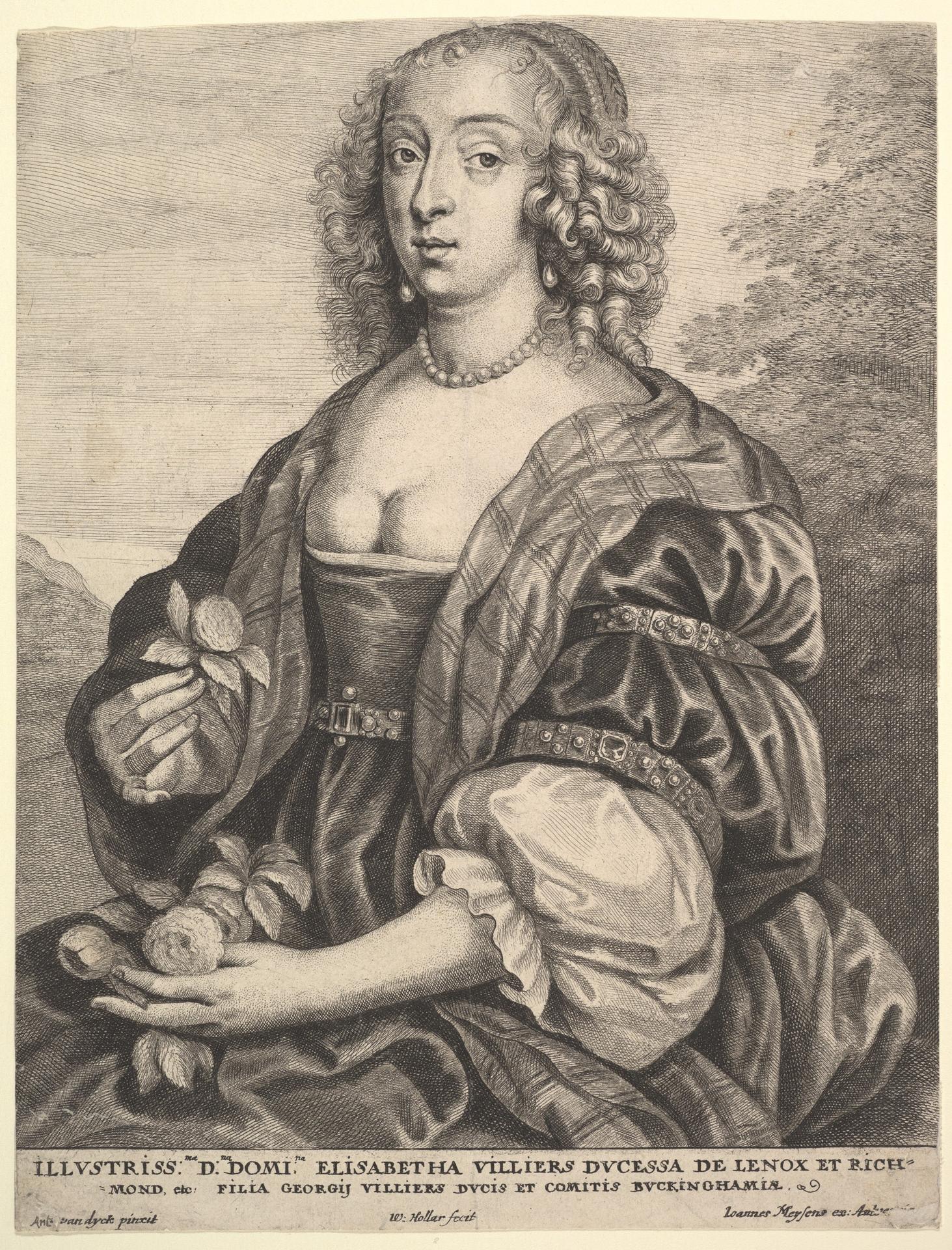
Mary Villiers, Dutchess of Lennox and Richmond
Original title: Mary Villiers, Dutchess of Lennox and Richmond
kurzbeschreibung
Wenceslaus Hollar made this portrait of Mary Villiers, Duchess of Lennox and Richmond, as an etching between 1645 and 1650. It is the fourth state of five. The duchess appears in a patterned dress with a pearl necklace; her right hand holds a flower, her left a rose.
Description
Mary Villiers occupies the center as a half-length figure, drawing attention to her face and upper body. She wears a checkered garment and a pearl necklace. Curly hair falls over her shoulders. Behind her, trees and a hill are only faintly indicated. The sheet remains monochrome in shades of gray, with even lighting that lacks strong shadows. Latin inscriptions giving her name and origin appear at the bottom.
Context
The Bohemian printmaker Wenceslaus Hollar created this portrait during his stay in England, where he worked for aristocratic circles. Mary Villiers belonged to the English nobility and was connected through her marriages to the Duke of Lennox and later the Duke of Richmond. The etching was made during a period of political upheaval, at the time of the English Civil War. Hollar was known as a master of precise portraits and topographical views, often used as models for reproductions.
Impact
The print's fine lines and calm, even lighting give it an elegant and understated effect. The checkered pattern of the dress and the delicate flowers add a decorative note, while the sitter's serious expression creates distance. The gray tones and the shadowy landscape produce an intimate, almost introspective mood.
Technique
For this work Hollar used etching: the drawing was scratched into an acid-resistant ground on a copper plate and then bitten with acid. Fine, careful lines model the face, clothing, and background. The fourth of five states suggests possible revisions or corrections made before printing.
AI-generated description text
Source: Metropolitan Museum of Art · Public Domain (CC0 1.0)