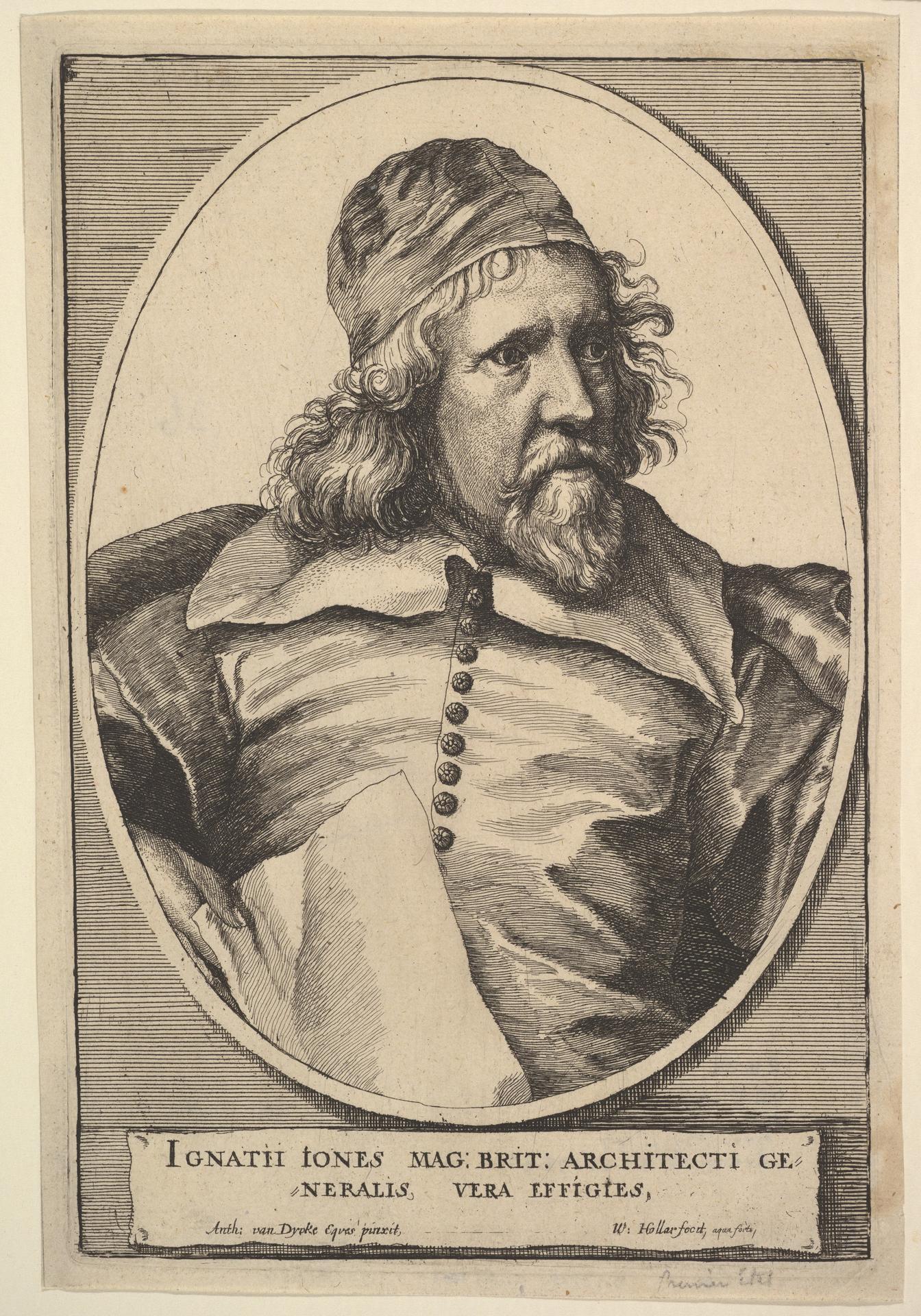
Inigo Jones (from Inigo Jones's "The most notable Antiquity of Great Britain vulgarly called Stone-heng on Salisbury Plain," 1655)
Original title: Inigo Jones (from Inigo Jones's "The most notable Antiquity of Great Britain vulgarly called Stone-heng on Salisbury Plain," 1655)
kurzbeschreibung
Inigo Jones appears within an oval frame, portrayed by Wenceslaus Hollar in 1655. The etching was intended as the frontispiece for Jones's book on Stonehenge, published posthumously. This is an early, black-and-white impression.
Description
A man with a turban-like head covering and curly hair looks out from an oval frame. He wears a buttoned shirt and a jacket with a broad collar. Below the portrait, a Latin text field gives his name and his title as General Architect of England. Fine lines and hatching shape light and shadow; the lighting remains even and avoids harsh contrasts.
Context
The English architect Inigo Jones (1573–1652) is regarded as a pioneer of Palladianism in England. The image served as the frontispiece to his work 'The most notable Antiquity of Great Britain vulgarly called Stone-heng on Salisbury Plain', which appeared in 1655 after his death. The Bohemian etcher Wenceslaus Hollar, who worked in England, made the portrait after a model. In the book, Jones argued that Stonehenge was of Roman origin—a hypothesis later proven false.
Impact
Dignity and authority emanate from this portrait, underscoring Jones's status as a leading architect of his era. The precise etching technique and clear layout give the sheet an elegant, historical note. The oval framing and Latin inscription emphasize the sitter's classical education and humanist background.
Technique
The sheet is an etching, an intaglio process in which the drawing is bitten into a metal plate. Subtle tonal values and textures arise from fine lines and hatching. The present example is the first state of two, indicating an early printing phase.
AI-generated description text
Source: Metropolitan Museum of Art · Public Domain (CC0 1.0)