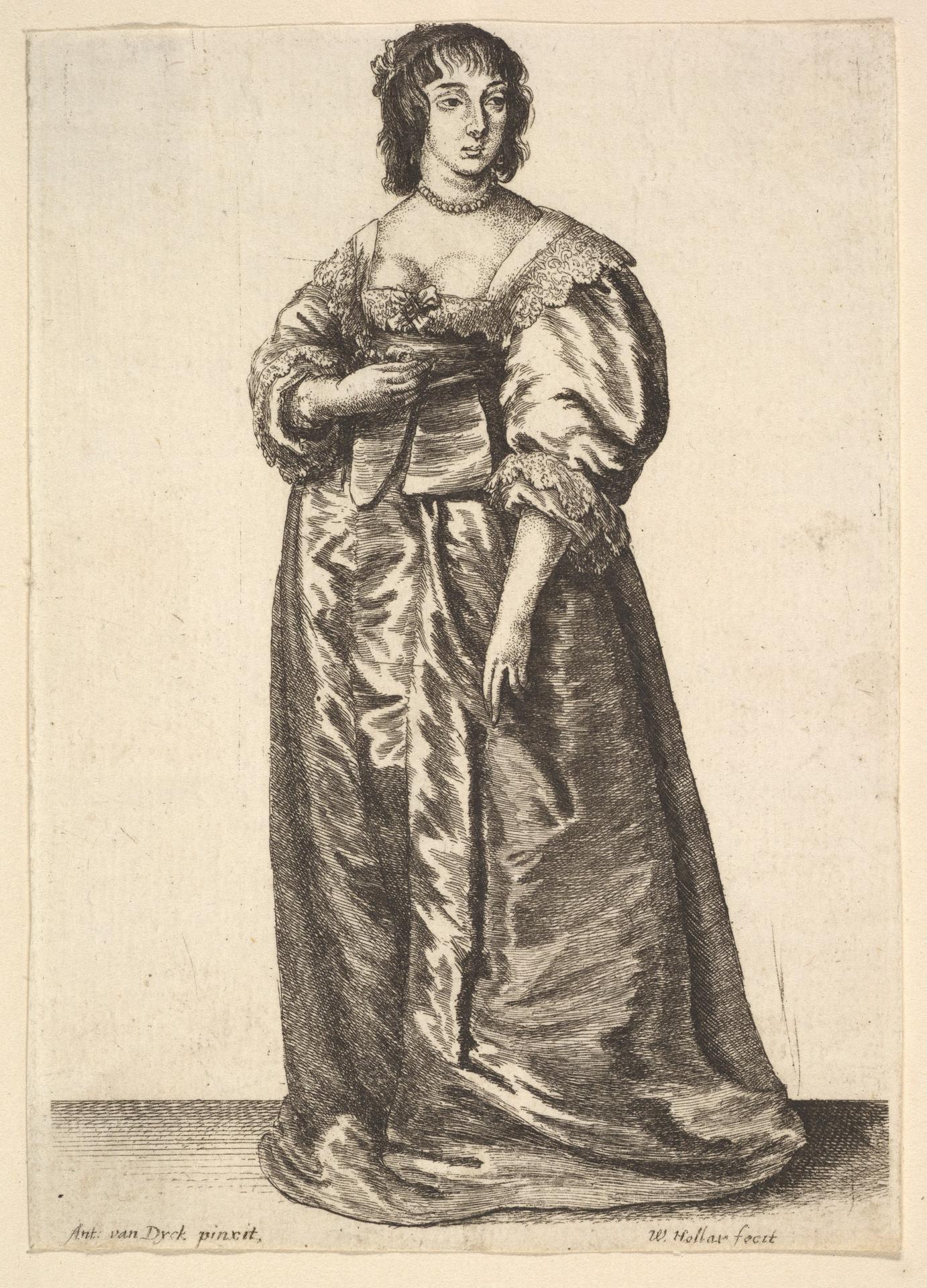
Whole-length Figure of a Lady
Original title: Whole-length Figure of a Lady
kurzbeschreibung
Wenceslaus Hollar's etching 'Ganzfigur einer Dame' presents a woman dressed in costly attire, a reproduction after a painting by Anthony van Dyck. The sheet, created between 1625 and 1677, exists as a single-state print made with the etching technique.
Description
The figure appears from head to toe, facing the viewer. She wears a long gown, over which is a jacket with fur trim and an ornate bodice. Her hands are clasped, the right holding a small object; her hair is gathered into a curly bun. The background remains sparse, ensuring nothing distracts from the lady. The lines in black and white are sharp and rich in detail; at the bottom are the inscriptions 'Ant. van Dyck pinxit' and 'W. Hollaar fecit'.
Context
Hollar made this etching after a painting by Anthony van Dyck, one of the leading portrait painters of the 17th century. The artist was known for his precise reproductive prints, often based on works by other masters. The dating cannot be fixed exactly but falls within Hollar's active period, which was marked by stays in England and on the Continent. Prints of this kind made paintings accessible to a wider audience and were highly popular among collectors.
Impact
The delicate linework and clear contour give the sheet an exceptionally precise and noble appearance. Because the background is reduced, the eye focuses entirely on the figure, whose posture and clothing convey a calm dignity. The accuracy in detail—such as the fur trims and the hairstyle—lends the print an almost tactile quality.
Technique
The work is an etching, an intaglio process in which the drawing is scratched into an acid-resistant layer on a copper plate and then bitten with acid. Hollar used this technique to achieve fine and exact lines that naturally render fabric and hair textures. The sheet is the only state and has been trimmed at top and bottom, reducing its original size.
AI-generated description text
Source: Metropolitan Museum of Art · Public Domain (CC0 1.0)