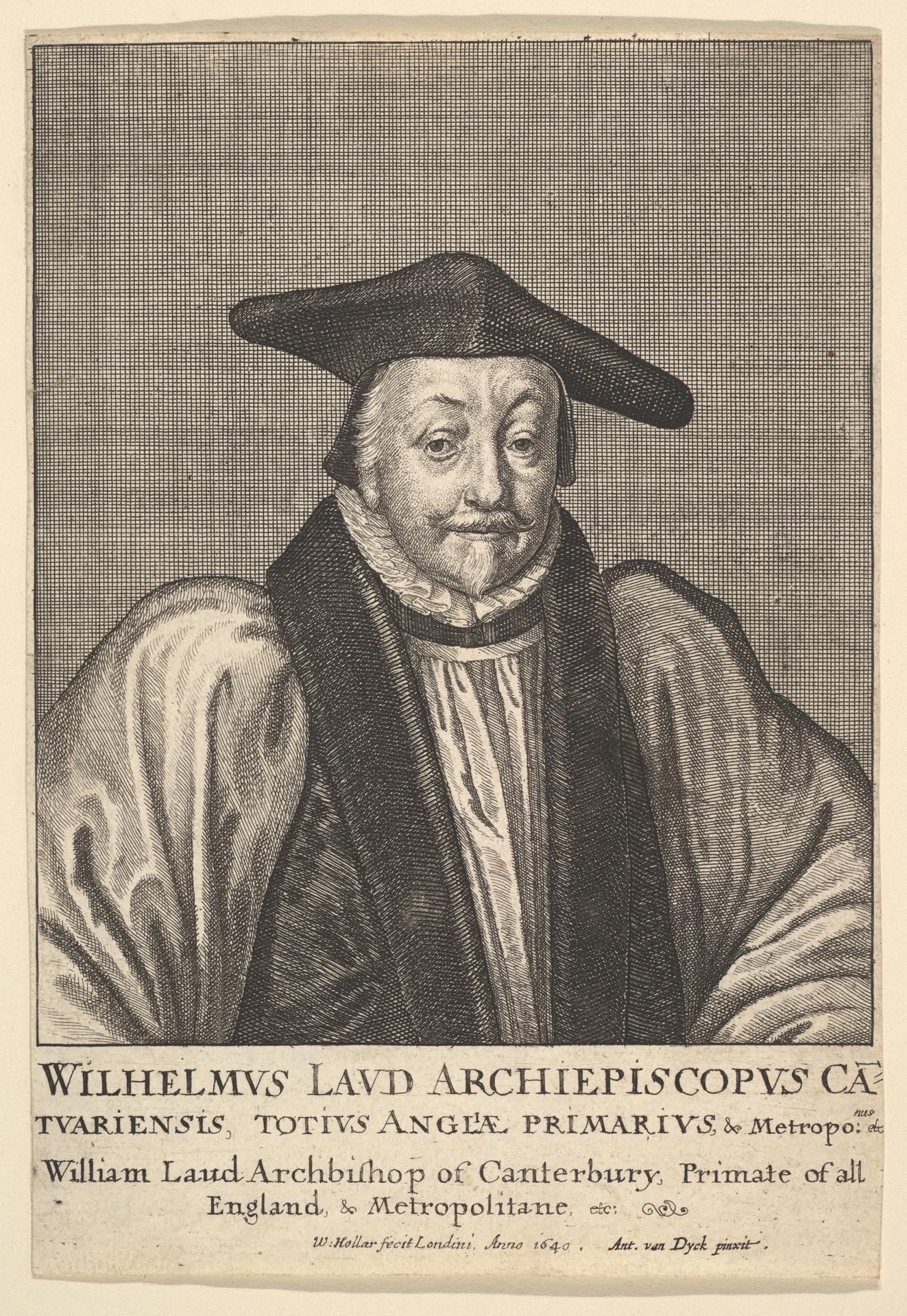
William Laud, Archbishop of Canterbury
Original title: William Laud, Archbishop of Canterbury
kurzbeschreibung
William Laud, Archbishop of Canterbury, is presented in this 1640 etching by Wenceslaus Hollar as a formal portrait. The print is in its seventh and final state and measures 14.6 × 10 cm.
Description
A black cap covers William Laud's head. Beneath it, he wears a robe with a broad collar, accompanied by a black scarf—garments typical of the English nobility and the Anglican Church of the 17th century. His upright posture and serious gaze lend the figure a solemn and respectful air. A Latin and English dedication below the portrait names Laud as 'Archbishop of Canterbury, Primate of all England and Metropolitan'.
Context
Wenceslaus Hollar, born in Prague, produced this portrait in London in 1640. At that time, William Laud was a key figure in the English Church and politics and was increasingly resented in the years leading up to the English Civil War. During a period of growing tension between Crown and Parliament, Laud held a prominent position as Archbishop of Canterbury.
Impact
Dignity and authority emanate from this print, supported by the upright stance and the splendid vestments. The precise linework and the clear rendering of the face make the portrait appear detached and ceremonial.
Technique
Hollar worked with etching, an intaglio process in which the drawing is bitten into a metal plate. This allowed him to achieve the finest details in the drapery and facial features. The existence of seven states of the plate shows that the artist revised the print multiple times.
AI-generated description text
Source: Metropolitan Museum of Art · Public Domain (CC0 1.0)