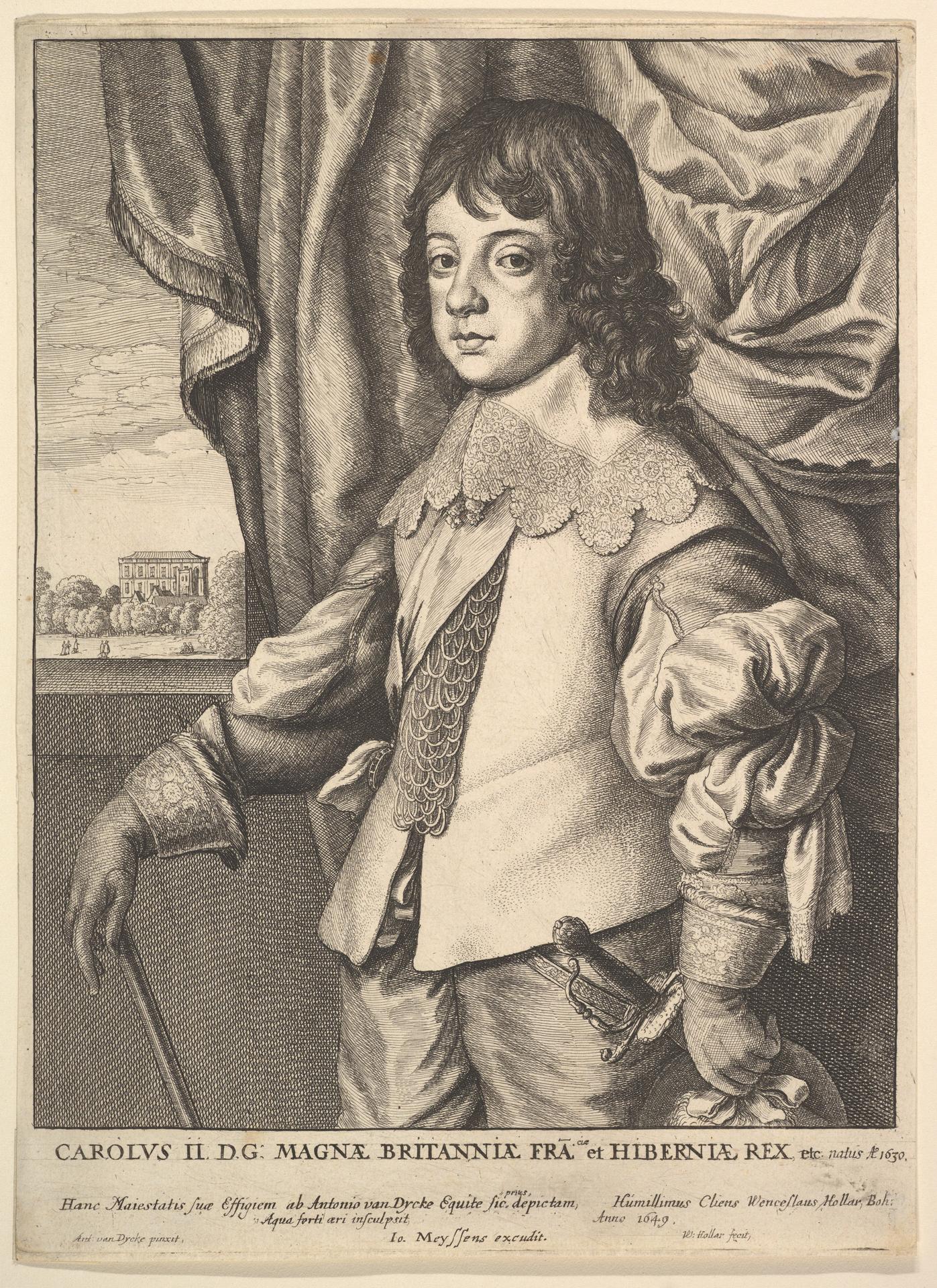
Charles II (1649, Met-Objekt 1770)
Original title: Charles II
kurzbeschreibung
Wenceslaus Hollar's 1649 etching portrays the young Charles II, King of England, Scotland and Ireland. This impression is the third of six states and measures 25.4 × 18.6 cm. The sheet ranks among the representative ruler portraits in the medium of etching.
Description
Charles II appears in sumptuous attire, with an elaborate collar and a patterned waistcoat. His left arm is slightly bent, the hand indicating a chair or table. A window behind him opens onto a landscape with a building and trees. The layout is symmetrical and wholly focused on the figure, with even lighting. The execution is precise and detailed, as is characteristic of 17th-century art.
Context
The portrait was made in 1649, the year of Charles I's execution and the proclamation of the Commonwealth under Oliver Cromwell. Charles II was then in exile on the continent. Hollar, a Bohemian etcher, worked in England and produced numerous portraits of the royal family. The sheet belongs to a series of prints intended to present the exiled monarch as the rightful ruler.
Impact
The viewer's gaze is first drawn to the sitter's calm, almost ceremonial presence. The symmetrical arrangement and the accurate rendering of the clothing give the portrait a dignified and formal air. Through the view onto the landscape in the window, the portrait gains spatial depth that enhances the figure's impact. Overall, the sheet conveys a sense of regal authority.
Technique
For this etching, lines were bitten into a copper plate that had first been coated with an acid-resistant ground. The plate was then printed on paper, with the plate mark remaining visible on the sheet. The fine line and even tonal gradation demonstrate Hollar's assured mastery of the process.
AI-generated description text
Source: Metropolitan Museum of Art · Public Domain (CC0 1.0)