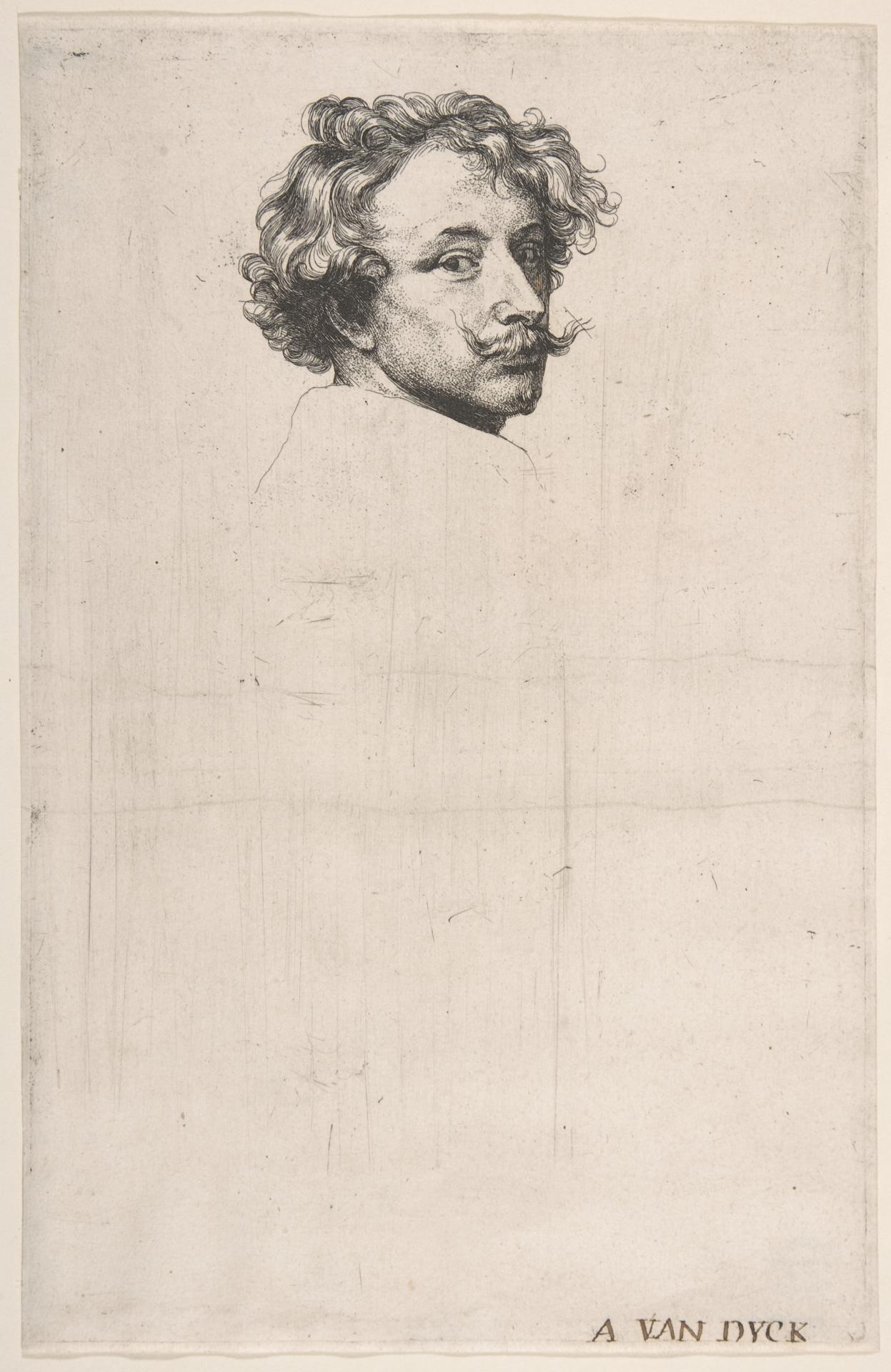
Self-Portrait, from "The Iconography"
Original title: Self-Portrait, from "The Iconography"
kurzbeschreibung
Anthony van Dyck made this self-portrait around 1640 as an etching; this impression is the first of seven states. The artist appears with curly hair and a distinctive nose, shown half-length against an empty background. The print belongs to the series 'The Iconography'.
Description
Van Dyck is seen in half-profile, capturing his face and upper body. Curly hair frames his features, and the notably upward-curving nose stands out; his expression remains calm and thoughtful. The print is signed at lower right with 'A. VAN DYCK'. Even light falls on his face, drawing out the contours. The arrangement has no accessories and feels immediate.
Context
Created around 1640, shortly before the artist's death, this etching served as the title page for 'The Iconography' — a collection of portrait engravings of famous contemporaries initiated by van Dyck. The self-portrait stood at the beginning of the series and was printed in seven states.
Impact
The artist's direct gaze pulls the viewer in at once, creating intimacy. Because all accessories are absent and only the face matters, the portrait gains a timeless, quietly collected quality — the focus rests entirely on the features and their expression.
Technique
For this etching, lines were bitten into a copper plate. The monochrome gray tones yield soft shading that makes the face emerge with volume. Since the first state shows the plate before later reworking, the original linework is preserved.
AI-generated description text
Source: Metropolitan Museum of Art · Public Domain (CC0 1.0)