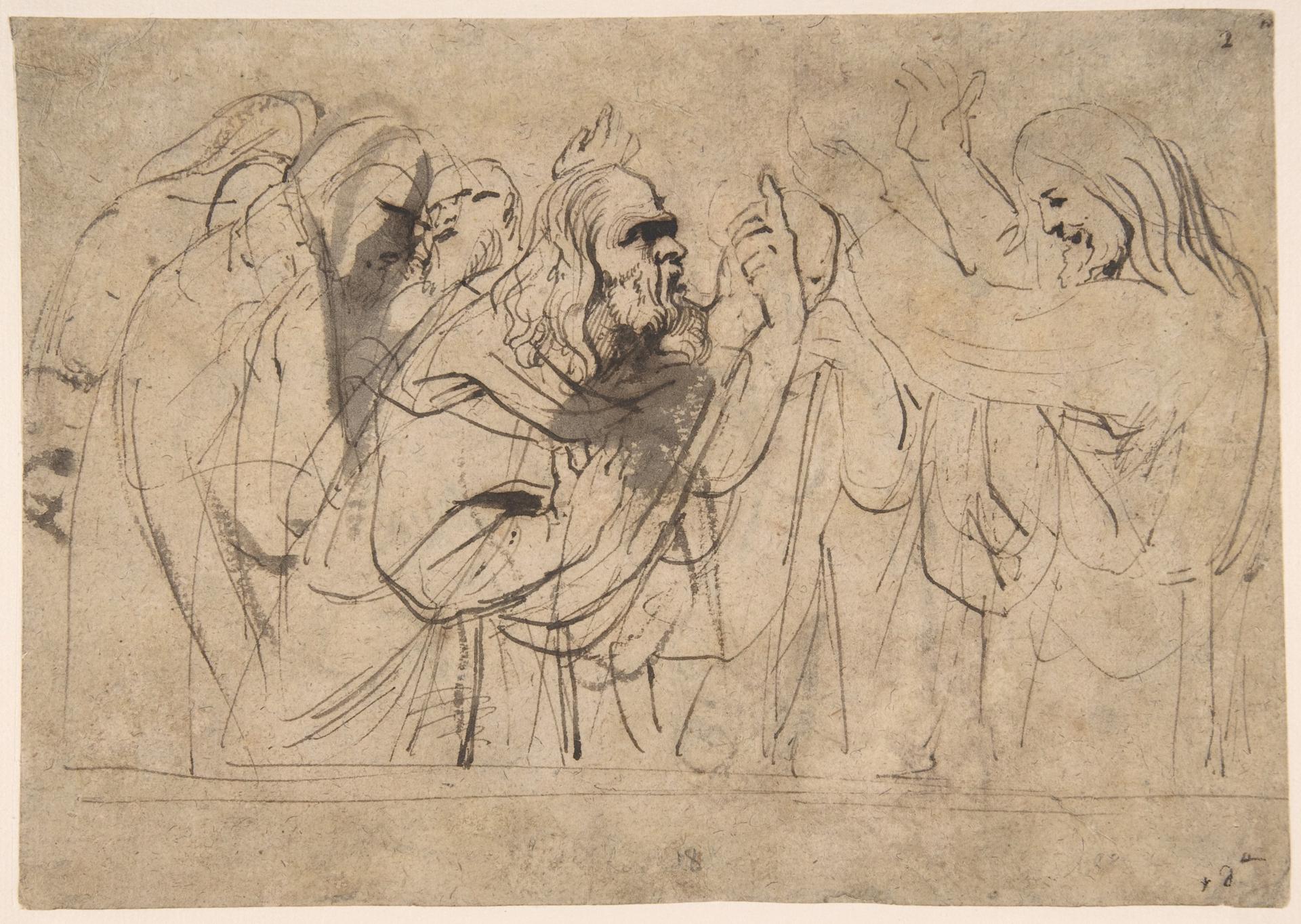
Christ and the Pharisees; verso: Christ and a Pharisee
Original title: Christ and the Pharisees; verso; Christ and a Pharisee
kurzbeschreibung
Unlike many of van Dyck's religious studies, this sheet brings together two scenes on front and back: an exchange between Christ and the Pharisees on the recto, and a separate encounter between Christ and a Pharisee on the verso. The drawing dates from the early 17th century and is executed in pen and brown ink, with brush and brown wash.
Description
On the front, a lively group appears in conversation. A bearded, long-haired man—Christ—raises his hand. To the left stands another figure with long hair and a sash, while on the right a third figure joins the discussion. The garments look traditional and point to a biblical setting. Brown and gray tones predominate, the light is even and casts no shadow. The sketchy style emphasizes gesture and movement.
Context
Van Dyck drew this sheet in the early 17th century, likely during his years in Flanders or Italy. It probably served as a preparatory study for a larger painting or an etching. Biblical subjects were widespread in the Baroque, and van Dyck produced numerous studies of religious motifs. The drawing on the reverse is a standalone scene, suggesting the paper was reused.
Impact
The loose, fluid linework conveys liveliness and immediacy. The figures' gestures create a palpable tension in the dialogue, drawing the viewer into the event. The restriction to brown and gray tones gives the sheet a calm, concentrated mood.
Technique
The drawing was made with pen and brown ink, supplemented by brush and brown wash. This allowed both precise contours and soft, tonal shading. The paper format of about 15.2 x 21.5 cm corresponds to a quick study made on the spot or from imagination.
AI-generated description text
Source: Metropolitan Museum of Art · Public Domain (CC0 1.0)