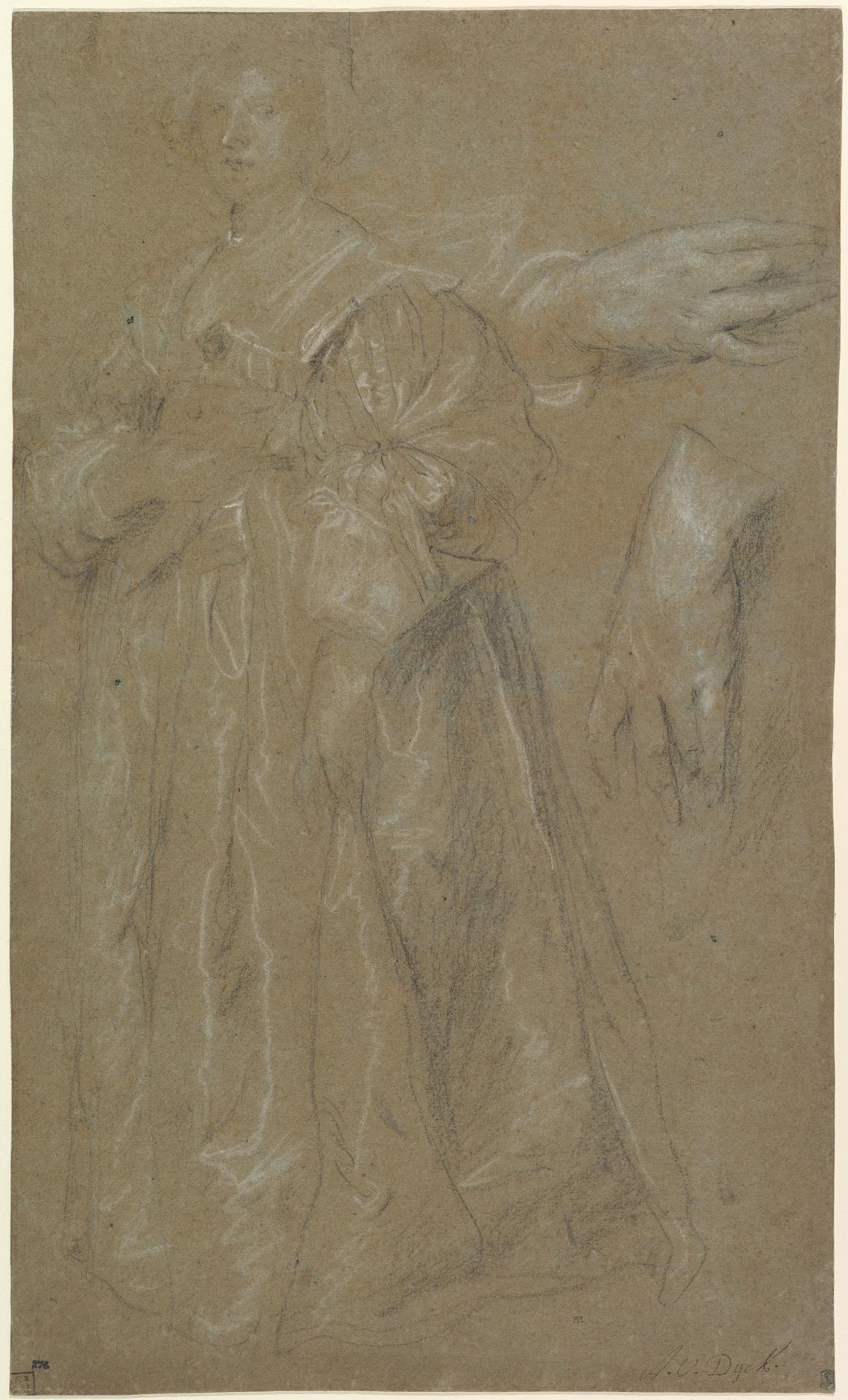
Study for a Portrait of a Lady
Original title: Study for a Portrait of a Lady
kurzbeschreibung
Anthony van Dyck drew this study for a portrait of a lady in the early 17th century. Executed in black chalk with white heightening on brown paper, it presents two female figures in an asymmetrical arrangement.
Description
On the left, a figure in a long robe stands holding a book-like object. On the right, a less sharply defined, more animated figure appears, possibly with outstretched arms. Both are shown frontally and upright, with the left figure dominating the foreground. Neutral browns and greys prevail, under even lighting. The lines flow and are sometimes transparent, giving the sheet a sketchy quality.
Context
The drawing dates from van Dyck's early career, when he worked in Peter Paul Rubens's Antwerp studio. Such studies often served as preparation for larger paintings or portrait commissions. Combining two variants of a figure on one sheet was common in the Baroque to compare poses. Brown paper and chalk were typical materials for fleeting sketches of this era.
Impact
The loose, flowing lines make the sheet feel lively and immediate. The transparency of the strokes lends the figures an elegant lightness without diminishing their presence. The asymmetrical layout creates a dynamic tension between the two figures.
Technique
Black chalk is heightened with white chalk, which creates fine light accents on the brown paper. This method allowed van Dyck to suggest volume and texture with quick, precise strokes. At approximately 50.5 × 30 cm, the paper format is unusually large for a study and points to careful elaboration.
AI-generated description text
Source: Metropolitan Museum of Art · Public Domain (CC0 1.0)