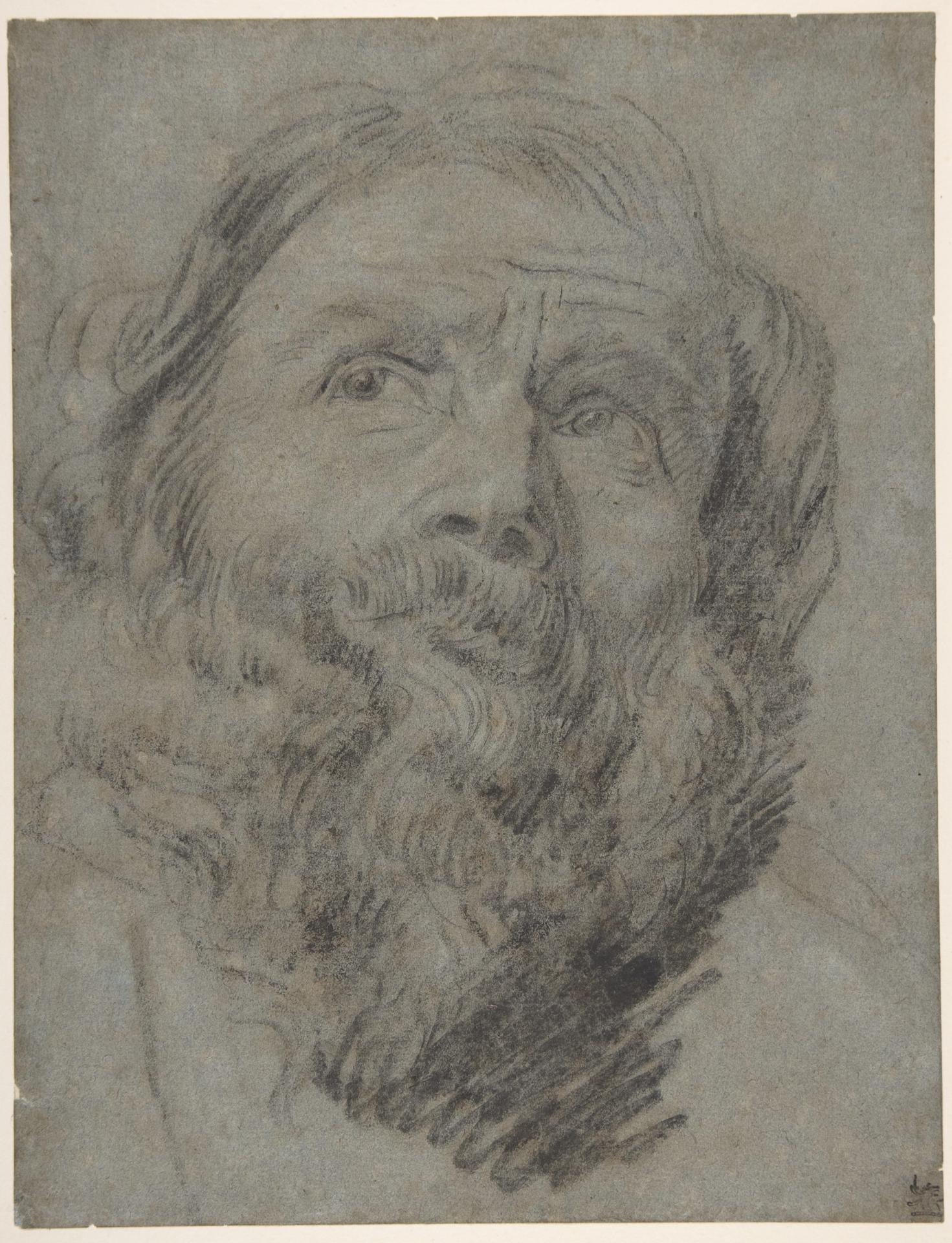
Head of an Apostle
Original title: Head of an Apostle
kurzbeschreibung
Unlike many apostle studies by his contemporaries, Anthony van Dyck's "Head of an Apostle" dispenses with any narrative accessories. This drawing from the early 17th century presents a bearded man seen from the front, set down in black and white chalk on blue paper. The facial features are captured in lively, flowing strokes.
Description
Unlike half-length studies, here the head almost fills the entire sheet. Wavy, forceful lines form the hair, while the beard is carefully worked out. Black and white together model the forms of the face, creating a sense of volume. The uniformly blue paper remains as a ground, drawing the face into focus. The stroke constantly changes in strength, keeping the view in motion.
Context
Van Dyck likely made this head in connection with his religious paintings, in which apostles appear repeatedly. The artist worked in the first half of the 17th century, initially in Antwerp and later in England. Blue paper was common among Flemish draughtsmen at the time because it enhanced the effect of the chalks.
Impact
Unlike finished paintings, this sheet has an immediacy that brings the viewer close to the subject. Dark and light accents meet in such a way that the face emerges bodily and seems almost within reach.
Technique
The drawing is executed in black and white chalk on blue paper. The chalks allow light and shadow to be placed precisely, while the blue tone mediates between them. The flowing, varying strokes reveal a confident hand and point to van Dyck's draughtsmanship.
AI-generated description text
Source: Metropolitan Museum of Art · Public Domain (CC0 1.0)