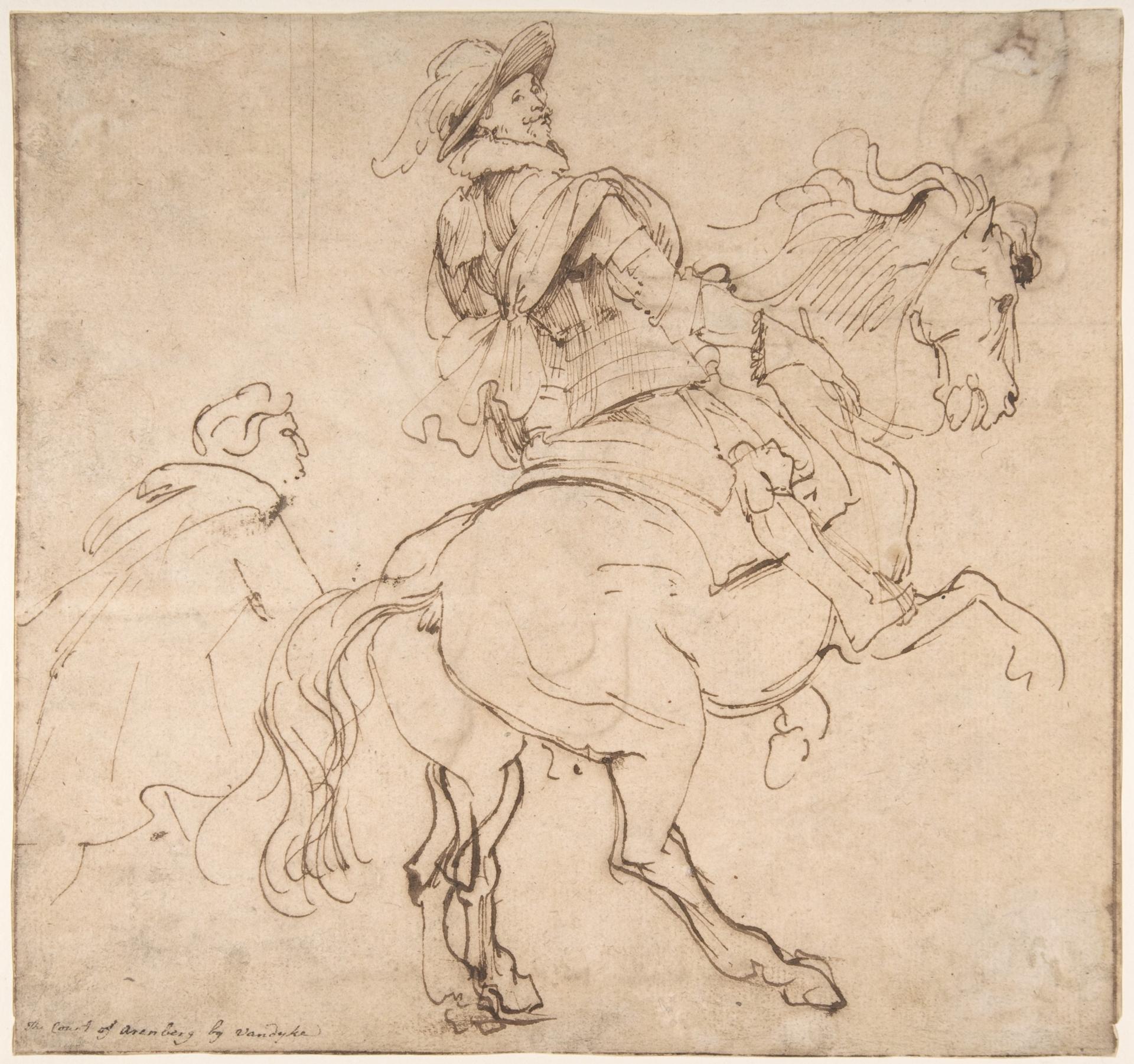
Study for an Equestrian Portrait, Possibly that of Albert de Ligne, Count of Arenberg; verso: Various Studies of Statues and Figures, Including the Venus Pudica and Scipio and his Lictor
Original title: Study for an Equestrian Portrait, Possibly that of Albert de Ligne, Count of Arenberg; verso: Various Studies of Statues and Figures, Including the Venus Pudica and Scipio and his Lictor
kurzbeschreibung
Around 1628–32, Anthony van Dyck made this pen drawing, a study for an equestrian portrait that may depict Albert de Ligne, Count of Arenberg. The sheet, measuring 23 x 24.5 cm, is executed in brown ink. On the reverse are figure and statue studies in pen and black chalk.
Description
A horseman sits astride a horse, wearing a striking headpiece and a long-sleeved jacket cinched at the waist by a sash. The horse is in motion, its hind legs raised, neck tossed. Behind the pair, another figure suggests, looking toward the horse. The layout is asymmetrical, pushing rider and horse to the fore. Flowing, dynamic strokes emphasize movement; the drawing remains in black and white with a hint of brown.
Context
Van Dyck produced this study during his time as court painter in the Southern Netherlands, where he made numerous portraits of the nobility. Albert de Ligne, Count of Arenberg, was a prominent nobleman whose portrait Van Dyck may have planned. The reverse, with studies after antique statues such as the Venus Pudica, attests to his engagement with classical models, important for his figure drawing. Such sketches served as preparations for paintings or prints and offer insight into the artist's working process.
Impact
The dynamic linework and the emphasized movement of the horse give the sketch an immediate liveliness that draws the viewer into the artist's creative process. The reduction to few strokes creates a concentrated, almost impressionistic effect that underscores the rider's nobility.
Technique
The drawing is executed in brown ink with pen, allowing for precise yet fluid lines. The reverse combines pen and black chalk, producing varied textures and tonal values. The sketch reveals Van Dyck's sure hand and his ability to convey movement and volume with minimal means.
AI-generated description text
Source: Metropolitan Museum of Art · Public Domain (CC0 1.0)