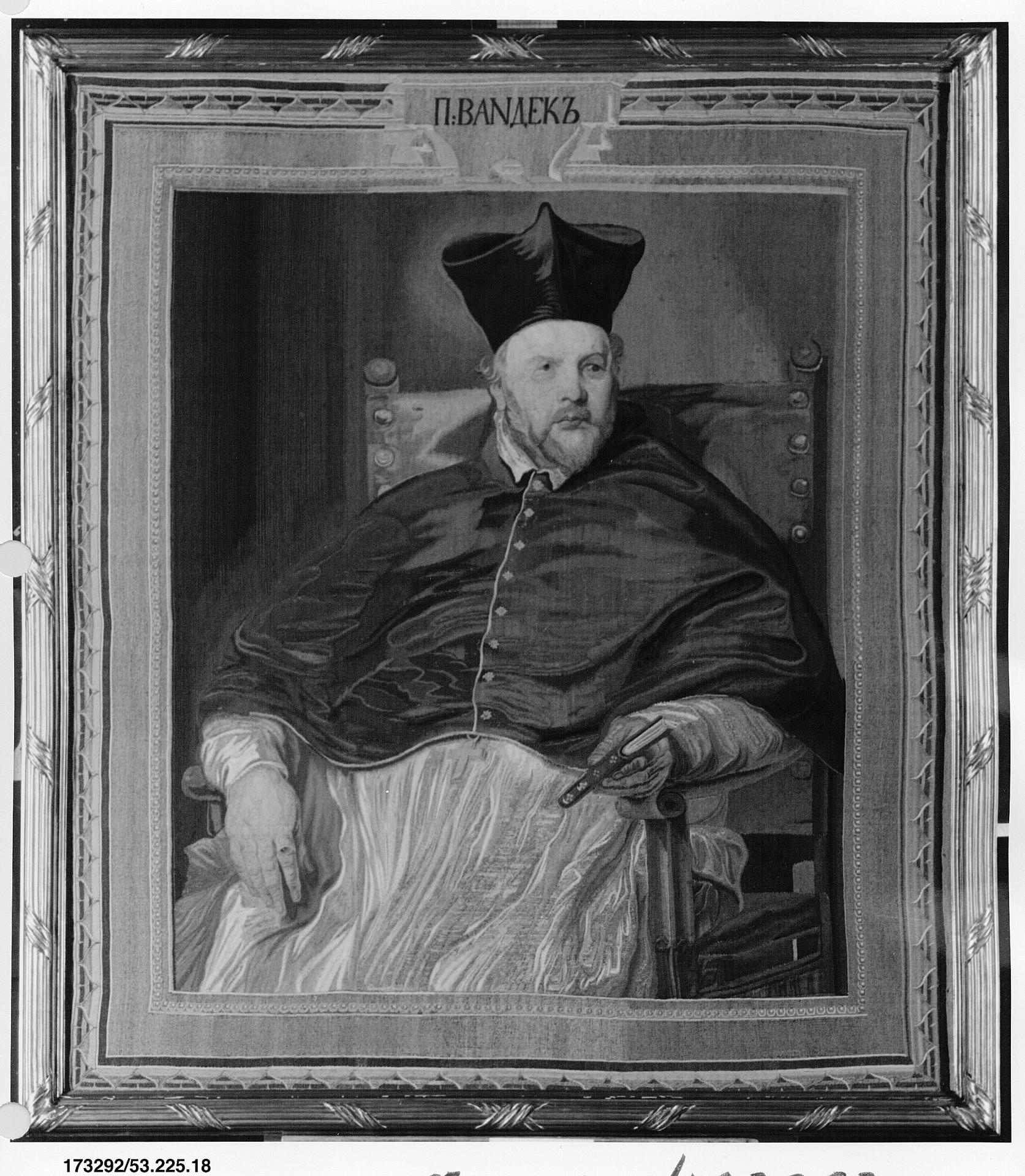
Jan Malderus, Bishop of Antwerp
Original title: Jan Malderus, Bishop of Antwerp
kurzbeschreibung
A late 18th-century tapestry woven at the Imperial Russian Tapestry Manufactory in Saint Petersburg depicts Jan Malderus, Bishop of Antwerp, in richly decorated ecclesiastical vestments. Made of wool and metal thread, the portrait honors the 17th-century prelate.
Description
The bishop appears in a half-length portrait, upright and dignified, his expression thoughtful and serious. He is dressed in a dark, elaborately embroidered robe and a tall, pointed miter. His right hand holds a pipe, a sign of calm and self-possession. Behind him, a dark, indistinct area suggests a curtain or wall. Above his head floats a shield inscribed 'P. VANDEK'.
Context
Founded in 1716 by Peter the Great, the Imperial Russian Tapestry Manufactory in Saint Petersburg was established to foster tapestry weaving in Russia. In the late 18th century, it produced portrait tapestries after painted models, often intended for the imperial court. Jan Malderus, a Flemish clergyman, served as Bishop of Antwerp from 1611 to 1633; the likeness likely derives from an earlier painting.
Impact
Authority and erudition emanate from this portrayal, supported by its symmetrical arrangement and solemn pose. The dark tonality and fine embroidery give the tapestry a dignified, almost monumental presence. Viewers are compelled to regard the subject with reverence.
Technique
Wool and metal thread are woven into a pictorial tapestry, lending it a shimmering, noble character. With 20 to 25 warps per inch, the weave achieves a high density that precisely renders facial features and fabric details. In this way, paintings could be transferred into textile with fidelity.
AI-generated description text
Source: Metropolitan Museum of Art · Public Domain (CC0 1.0)