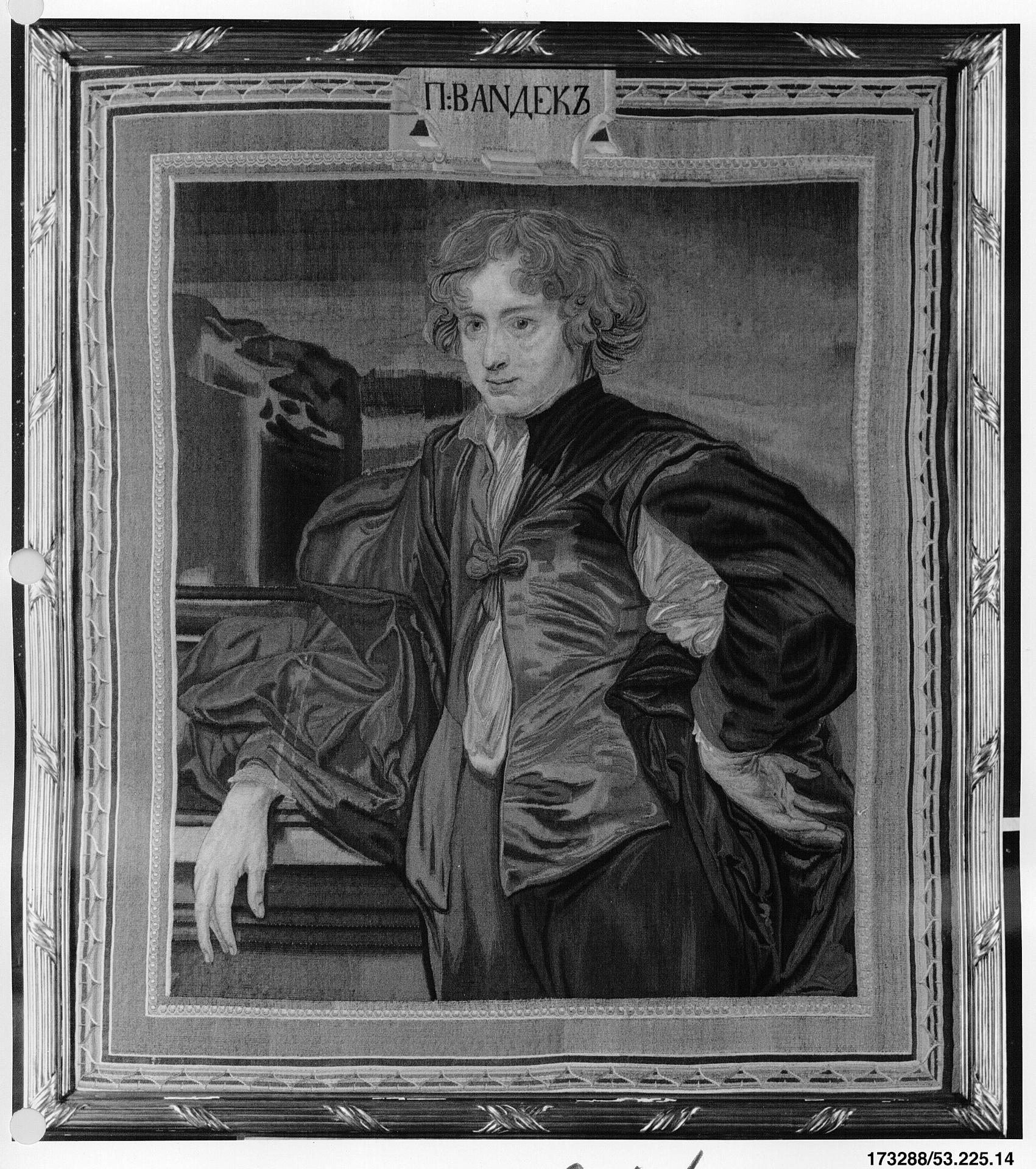
Self Portrait
Original title: Anthony Van Dyck, Self Portrait
kurzbeschreibung
This tapestry version of Anthony van Dyck's self-portrait was woven in wool and metal thread at the Imperial Russian Tapestry Manufactory in Saint Petersburg toward the end of the 18th century. It presents the Flemish painter in dark clothing, with curly hair and a bow at his collar; behind him appear a piece of furniture and a shield inscribed 'P. VANDEKZ'. The piece belongs to the manufactory's textile translations of well-known paintings.
Description
The artist stands at the center, leaning slightly to the left, wearing a dark garment with a turned-back sleeve and a bow at the collar. His curly hair falls backward. Part of an ornate piece of furniture can be made out behind him, and above it a shield with the inscription 'P. VANDEKZ', which likely stands for P. van Dyck. The view remains black and white, yet the structure of wool and metal threads shapes the surface.
Context
The Imperial Russian Tapestry Manufactory in Saint Petersburg was founded in 1717 by Peter the Great and produced tapestries based on European models. Later in the 18th century, reproductions of famous paintings were made there, including this self-portrait by van Dyck. Van Dyck ranks among the important Flemish Baroque painters and worked as a court painter in England. The high-warp loom enabled the manufactory to transfer painting into textile.
Impact
Through the fine weave and clear pictorial structure, the artist appears present and dignified. The black-and-white version emphasizes the texture and the craftsmanship of the tapestry. The sitter's direct gaze and the wealth of detail draw the viewer in.
Technique
The tapestry was woven from wool and metal thread, with 20 to 25 warps per inch, equivalent to 8 to 10 per centimeter. This density allowed an exact rendering of the original. Metal threads provided a shimmering effect intended to recall oil painting.
AI-generated description text
Source: Metropolitan Museum of Art · Public Domain (CC0 1.0)