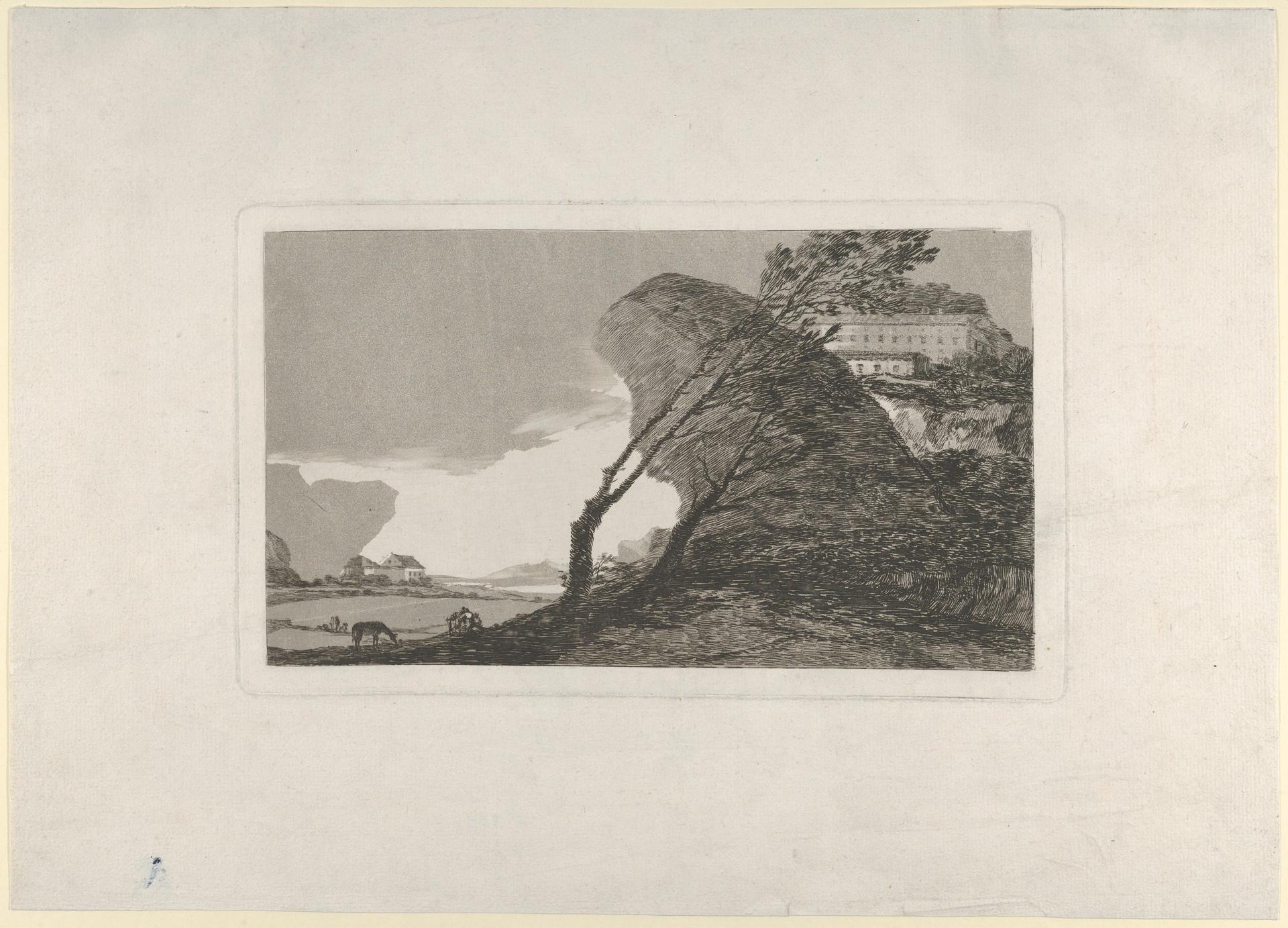
Landscape (ca. 1807–10)
Original title: Landscape
kurzbeschreibung
Around 1807–10, Francisco de Goya made this etching with aquatint, which depicts a windblown cluster of trees with buildings behind. He used the technique to create an atmospheric landscape in shades of gray.
Description
A single tree dominates the foreground, its branches bending sharply to the right—a sign of fierce wind. Behind it, on a rise, stands a building surrounded by more trees. Farther off, additional structures and a field can be made out. In the lower left sits a small dot that resembles an animal. Light falls from the upper left, bringing out the shadows on the right side of the tree and the house. The layout is asymmetrical, with the tree acting as the commanding element.
Context
This print emerged during a period when Goya was pulling away from court painting and turning increasingly to printmaking. Likely made between 1807 and 1810, during the Napoleonic occupation of Spain, the etching belongs to a group of landscape studies Goya produced for himself. It shows his experimental handling of aquatint, which he brought to mastery at the time.
Impact
The strong wind and deep shadows give the scene something dramatic, almost menacing. The restriction to gray tones creates a mood that is calm and eerie at once. The exposed tree pulls the eye toward the middle of the image, and the viewer senses the movement of nature.
Technique
The print was executed as an etching with aquatint on paper. Aquatint allows fine tonal gradations, from which the landscape's gray values emerge. Goya combined linear etching with tonal aquatint to achieve both contours and atmospheric shadows.
AI-generated description text
Source: Metropolitan Museum of Art · Public Domain (CC0 1.0)