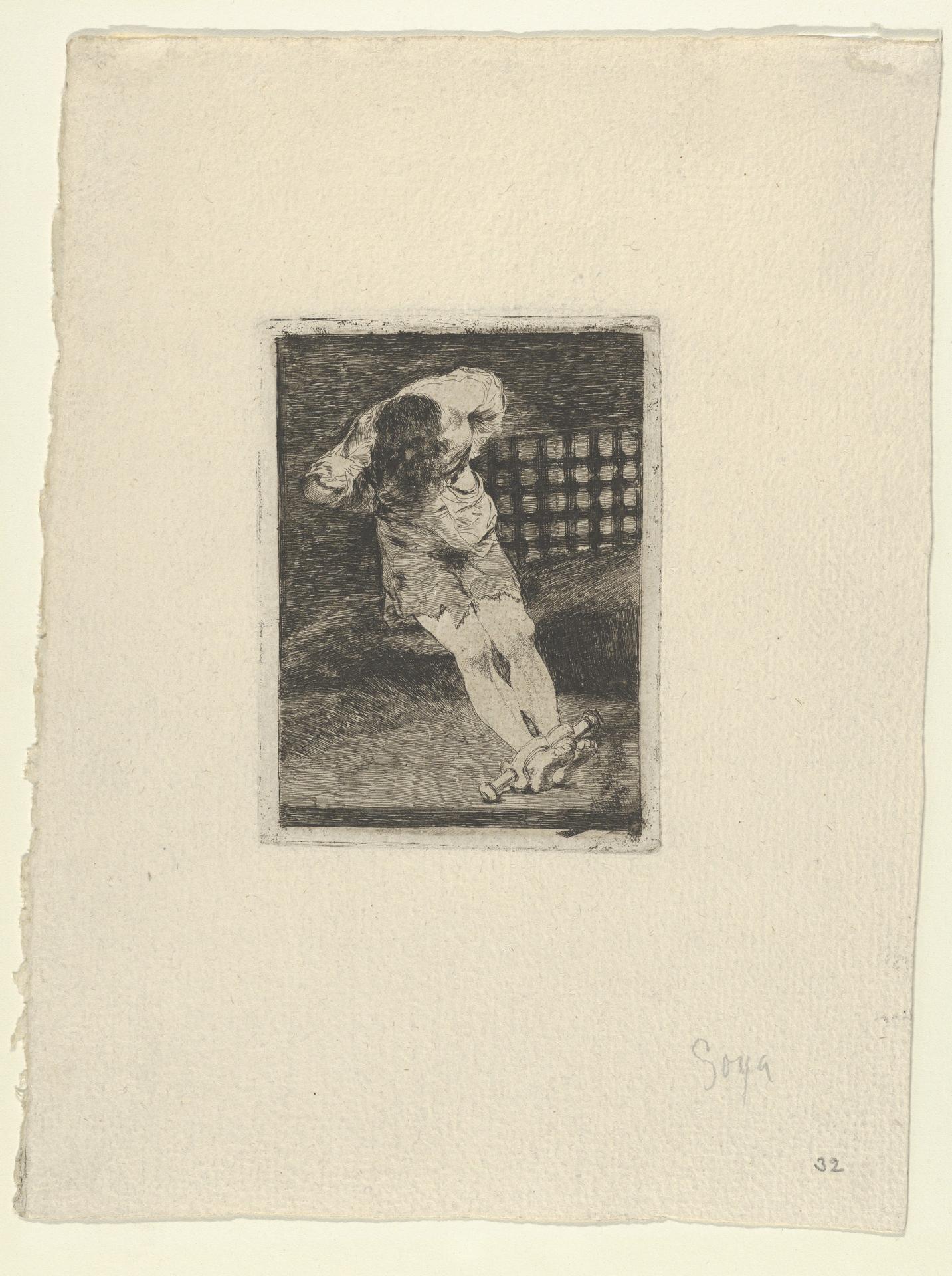
The Custody of a Prisoner Does Not Call for Torture (La seguridad de un reo no exige tormento)
Original title: The Custody of a Prisoner Does Not Call for Torture (La seguridad de un reo no exige tormento)
kurzbeschreibung
Unlike many prison scenes of his era, Francisco de Goya y Lucientes offers no accusatory gesture here. This etching, made around 1815, shows a shackled man in a cell and belongs to a series that examines captivity and human dignity. With drypoint and burin, the artist achieves a dense, expressive line.
Description
A man in chains, bent in a tense, heavy posture, his face hidden by his lowered head. He wears a simple shirt and is barefoot. Behind him, a grate suggests the cell. Grays and fine hatching give skin and chains a palpable texture. Light falls evenly, without harsh shadows or dramatic contrasts.
Context
Goya worked on this plate at a time when the aftermath of the Spanish War of Independence and the Restoration weighed heavily on him. The etching was not published until 1859, long after his death. It belongs to a series that critically examines justice and prison conditions of the day. The artist was then marked by political repression and personal disappointments.
Impact
A oppressive silence hangs over the image, drawing attention to the prisoner's vulnerability. The restrained lighting and delicate lines heighten the sense of hopelessness and isolation. Because all pathos is absent, the scene feels immediate and prompts reflection.
Technique
For this print, Goya used etching with burin; lines and hatching are precise and detailed. Drypoint work appears in the sharp contours and fine texturing of chains and skin. The sheet is printed on paper and shows an even, monochrome tonality.
AI-generated description text
Source: Metropolitan Museum of Art · Public Domain (CC0 1.0)