Tiburcio Pérez y Cuervo, the Architect
Original title: Tiburcio Pérez y Cuervo (1785/86–1841), the Architect
kurzbeschreibung
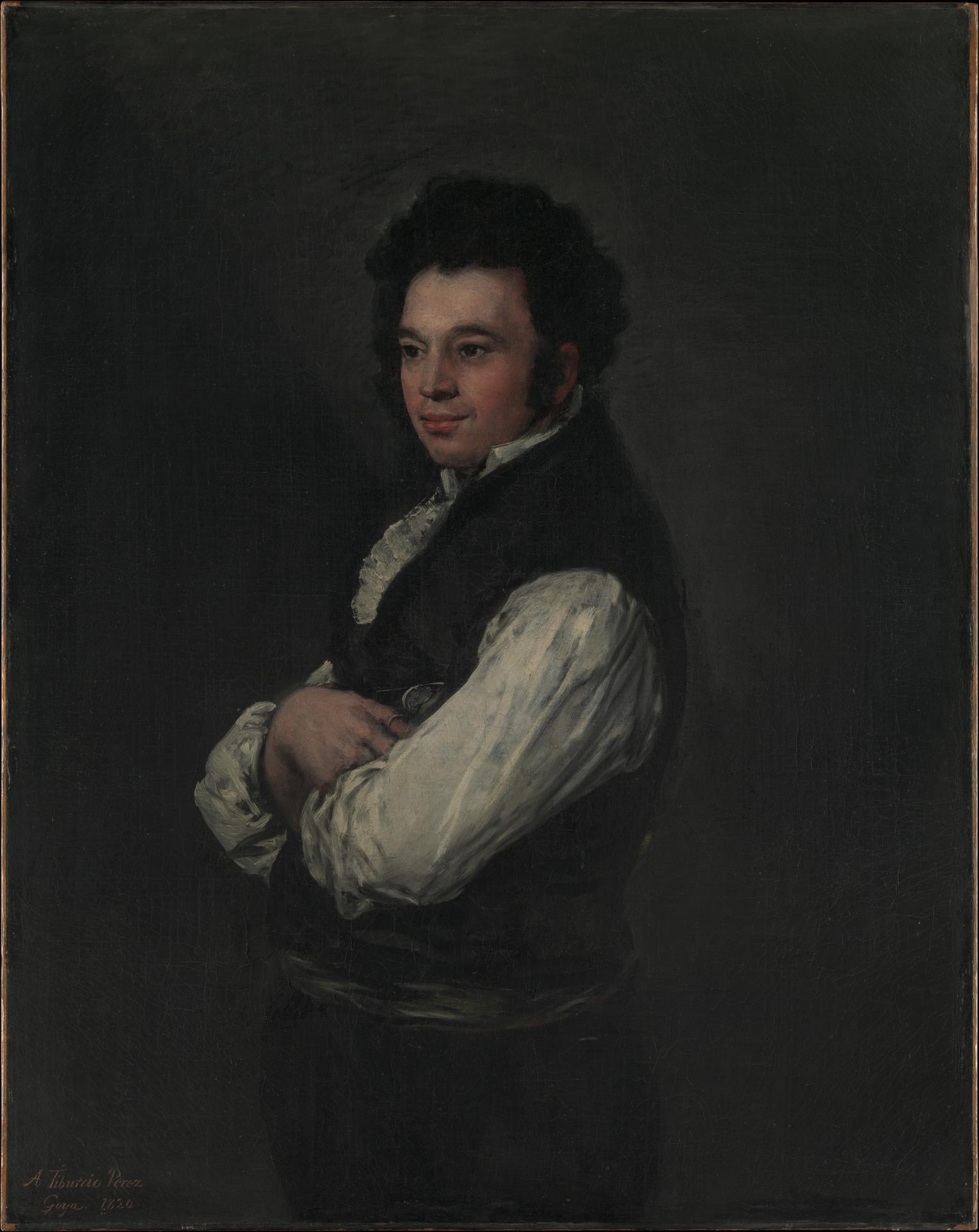
Francisco de Goya painted the Spanish architect Tiburcio Pérez y Cuervo in 1820. This oil on canvas shows the sitter with crossed arms in a dark room. It belongs to Goya's late works, in which he adopted a free, expressive manner of painting.
Description
In a dark room stands a man dressed in a white shirt with sleeves rolled up and a black waistcoat. His arms are crossed over his chest, his gaze turns slightly to the side, and a gentle smile is visible. Light falls from the left onto his face and body, while the background remains uniformly dark. In the lower left, the signature and the year 1820 can be seen.
Context
Goya made this portrait in 1820, when he was turning increasingly away from court painting. Tiburcio Pérez y Cuervo was a respected Madrid architect who worked, among other things, on the royal palace. The portrait belongs to Goya's late period, marked by a personal, often somber imagery. It is one of the few portraits Goya made of friends and professional colleagues after his serious illness.
Impact
The frontal pose and direct gaze of the sitter give the picture an immediate presence. The muted colors and soft lighting create a calm, intimate mood. The visible brushwork makes the painting lively and almost sketch-like.
Technique
The painting is executed in oil on canvas and measures 102.2 x 81.3 cm. Goya applied paint sparingly and with thick impasto, so that the texture stands out clearly. The dark underpainting and targeted light accents on the face and shirt produce a strong contrast between light and dark.
AI-generated description text
Source: Metropolitan Museum of Art · Public Domain (CC0 1.0)