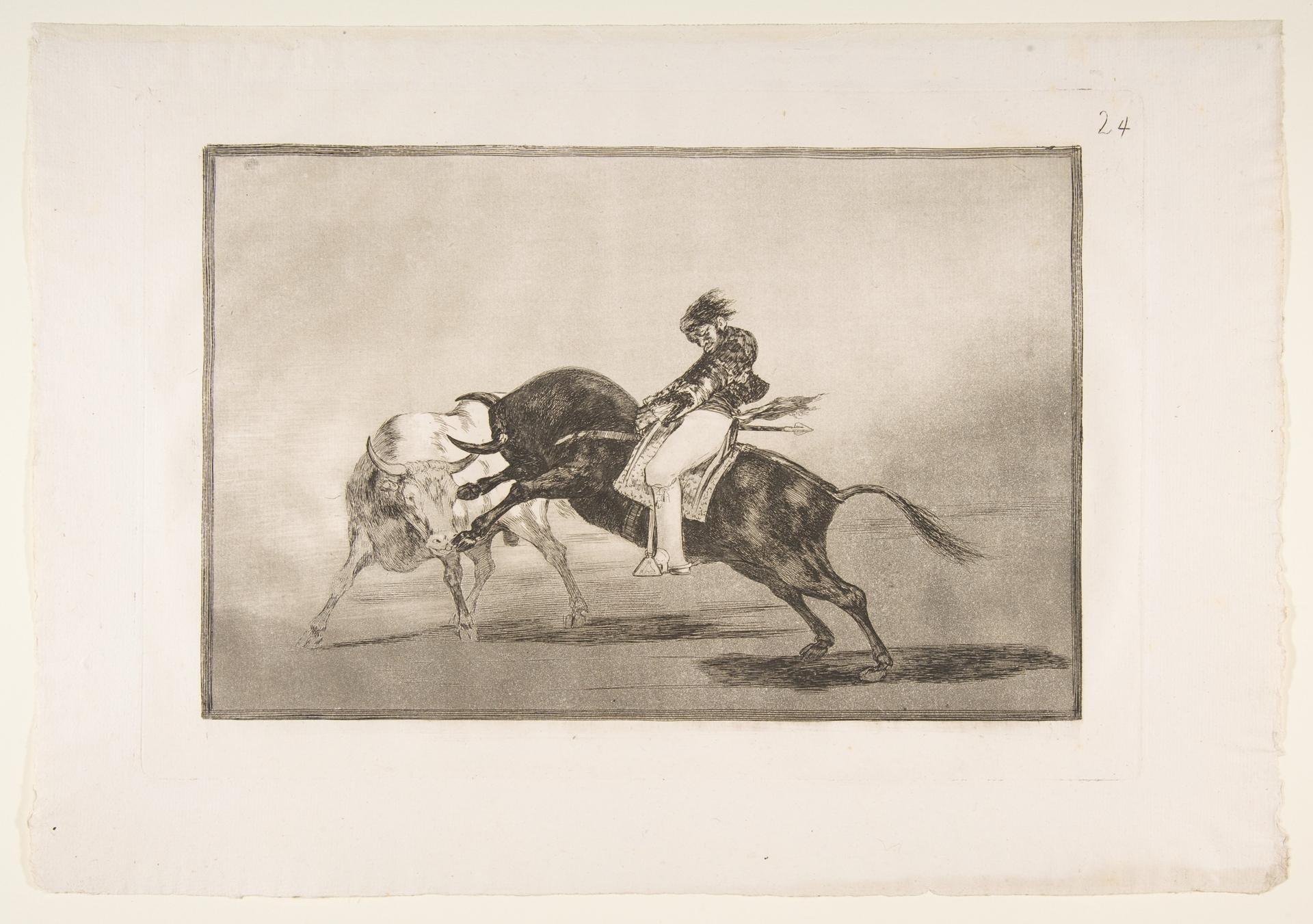
Plate 24 of "La Tauromaquia": The same Ceballos mounted on another bull breaks short spears in the ring at Madrid
Original title: Plate 24 of "La Tauromaquia": The same Ceballos mounted on another bull breaks short spears in the ring at Madrid
kurzbeschreibung
A matador named Ceballos rides on the back of a bull and breaks short lances in the arena of Madrid. This scene belongs to Francisco de Goya's series La Tauromaquia, published in 1816. The print was made using etching combined with aquatint, drypoint, and burin.
Description
In the foreground, a matador sits astride a bull that twists toward him in a sudden surge of movement. The rider wears traditional bullfighting attire and grips spears. Black and white dominate the entire image, and the light falls evenly, without pronounced shadows. The arrangement pulls the eye straight to the encounter between man and animal; realistic lines and hatching build depth and a sense of motion.
Context
Between 1815 and 1816, Goya produced his series La Tauromaquia, consisting of 33 etchings that present various scenes of bullfighting from its origins to the practices of his day. During this period, Goya worked intensively in printmaking and, after the Desastres de la Guerra, turned to a new subject. This print refers to a historical bullfighter known for his risky actions.
Impact
From the first glance, the print generates an immediate tension and drama characteristic of Goya's bullfighting subjects. Because everything is reduced to black and white and the layout is clear, the dangerous encounter between man and animal takes center stage.
Technique
Etching, burnished aquatint, drypoint, and burin were used together, yielding fine lines and subtle tonal values. Aquatint provides soft gradations of gray, while drypoint and burin bring out precise details in movement and texture.
AI-generated description text
Source: Metropolitan Museum of Art · Public Domain (CC0 1.0)