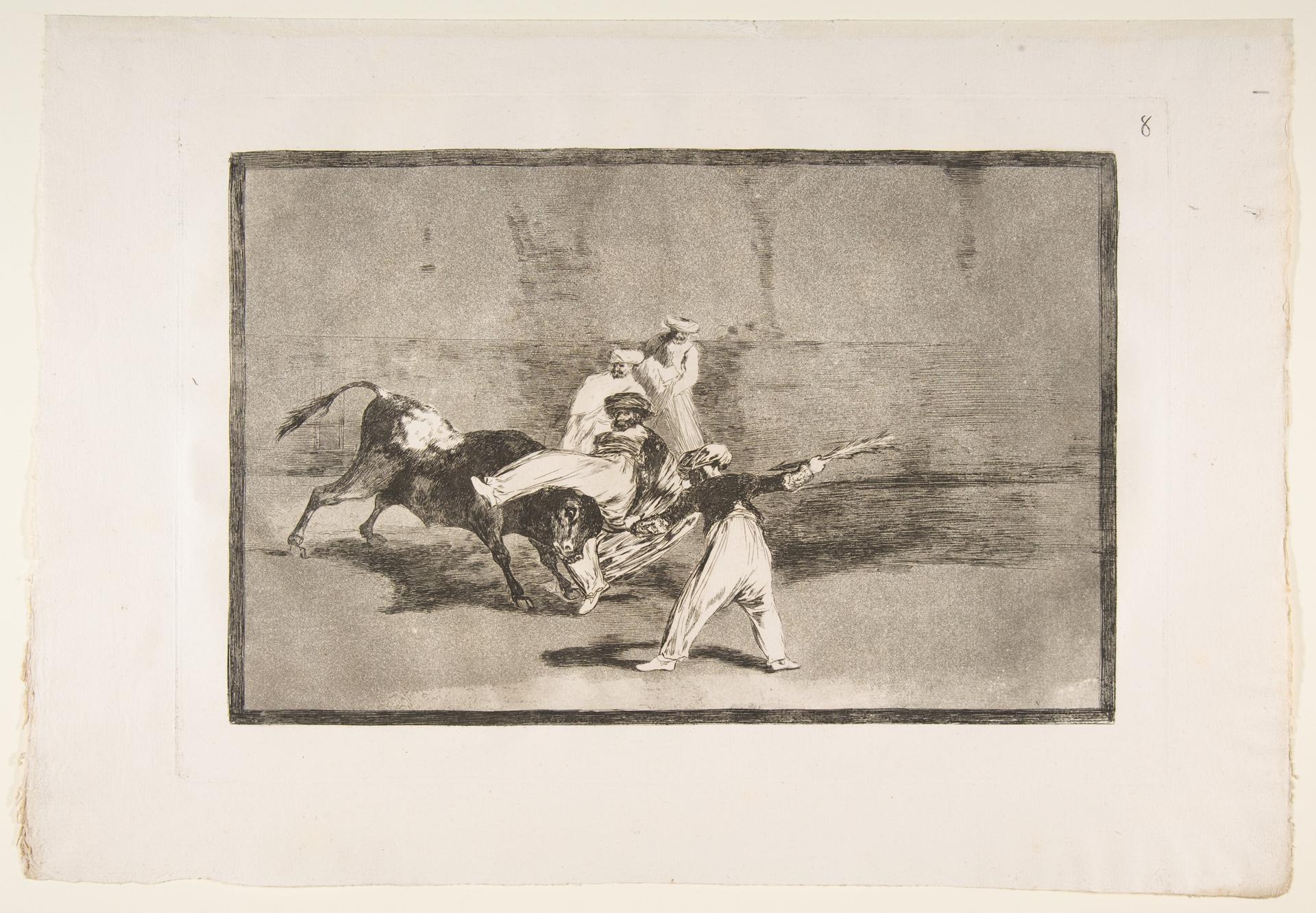
A Moor caught by the bull in the ring
Original title: Plate 8 from "La Tauromaquia": A Moor caught by the bull in the ring
kurzbeschreibung
A man lies on the ground, seized by a bull, while another man stands nearby holding a weapon. This etching is part of Goya's bullfighting series 'La Tauromaquia' from 1816. The monochrome print in shades of grey belongs to the set of 33 prints.
Description
In the foreground, a man stretches out on the ground as a bull appears to move over him. To the right, a second man stands holding a lance or sword. Two further figures watch from the stage. The dynamic arrangement draws the eye to the central action between man and animal. The grey tones create a dark, dramatic mood, with light and shadow emphasizing the outlines of the figures.
Context
This etching was made in 1816 as part of the series 'La Tauromaquia', which Goya created after the French occupation of Spain. In it, he documented various scenes of bullfighting, from historical to contemporary. This print shows a Moor attacked by a bull in the arena, a motif that refers to the Moorish tradition of bullfighting. The series was first published in 1816 in Madrid and is considered one of the masterpieces of Spanish printmaking.
Impact
Through its immediate violence and unvarnished portrayal of danger, the scene feels oppressive. Goya's precise linework and nuanced grey tones give the print an almost cinematic tension. The viewer witnesses a moment that reveals both the cruelty and the tragedy of bullfighting.
Technique
The print was executed in a combination of etching, burnished aquatint, and drypoint. The aquatint technique allows for fine tonal gradations, while drypoint provides strong, dark lines. The paper size of 30.7 x 44.5 cm allows space for the detailed depiction of the figures and the setting.
AI-generated description text
Source: Metropolitan Museum of Art · Public Domain (CC0 1.0)