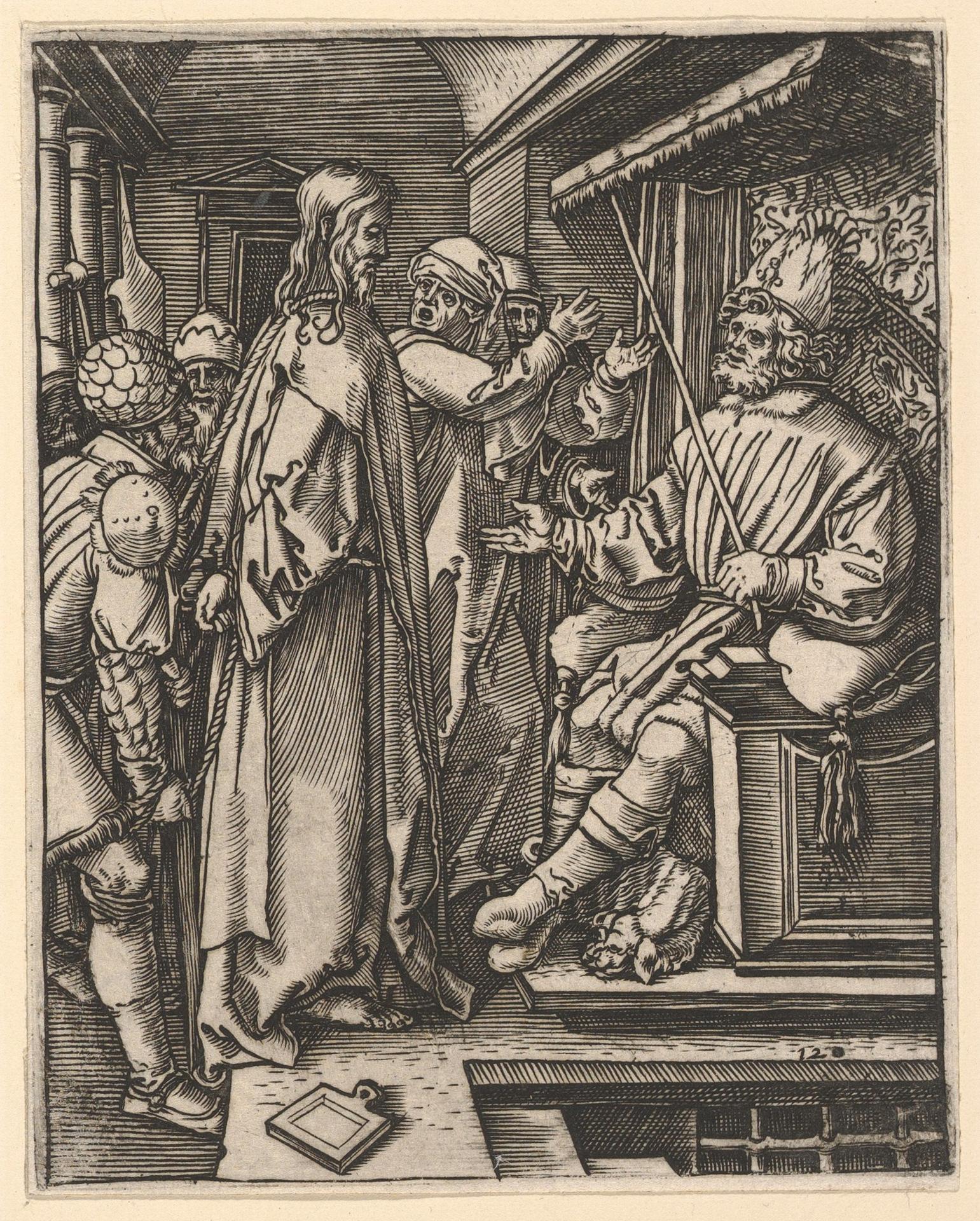
Christ standing, hands tied behind back, before Herod seated on throne, from "The Passion of Christ"
Original title: Christ standing, hands tied behind back, before Herod seated on throne, from "The Passion of Christ", after Dürer
kurzbeschreibung
Bound with his hands behind his back, Christ is led before Herod, who sits on a throne. This subject comes from Marcantonio Raimondi and was made between 1500 and 1534 as an engraving. The print belongs to the series 'The Passion of Christ' and derives from an invention by Albrecht Dürer. The present impression is the second of three states.
Description
Christ stands at the center, barefoot, wrapped in a long, hooded cloak, his hands tied behind his back. Opposite him, Herod is enthroned on the right; the throne is fitted with a hanging and a shield. A soldier carries a lance, and other figures and armed men are spread across the ground. The floor is made of wooden boards, on which a book lies. Executed without color and with even light, strong shadows are absent.
Context
Raimondi, an Italian engraver of the Renaissance, became known for reproductive engravings after Dürer and Raphael. The 'Passion of Christ' was made after Dürer's woodcut series of the same name, which Raimondi transferred to copper. Such copies were common in the early sixteenth century, although Dürer took legal action against copies of his works. Raimondi's prints helped spread Dürer's pictorial ideas in Italy.
Impact
Fine, precisely placed lines model the figures clearly and give the print a calm, dignified mood. The symmetrical layout and the even lighting emphasize the seriousness of the event without dramatic escalation. The exact rendering of textures and implements invites close looking.
Technique
For engraving, lines are incised into a copper plate and then printed. Raimondi used this method to obtain fine hatching and precise contours that follow Dürer's ductus. The second state suggests reworking or changes to the plate that are significant for print quality.
AI-generated description text
Source: Metropolitan Museum of Art · Public Domain (CC0 1.0)