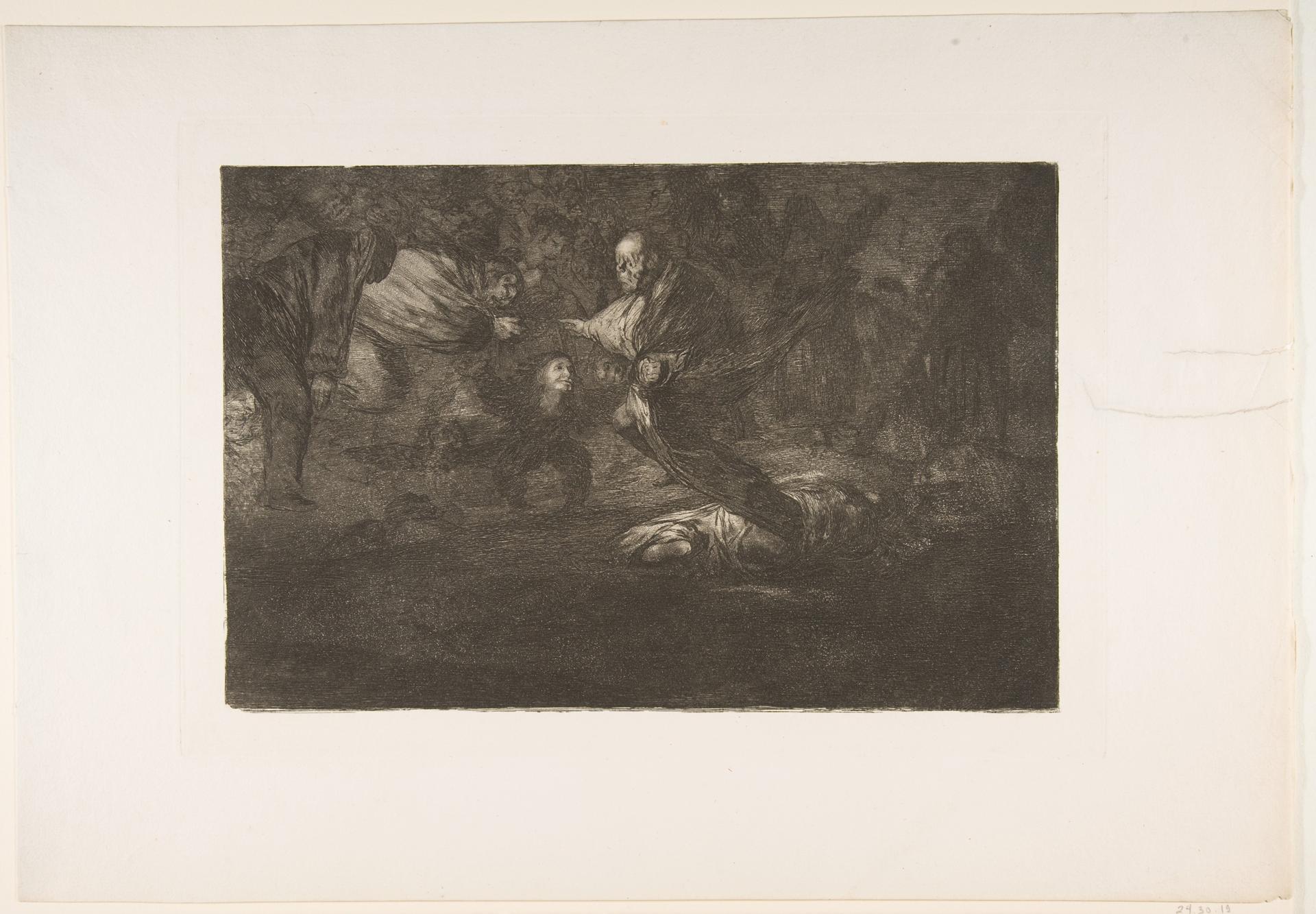
Funereal Folly, from "The Disparates" (Follies / Irrationalities)
Original title: Funereal Folly, from "The Disparates" (Follies / Irrationalities)
kurzbeschreibung
Around 1815–19, Francisco de Goya made the etching Begräbnis-Narrheit (Funeral Folly), part of his series Los Disparates. The image presents a grim gathering: a kneeling figure in a light garment and a dark authority stand at the center, surrounded by other figures who form a menacing community.
Description
An almost black room swallows the action. In the foreground, a figure dressed in white kneels, seemingly praying or mourning. Over them bends someone in a nearly black robe, touching them with one hand and radiating power. Behind, more dark-clad figures have clustered into a group. The heavily dimmed light falls on the kneeling figure, making the overall arrangement feel uneven.
Context
The series Los Disparates was created between about 1815 and 1819 but only published posthumously in 1864. At that time, Spain suffered political repression after the restoration of the Bourbon monarchy. Goya often addressed social ills and human folly in these works without clearly decoding the motifs.
Impact
The harsh contrast between light and dark creates a heavy, dramatic mood. Because the light falls on the kneeling figure, one senses their powerlessness and exposure to an overwhelming authority.
Technique
Executed as an etching with burnished aquatint, this process allows deep blacks and fine tonal gradations. Goya used the etching technique to evoke the somber mood through high-contrast lighting.
AI-generated description text
Source: Metropolitan Museum of Art · Public Domain (CC0 1.0)