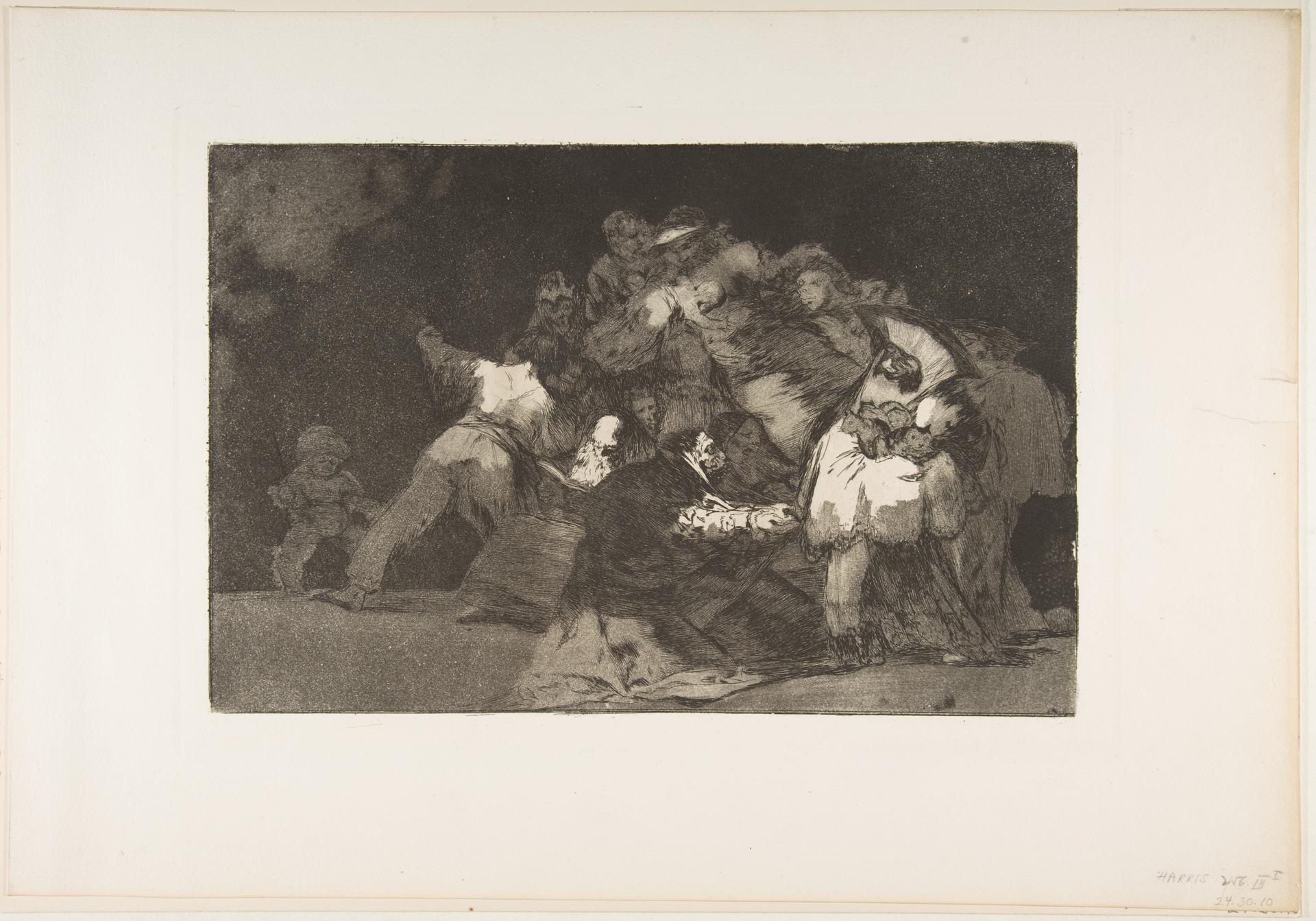
General Folly, from "The Disparates" (Follies / Irrationalities)
Original title: General Folly, from "The Disparates" (Follies / Irrationalities)
kurzbeschreibung
Around 1815–19, Goya made the etching "General Folly", a plate from the series "The Disparates" (also known as "Follies" or "Irrationalities"), which was not published until 1864. It presents a tightly packed group of figures in a wild, dramatic scene; at the centre, a person lies on the ground, surrounded by others. Goya worked with drypoint and burnished aquatint.
Description
In the foreground, a person who appears injured lies on the ground, surrounded by several figures who seem to be trying to help or carry them away. Bodies are captured in various postures and movements, creating an impression of haste and confusion. Some figures are in action, others hold still or crouch; their faces sometimes look distorted or are barely recognisable. The layout is irregular, and the figures stand close together, which heightens the intensity. Tones fluctuate between very light and very dark; the light remains gloomy and reinforces the drama.
Context
The "Disparates" belong to Goya's late work, shaped by the horrors of the Spanish War of Independence and the political restoration under Ferdinand VII. During the artist's lifetime, the plates remained unpublished; the Academia de San Fernando issued the first edition in 1864. The series ranks among Goya's most enigmatic and bleakest groups of works, and its exact meaning is still disputed today.
Impact
The dense arrangement of figures and the harsh contrasts of light and dark evoke an oppressive, menacing mood. The distorted faces and the unclear action make the image appear like a nightmare or an allegorical vision. Viewers are drawn into a world of the irrational and chaotic that offers no clear narrative.
Technique
Goya used drypoint etching with burnished aquatint, lightening the aquatint tones in places by burnishing. The sharp, detailed drypoint lines give the figures a vivid presence, while the aquatint allows fine gradations from deep black to delicate grey. The plate measures 24.5 x 35.5 cm and demonstrates Goya's expressive range in printmaking.
AI-generated description text
Source: Metropolitan Museum of Art · Public Domain (CC0 1.0)