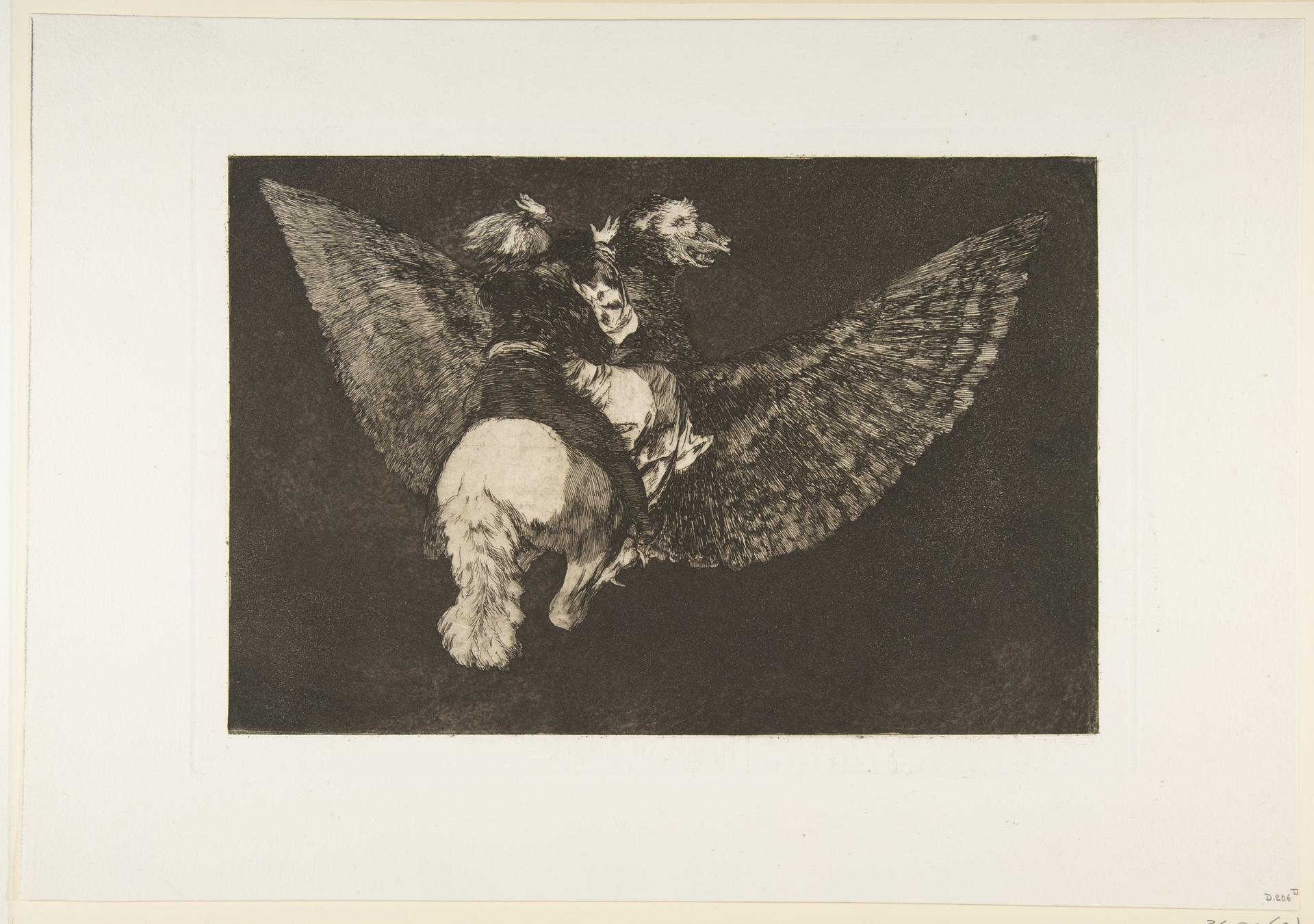
Flying Folly (ca. 1815–19 (published 1864))
Original title: 'Flying Folly' from the 'Disparates' (Follies / Irrationalities)
kurzbeschreibung
Fliegende Torheit (Flying Folly) belongs to Goya's Disparates, a series of irrationalities made around 1815–19 but not published until 1864. In this etching with aquatint, a winged dog rides on a horse; the background lies in darkness.
Description
A dog with broadly outstretched wings crouches on the back of a horse. The horse wears a helmet-like headpiece. The dog's white fur stands out, and its posture seems dynamic, as if it is about to take off. Darkness surrounds the animals and pushes them into view. The greys of the image arise from the lines and shading of etching and aquatint.
Context
Between 1815 and 1819 Goya worked on the Disparates, likely as private criticism of social and political ills of his era. The prints were only published in 1864, many years after his death, by the Academia de San Fernando in Madrid. The series is among Goya's most enigmatic groups of works and often revolves around the absurdity of human behaviour.
Impact
The combination of dog, wings and horse creates an absurd, dreamlike scene that feels surreal and disturbing. Dark, high-contrast passages heighten the impression of threat and irony. Viewers are prompted to allegorical interpretation without any definitive resolution emerging.
Technique
Etching and aquatint allow fine gradations of grey and a soft, painterly effect. The etched lines define the contours, while the aquatint areas build shadow and texture. The print was made on paper; it measures 24.3 × 35.4 cm (sheet) with a plate of 33.1 × 47.8 cm.
AI-generated description text
Source: Metropolitan Museum of Art · Public Domain (CC0 1.0)