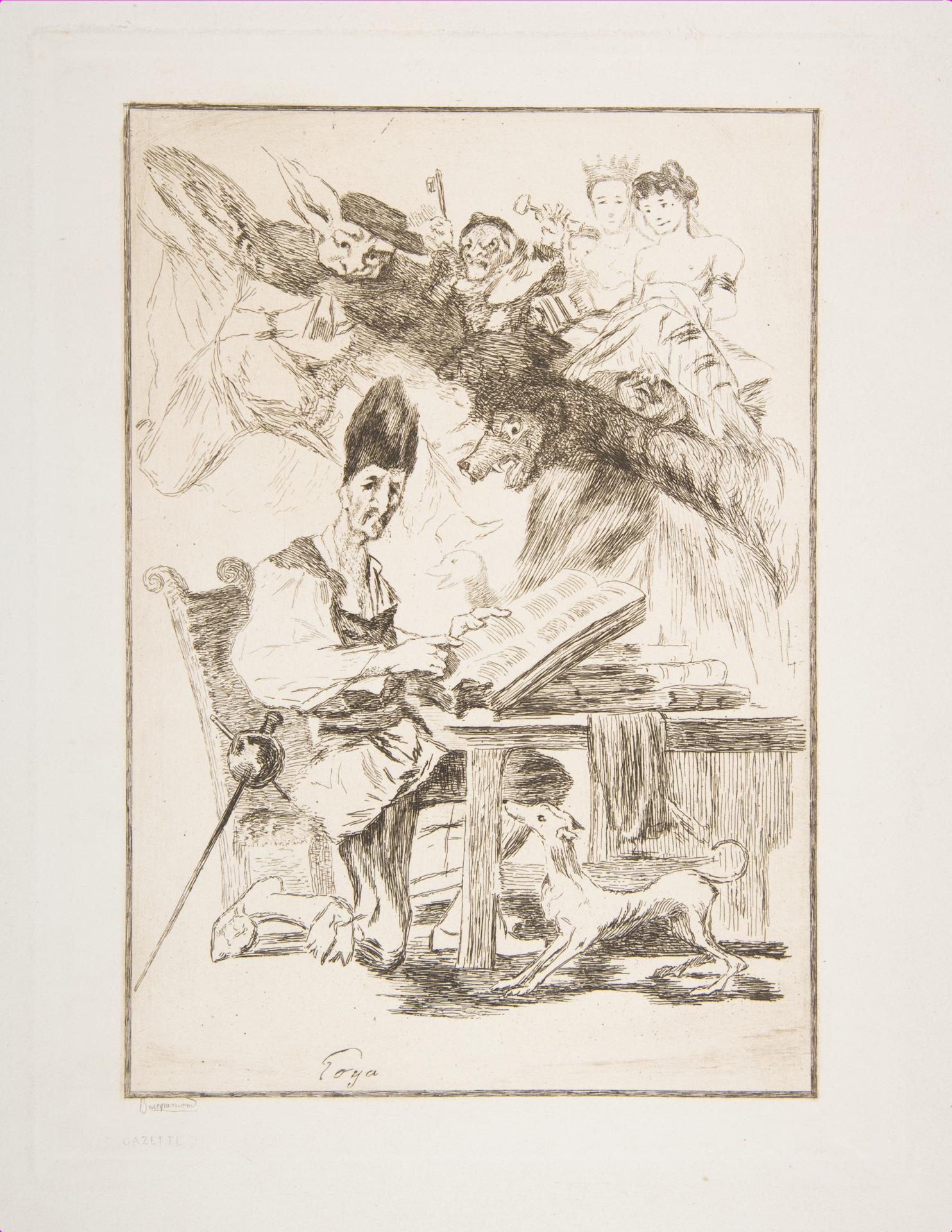
Don Quichotte
Original title: Don Quichotte
kurzbeschreibung
Unlike typical Cervantes illustrations, Félix Bracquemond's 1860 etching "Don Quichotte" centers not on an adventure scene but on a reading hero. The print was made as an etching and exists in the second of two states; the plate measures 23.7 × 18.1 cm.
Description
In the foreground, Don Quichotte sits in a chair, plainly dressed, absorbed in a book. A sword lies on the ground beside him, and a dog stretches out in front. Behind him appear several figures: a crowned woman carried by a wolf, along with two other figures on animals. The layout feels animated, the figures are shown in action, and the light falls evenly.
Context
Bracquemond made this etching in 1860, when he was deeply engaged with printmaking and was regarded in France as a renewer of etching. The motif takes up the Don Quixote material by Miguel de Cervantes, which was frequently treated in 19th-century art. Bracquemond was known for idiosyncratic interpretations of literary sources and avoided conventional illustration patterns.
Impact
A strange tension arises between the realistic main figure and the unsettling elements behind him. The quiet reading contrasts with the fantastical figures, which unsettles the viewer and prompts reflection. The black-and-white execution reinforces the graphic quality and draws attention to the details of the image.
Technique
In etching, the plate is bitten with acid to create the lines. Here we have the second of two states, suggesting the plate was reworked. The process allows fine lines and precise rendering of shading, as seen in the figures and the sense of space.
AI-generated description text
Source: Metropolitan Museum of Art · Public Domain (CC0 1.0)