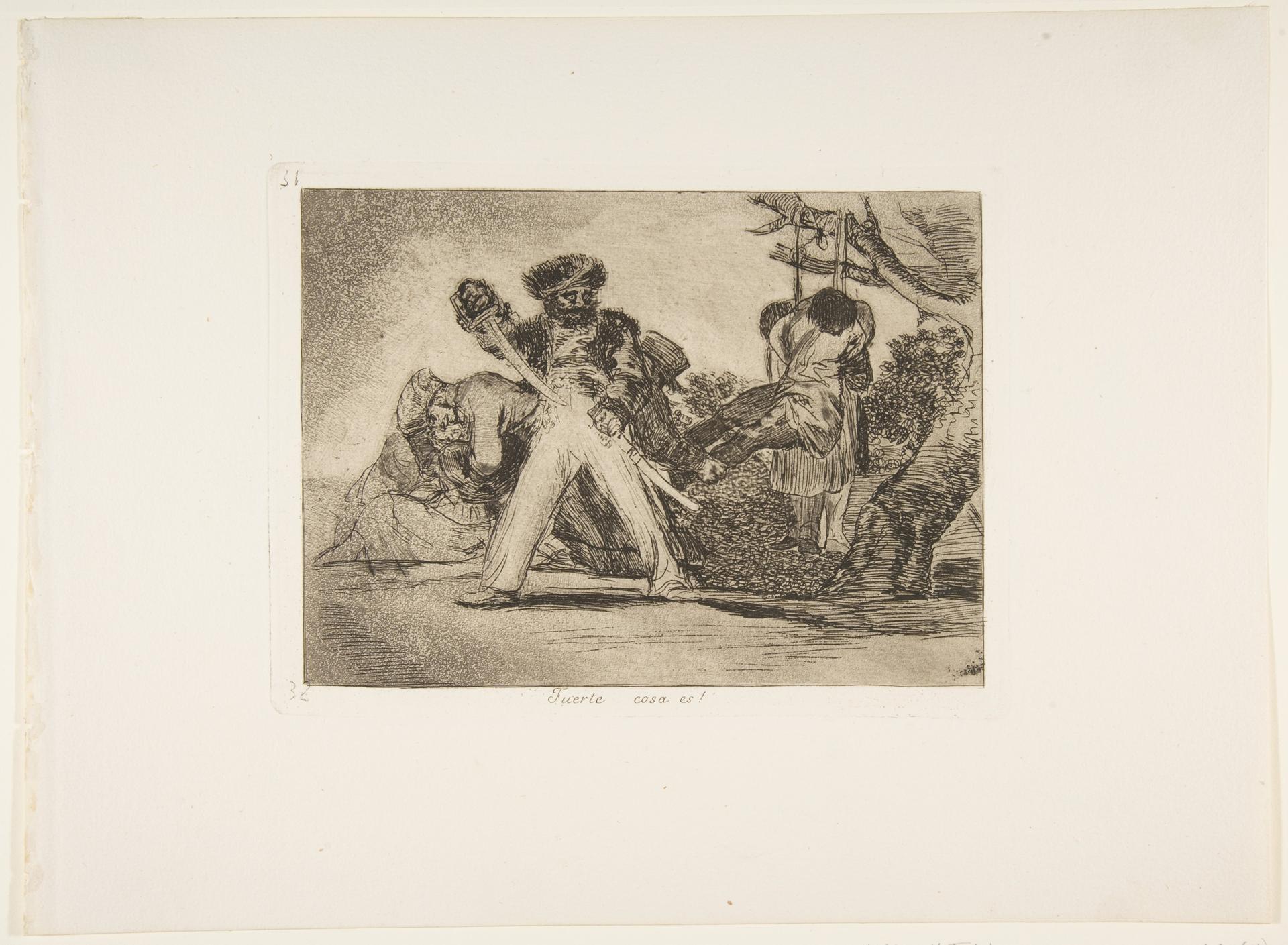
That's tough! (Fuerte cosa es!)
Original title: Plate 31 from "The Disasters of War" (Los Desastres de la Guerra): 'That's tough!' (Fuerte cosa es!)
kurzbeschreibung
Created around 1810, plate 31 from Francisco de Goya's etching series 'The Disasters of War', published posthumously in 1863, presents a violent confrontation: a man is set upon by several attackers wielding sticks.
Description
The layout centers on a knot of figures caught in a menacing brawl. A man in what appears to be a uniform stands at the middle, beset by people around him who strike with sticks or staffs. Behind him, another figure raises a stick as if to deliver a blow. The plain, dark background pushes the bodies forward, while diffuse light creates a somber atmosphere. A monochrome palette of grays heightens the realistic yet dramatic impression.
Context
During the Spanish War of Independence (1808–1814) against Napoleonic occupation, Goya made the series 'The Disasters of War'. The plates remained unpublished in the artist's lifetime; only in 1863 did the Real Academia de Bellas Artes de San Fernando issue them posthumously. The series ranks among the earliest and most unvarnished artistic records of the horrors of war, avoiding any heroic portrayal.
Impact
The print generates an immediate sense of threat and violence that draws the viewer into the event. Restricted to grays and with a restless arrangement, it creates an oppressive mood in which horror at human cruelty becomes palpable.
Technique
For this plate Goya combined etching, burnished aquatint, and drypoint to achieve fine lines and soft tonal gradations. Aquatint laid down broad areas of shadow, while drypoint allowed precise details. Printing was done on paper; the plate measures 20.5 × 15.3 cm.
AI-generated description text
Source: Metropolitan Museum of Art · Public Domain (CC0 1.0)