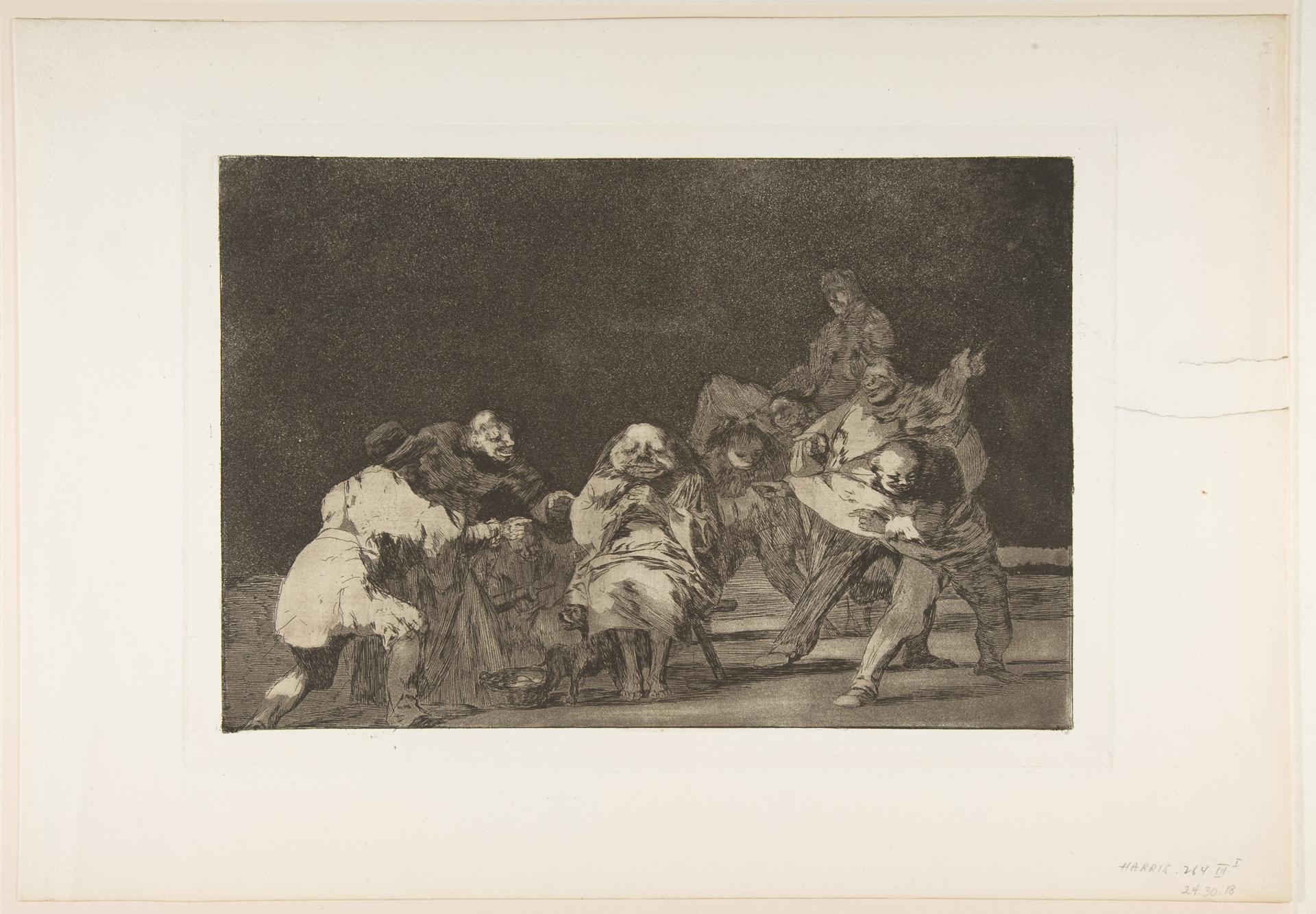
Loyalty (ca. 1815–19 (published 1864))
Original title: 'Loyalty' from the 'Disparates' (Follies / Irrationalities)
kurzbeschreibung
Francisco de Goya made 'Treue' (Fidelity) as part of his 'Disparates' series, also known as 'Proverbios', between about 1815 and 1819; it was not published until 1864, long after his death. In etching with burnished aquatint, a crowd of people appears in a dark room, their distorted faces telling of despair or threat.
Description
In a gloomy room, several figures sit, stand, or kneel, each in a different pose. Their faces look twisted and eerie, suggesting mental or physical deformation. Some figures interact, others remain isolated. The sparse light draws attention to faces and upper bodies, emphasizing their expressions. The gray tones and irregular layout, with the main figure at the center, create an oppressive mood.
Context
The 'Disparates' came from Goya's late years, when he increasingly turned away from court art and toward the social and human depths. The prints were not published during his lifetime; the first edition was issued in 1864 by the Academia de San Fernando in Madrid. 'Treue' is among the most enigmatic works in the series, whose exact meaning remains undeciphered. Goya used aquatint to achieve dark, atmospheric effects that were unusual for the time.
Impact
An oppressive atmosphere arises, intensified by the distorted faces and the dark lighting. The viewer enters a realm of the uncanny and ambiguous, prompting reflection on human abysses. The fine grain of the aquatint gives the print an intense, almost tactile surface.
Technique
Etching with burnished aquatint allows nuanced gradations of gray and a rough, detailed structure. The aquatint was partly burnished to set light accents and contrasts. The plate measures 24.5 × 35 cm, the sheet 33.2 × 47.1 cm.
AI-generated description text
Source: Metropolitan Museum of Art · Public Domain (CC0 1.0)