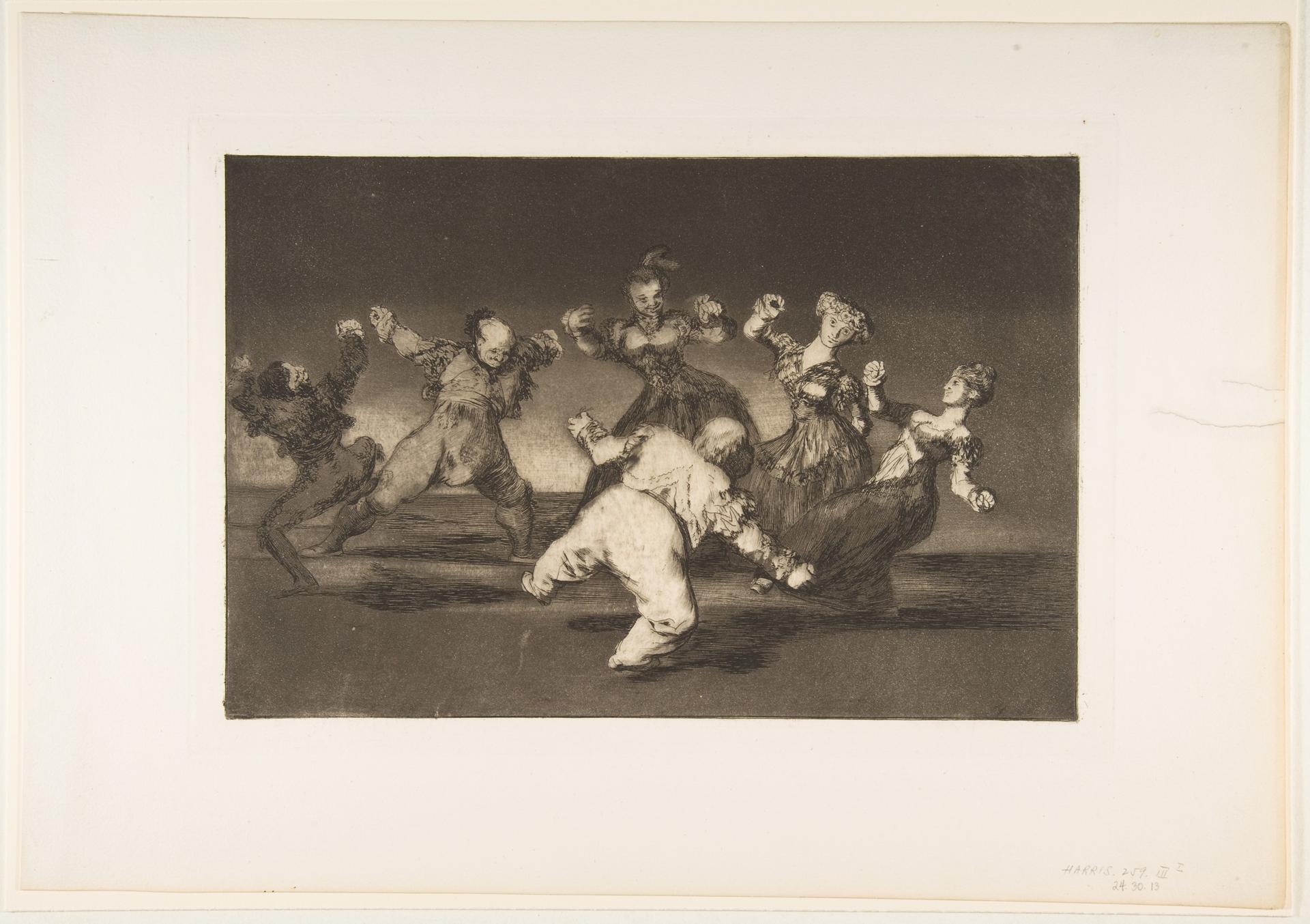
Merry Folly
Original title: 'Merry Folly' from the 'Disparates' (Follies / Irrationalities)
kurzbeschreibung
Francisco de Goya y Lucientes made Lustige Torheit (Merry Folly) as part of his Disparates, or Follies. This etching with burnished aquatint and drypoint dates from around 1815–19 but was not published until 1864. A group of dancing or moving figures appears in a satirical scene.
Description
People in dynamic, chaotic motion seem to dance, filling the image. Their gestures and poses are expressive; some wear traditional clothing, others unusual costumes. The figures stand in a row, which heightens the energy. The dark background pushes the monochrome grey figures in the foreground into view. Light spreads evenly, without strong shadows or highlights.
Context
Between 1815 and 1819, during a time of political uncertainty after the Bourbon restoration in Spain, Goya created the Disparates series. The prints were only published in 1864 by the Royal Academy of San Fernando in Madrid. The series is considered Goya's most enigmatic and pessimistic graphic cycle; it satirically addresses human folly and irrationality.
Impact
The dynamic row of figures and expressive poses give the print immediate liveliness and energy. At the same time, the dark background creates a threatening, almost nightmarish mood typical of Goya's late graphic work. Monochrome and soft aquatint tones produce a sombre yet fascinating aesthetic.
Technique
Etching, burnished aquatint and drypoint create fine tonal gradations and soft transitions. Aquatint provides the even grey tones, while drypoint adds strong linear accents. At 33.2 × 48.2 cm, the paper size is unusually large for a print of this period and reinforces the monumental effect of the composition.
AI-generated description text
Source: Metropolitan Museum of Art · Public Domain (CC0 1.0)